I wanted to ask: does Mr Tzinellis’s method come with tablature?
Not for the first two levels that I have. On the one hand, he shows the song in detail in the videos, fret by fret, also stating which note each one is, and on the other hand, he writes it out in the text.
1 Like
Good evening, brother. If you don’t mind, I’d like to ask you a question too. Another friend asked you the same thing further up, but you probably didn’t notice it. What is the method like for someone with a three-course bouzouki? When he teaches songs, does he teach them for both types as well? Thank you.
Good morning, and sorry for the late reply. First of all, from what I’ve gathered while following Tzinellis, he seems to mainly play a three-course instrument. Of course, in some videos he plays certain songs exclusively on a four-course instrument, so someone with a three-course instrument would have to make adjustments when he plays on the third or even the fourth course in the video. On the other hand, he plays some other songs entirely on the three-course instrument.
Personally, I’m currently practising with a four-course instrument that I own. In one or two songs that had some notes on the third course and that he played on a three-course instrument in the video, I made my own adjustments. He shows the chords for both three-course and four-course instruments, and the notation is the same. So there will be a few cases where certain passages in songs might give you some difficulty when they move up to the third course, but there aren’t many.
Now, as I’m not at my computer to open the videos and check, if necessary I’ll correct my message this evening when I carry out a review. It’s something that hasn’t concerned me because I also have a tzoura and I’m familiar with the fretboard on both three-course and four-course instruments, so I didn’t pay much attention to it.
1 Like
Thank you very much for the answer, mate! Have a great week.
1 Like
To make my answer a bit more specific: I’ve just opened the videos for the songs, even if only for a few seconds. In the first level, in section B, there are videos for nine songs, and all nine are played on a three-string instrument. I don’t remember any of them giving me trouble when playing them on a four-string instrument, so logically perhaps only one or two had the occasional passage that went up to the third string, meaning I had to adapt the way I played it. By contrast, the second level has 17 songs, 15 of which are shown on a four-string instrument. Here, there may be more songs that go up to the third string or contain chords. The chords are shown in the notes for both the three-string and four-string instruments. Some are played exclusively on the first two strings, so there’s no issue.
I see. I don’t have the notes with the chords and so on. I only have the videos from his website. I bought the second course, and indeed, two of the songs are played on a three-string bouzouki, while the rest are played on a four-string one. Where did you find the notes?
I ordered the physical version, which comes with the videos on a disc and the notes in booklet form. Since my children sometimes hog the computer these days, I wanted the physical version. I think it works out a little more expensive that way. So, the first two levels cost me €100, but I’ll have the material at home for life, both in print and on video.
1 Like
I have private lessons with Thodoris Tzinellis, and I can honestly say that my progress has been like night and day. I noticed a huge difference within the first three months, and I can say that, at least for me, he has a real gift for explaining things so that you understand them. I’m learning the four-course bouzouki, but I know he also teaches the three-course bouzouki. A friend of mine who lives on an island took some online lessons and made very good progress too. Of course, it also depends on how much time and effort you put in.
1 Like
Of course, everything depends on each person’s individual effort and study. This applies to anything someone may try to learn, from a six-year-old child in Year 1 right through to someone aged 99. The fact that he has a gift for communicating and explains things simply is also evident from the videos he uploads to YouTube.
1 Like
Will I be able to play the 15 songs that are on the four-string bouzouki on the three-string one, despite not having much experience?
I haven’t seen the lessons in question. However, logically speaking, it shouldn’t be difficult to adapt things from a four-string instrument to a three-string one. The style may differ, though. Also, once you understand how the adaptation works, you’ll be able to do the reverse as well. I believe the “difficult” part is adapting the chords, and even that has been worked out. There may be some fingering issues, but with a little experience, those are easy to overcome too.
2 Likes
I think so, given that most are played exclusively on the first two strings, and those with any notes on the third or fourth string can be counted on one hand.
1 Like
Because they say a picture is worth a thousand words. A video even more so. This song is at the second level, after practising Sabah. I play Mr Tzinelli’s video and try to synchronise with it. I record my own videos and, whenever I can, I sit down to watch and listen to them to see where I’m rushing, playing too slowly or holding the pick in the wrong direction, etc. In this particular one, for example, I’ve already spotted two mistakes on the first playback.
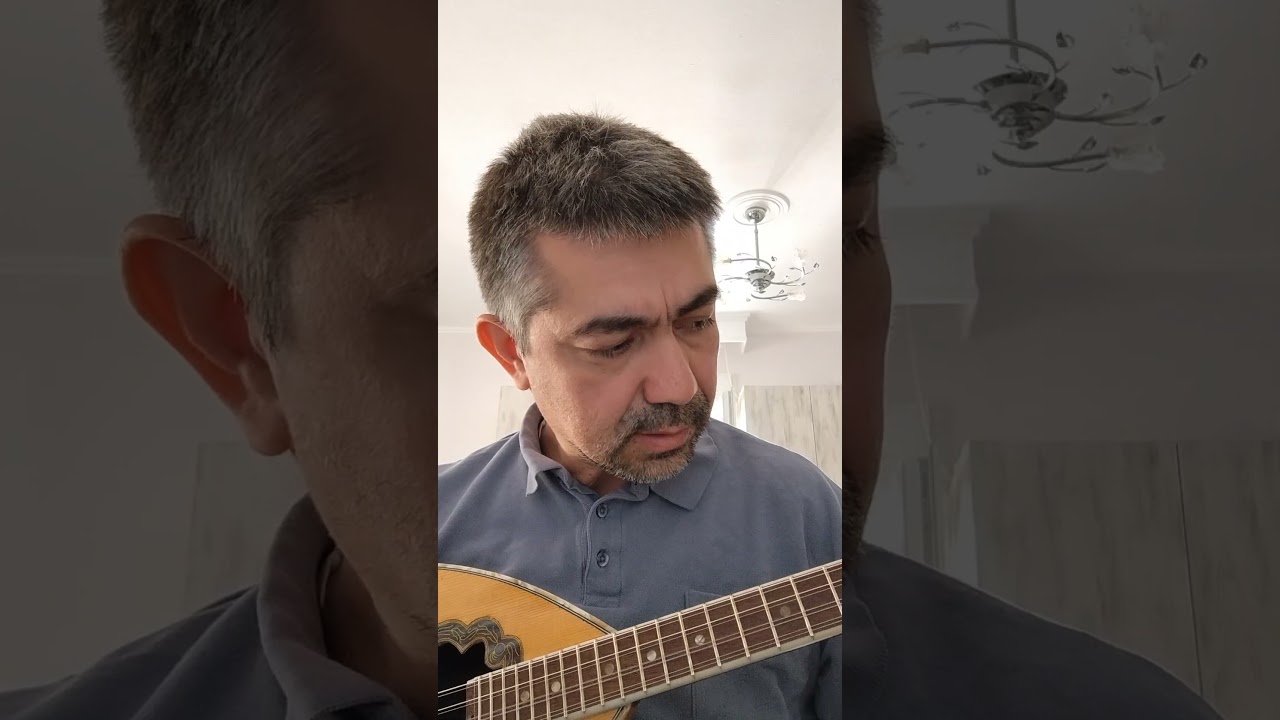
1 Like
All good, mate, but get yourself a tuner and tune the instrument first, because you might otherwise learn them out of tune and then blame the instrument afterwards.
What sounds out of tune to you? I tune it every time before I play, but using a mobile app.
Spyros is right. At least the two A strings don’t agree with each other.
Tip: with matching strings, don’t use the tuner for both of them. Tune the first one with the tuner, then tune the second by ear until the two together produce a single note, so you can’t tell whether it’s one string or two. Here, they’re grumbling.
(Ideally, we should practise tuning entirely by ear. The tuner is only there to give us the initial pitch, for the first string of the whole instrument we’re tuning. But okay, that will come gradually — just don’t forget to include it among your future goals as well.
Especially in the case of matching pairs, though, the tuner can also lead you astray. When it basically shows you a „correct A“ but, at the last moment, the needle moves just a hair to the right or left, it may be a difference that we hear more clearly when we’re playing both strings together than the tuner does. This doesn’t apply to the same extent to different strings.)
2 Likes
I wouldn’t rule out that it happened as you say, because the strings were changed on Friday evening and yesterday afternoon, when I recorded the video, was the first time I played them. Sometimes the initial tuning of new strings does this to me. Usually, after I’ve had them on for about a week, they settle down for a while and I don’t need to tune them every time, until they start to wear out. At that point they need tuning every day, and I realise it’s time to change them. I’m not confident relying on my ear. Quite often I can tell while playing that they’ve gone out of tune, but by the time I notice it, the difference is quite large. I still don’t fully trust my ear, although it’s gradually improving.
What I noticed was a ringing on the A string, but I’m wondering whether it’s because I decided to try Prodigy strings, gold- and silver-plated, and the shop I happened to pass only had 11s, with a 14½-gauge A string. I’m wondering whether they aren’t sitting properly in the slot.
Today, thanks to the lessons I’d been working on over the previous period, I had my first real day of enjoyment with the bouzouki. After all, the practice, the lessons and so on aren’t ends in themselves; they’re so that we can play with a group of friends and enjoy ourselves. So today we went to my in-laws’ for a meal and I took my bouzouki with me. I completed the first two levels and decided to see how what we’d learnt worked in practice. My father-in-law had played the bouzouki in venues for 37–38 years, from the age of 15 until about 15 years ago. As it happened, when I arrived at the house he was playing on his own, trying to get back into it (he doesn’t play often nowadays because of health problems). So we sat down and played together. For me, it was really enjoyable to manage to play the songs I’d learnt alongside him. He corrected me in a few places, helped me add some variety to my playing in others, and in general we spent an hour to an hour and a half playing and occasionally even quietly singing along. I’ll spend another week or two revising and focusing on a few details to fully master these two levels, and then I’ll order the next level as well.
3 Likes
I ordered it and am waiting for Level 3. Once I’ve worked with Level 3 for a while, I’ll write another review. What I’m waiting for and hoping for, beyond the 10–15 different songs, is for there to be exercises that help improve both technique and musical perception, as well as more material on the different modes. The previous levels made a start in all these areas. Since I noticed that the titles are repeated in Level 3 as well (and quite a few of the songs are the same), what I believe is that all of these aspects will nevertheless be taken further than before. As for the songs, I expect they will now be presented in a less simplified arrangement and closer to the originals. As I mentioned about the previous levels, the playing was basic: simply the melody line and rhythm, without embellishments (legato, tremolo, etc.).