I suppose that the rebetiko “kaimós” is not about “the fairest one” but about age 
I know it a little differently, but the gist is more or less the same:
Lady: Shall I offer you a sweet with your coffee?
Matchmaker: Oh yes, please!
Her daughter brings the sweet. Lady: My daughter made it!
Matchmaker: Your daughter’s a dab hand, ma’am—what can I say!..
(Not a single word was said about her looks…)
Speaking of Vasilis Lembesis, quite a few messages back.
From the aforementioned Autobiography:
On a little coffeehouse in Tambouria, where Lembesis was living at the time:
“Markos Vamvakaris used to frequent it too. He was about thirty at the time. He worked at the slaughterhouses in Drapetsona. Shy, heavy-set and taciturn. He loved listening to us play and sing our own songs. We knew he played the bouzouki, and many times we would ask him to go and fetch it so he could play for us. But to go to his house and bring it back, he had to wait until it got dark. He was ashamed to be seen carrying it. Back then, the bouzouki was found only in prisons and in a few secret tekes. He loved the guitar and would ask me to play for him. ‘Those cinema pieces,’ he would say, meaning some classical melodies that I had arranged for solo guitar. That was the other kind of music for him.”
And later in his book, on Piraeus rebetiko:
“Markos and Batis, with a guitar, would record four or five songs at ODEON within an hour, and practically for free. Batis, one of the oldest rebetes, always carried his little baglamas with him, taking it out of the inside pocket of his jacket; he belonged to the first trio of rebetiko singers, together with Stratos ‘the Lazy One’, on the earliest records, as well as on the first jobs where they began playing in establishments of that kind. Before the astonishing development they experienced as musicians, Batis, standing on a cart in Athinas Street, used to sell a powder for toothache and even pull teeth, using a pair of pincers on gullible passers-by who volunteered, to advertise this medicine.
One of the reasons this music found such a receptive audience among our people was the Asia Minor element of the refugee experience, which was transmitted in an alla turca style, whose roots also reach back to Byzantium. And from childhood our people have heard this music in church. The ground was fertile for the clumsy simplicity of the music of the tekes. Of course, there were undoubtedly some exceptional songs, fine examples, as happens in every form of folk art. The most important reason for their spread, however, was the commercial networks, as well as the motives of personal ambition among some of our good musicians.”
(Vasilis Lembesis, Autobiography—Letters to My Daughter, Odos Panos Publishing, 2012)
2 Likes
No, really, let’s think about this for a moment:
He was an itinerant peddler, a jack-of-all-trades and a drifter, an irresponsible and unserious character, a hashish smoker and a small-time con artist, who happened to have a musical talent. His profile doesn’t match, even by 1%, that of anyone we would consider a musician (professionalism, a certain degree of consistency in his work — after all, it wasn’t his profession —, some training, either through formal study or an apprenticeship with an older teacher, or at least a good voice and good playing — none of these). It matches only that of a peddler and a joker.
And yet a music producer comes along, observes him and his musical companions, and says, “Could there be some uncut gem hidden here?” And he decides to take the risk. And he is vindicated! If not immediately, then at least we, a hundred years later, are studying this tiny sample of Batis’s recorded work, trying to reconstruct the rest of the treasure, while at least some of his songs retain a timeless lustre.
How many other unknown talents might have been hidden, then or at any time, behind similarly misleading profiles!
1 Like
Yes, except that everything you mention applies to Markos. Markos went to Mino Matsa’s office, not Batis.
This is where I get stuck. The light-music musicians may have looked down on the rebetes and laïkó musicians, but the rebetes appreciated European music.
This is also a political document from the post-dictatorship transition. The collected works of Mao, Che, and Andreas!
Yes, Karanasis specialised in these topics.
1 Like
I’m trying to imagine a contemporary Mao-Guevarist publisher including Andreas’s books in its catalogue.
1 Like
I don’t know Batis’s story exactly, but somehow he too ended up recording albums. The producer (Matsas, was it?) must surely have heard him beforehand, and must surely have noticed that he wasn’t in the same league as the musicians who were conventionally brought in to record. Nevertheless, he must have had his reasons for making that decision—not out of ignorance of the risk, but as a conscious gamble.
The funny thing is that Batis recorded first (solo!), and Markos afterwards.
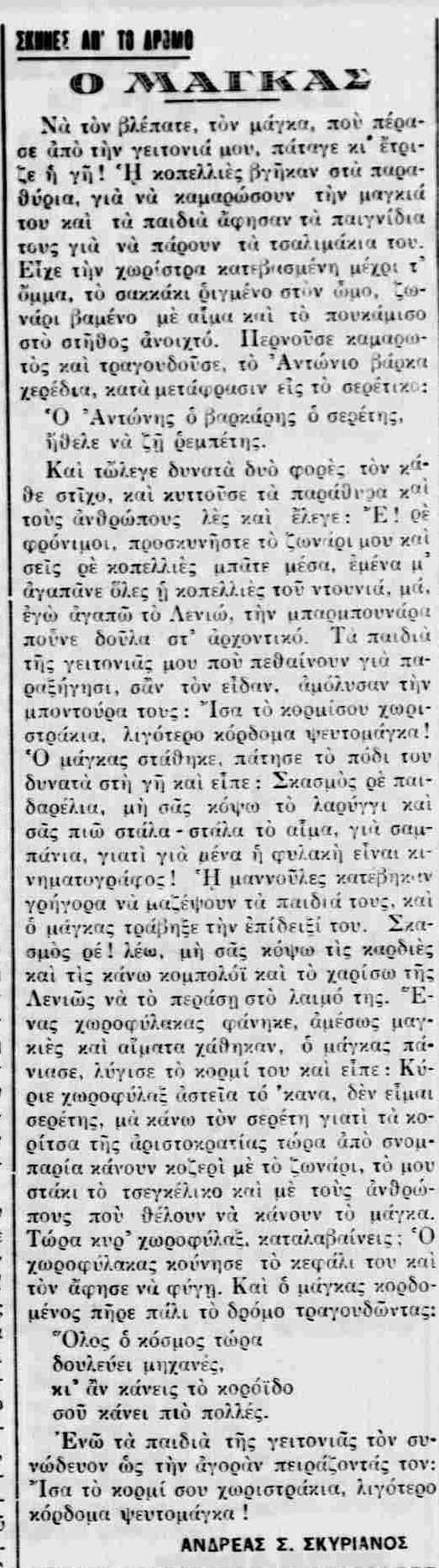
Batis had an excellent sense of humour and was very self-deprecating, but he also wrote very serious rebetiko songs (Gyftopoula sto hamam, Thermastis, Oi fylakes tou Oropou, Sfouggaradες, Zoula se mia varka bika, Fonografitzides)—so it wasn’t just the light-hearted style of “O Boufetzi̱s”… Mathesis, too, praises Batis as a pioneering rebetiko musician; in other words, he also had a history in the world of the bouzouki and mangas culture.
Also, if we listened to Batis’s repertoire again purely as songs, without knowing the story and especially the humorous anecdotes about his character, I can’t see why these songs shouldn’t speak to people in general…
1 Like
I’ll add “Barberaki”, which I’m very fond of in every respect, especially the lyrics, where — unless I’m mistaken — it also preserves the word “manga” in the feminine form, which is, historically speaking, how this word began.
Looking for the manga in the lyric, I did indeed find it. However, I also spotted a little mistake. Batis says
When you wave your hair
The person who transcribed the lyric should, to help anyone who may not have heard the word before, have added an (o) before the (not very common) word (onduler = to wave)
1 Like
Anyone transcribing the lyric should preferably record what is heard (“ντουλάρεις”) and, in a footnote beneath the song, explain the issue with “οντουλάρω”.
The same applies to “'Οντα”, which is heard twice in the song in question: transcribe it as “'Οντα” and add a footnote beneath it: “Όντα” = “Όταν”.
A proper apparatus criticus, in other words 
Come on, Babis, we’re just stating the obvious. We’re a forum for rebetiko enthusiasts here. Are we really going to prove Batis’s worth to one another?
But if you were the company’s producer-manager, and I were a colleague concerned with the company’s interests, I’d have plenty to say about his less-than-great voice, his rough playing and other commercially unappealing traits. Quite apart from the fact that he played—would you believe it—the baglamas.
1 Like
But you really would have had to tell me what Matsas said to Chatzapostolou about Markos and his group (Batis and the others) “invading” the studio: “Maestro, just as I don’t interfere with your score, I would ask you not to interfere with my work either.” And their collaboration would have been terminated (once and for all!!!) for Markos’s sake—which, as we know, is what happened. The only difference is that Chatzapostolou was also looking out for his own interests (and, above all, his reputation), not just those of the company.
But what does any of this have to do with anything? Why are we going off on a tangent?
What I wrote in the now-distant 1164, concerning Lebesis’s phrase „unlikely development“, was simple: that Batis, as a musician, seemed so awful by the standards of the recording industry at the time, and of professional music in general (however highly regarded he was within the musical milieu in which he operated: the amateur oral tradition of a closed circle), that it really was extremely unlikely that he himself would be recorded and, more generally, develop in the way he did.
His producer took a bold risk, whether through exceptional insight or sheer recklessness, and we were extraordinarily lucky that his recordings brought him down to us.
It sounds like this: Batis was a pop star.
1 Like