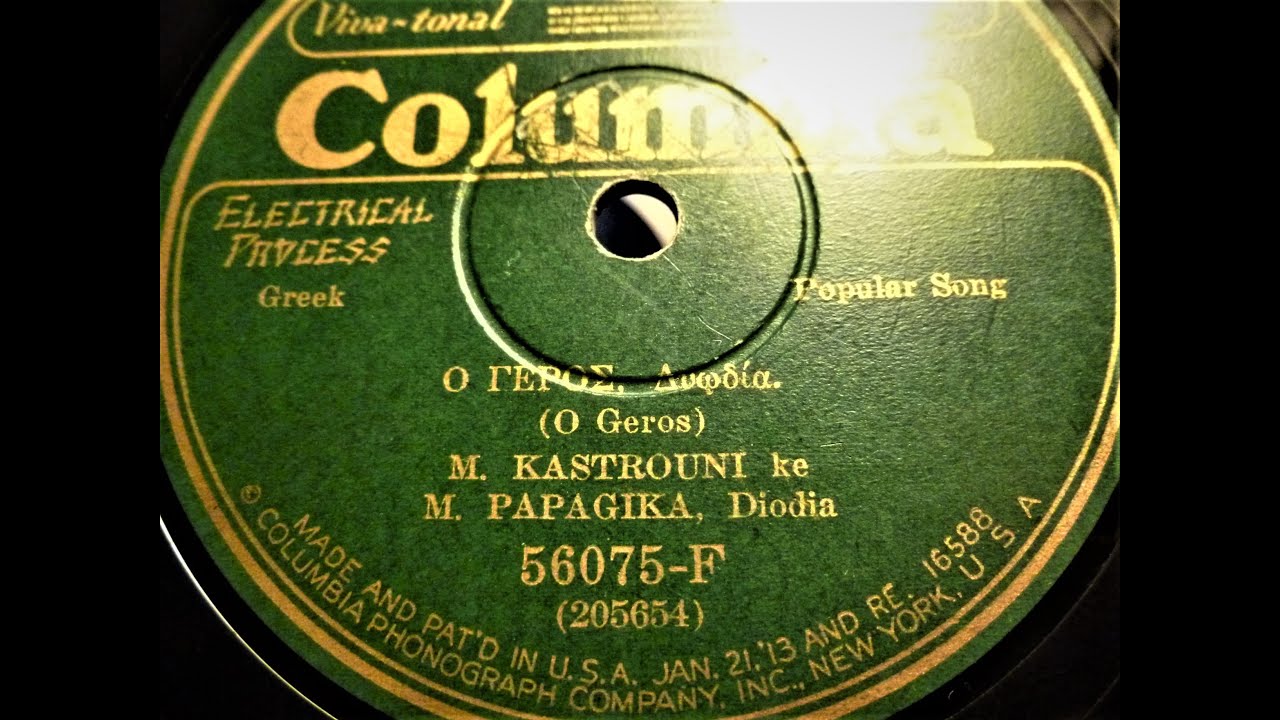
I don’t know whether you’ve noticed it (surely you have), but in US recordings, a great many singers pronounce “ου” in a very heavy way. A few examples that come to mind off the top of my head are Amalia Vaka, Kostas Dousas, Katsaros (from time to time), Marika Kastrouni and Achilleas Poulos, while some, such as Tetos Demetriadis, Papagika and Melkon (although Greek was not his mother tongue), pronounce it normally. I’ll include a few videos as examples, and I’d like you to tell me how you think it came about that so many people—mainly artists in New York, but not exclusively—came to pronounce it that way.
Here, focus on Kastrouni’s voice, not Papagika’s, in the first verse when she says “τους γέρους”:
“μα 'γω παράπονούμαι” “τη μάνα μου αρνούμαι”:
“Μαύρη ζωή μικρούλα μου"” “να 'χωμε φλόγα στη καρδιά, καμωματού”:
When singing, “ου” often gets too boomy. There is a technique, used mainly by traditional folk singers, of pronouncing “ου” like the French “u”, so they don’t get this effect. There’s also the possibility that they’re not pronouncing “ου-micron” correctly
She generally seems to adopt a strange pronunciation. It sounds foreign, but only in the vowels!
But “το μόνο μου παράπονο” and “δεν αγαπούνε τώρα” are pronounced normally. And Poulos: “μαύρη ζωή μικρού-(normally)-λα μου (altered)”.
I can’t work out the algorithm: sometimes they alter an “ου” that is stressed in the word, and sometimes they don’t. Sometimes they alter an “ου” that is stressed in the melody, and sometimes they don’t. In any case, I’ve noticed it with Katsaros too, and I think with folk songs as well. And it produces what Nikos N. describes, roughly like a French u, although in Marika Kastrouni’s case it isn’t exactly that.
I once read something that I don’t remember accurately, but it went roughly like this:
Each vowel has its own frequency, or at least a certain range of frequencies, belonging to it and not very wide. If, in a melody, there is a syllable whose note does not fall within the frequency range of its vowel, something doesn’t work properly (I don’t remember exactly what). Apparently, classical composers take this into account in operas, art songs and generally wherever they set lyrics to music.
The text also described an experiment in which, by changing the speed of a record, we could hear the vowels changing—sometimes for the better (that is, a distorted vowel, which had turned out that way because the note did not suit it, would suddenly sound right), and sometimes for the worse (correct vowels would become distorted).
I don’t think it’s a technical feature, since we only observe it among Greek Americans. To me, the more likely explanation is that, over time, they adopted the heavier English “ou” sound in English-speaking America. On the other hand, you could argue that someone who grew up in Greece would find it very difficult to unconsciously change their pronunciation, even in the environment of a foreign country. I think it’s difficult to say. However, the information in the second message is very interesting, and I’ll look into it further and post here if I find anything relevant.
At least in Katsaros’s case, since he went to America as a child and stayed there continuously for countless decades, we really do hear a slightly Brooklyn-ish accent. It is more noticeable in spoken language (interviews, videos from concerts where he addresses the audience), but you can also hear it in the songs if you pay a little attention.
But I can’t say that this explanation satisfies me for everyone who makes this particular alteration to “ου”, which, moreover, doesn’t even sound English but perhaps resembles other languages.
It’s the same as when we know a foreign language but aren’t fluent in it and don’t speak it very often: we use the pronunciation of our own language:
Each sound is produced with a specific positioning of the mouth and the speech organs. In their native language (and in their native dialect—regional variety—local speech), people constantly position their mouths as required for those sounds, so naturally the movement becomes automatic and unconscious. To achieve the positioning required for the sounds of a foreign language, quite apart from the fact that we may simply not have understood it precisely, even if we have understood it, some movements are needed that we have not practised much and that require effort. It is very easy to avoid them, hoping that the other person will understand us anyway. That is a “foreign accent”.
But when someone lives permanently in the foreign country and speaks its language all the time, they become accustomed to these mouth positions too, making them automatically, and may eventually lose their familiarity with the positions required by their native language.
There’s nothing strange about it. It simply depends on (a) how well you have learnt the foreign language and (b) how often you speak each one.
There is the frequency of the note itself (e.g. A 440 Hz), and there are the specific harmonics, or, to be more precise, the peaks in the overall shape of the spectrum that give you one vowel or another. I don’t know the Greek terminology; in English, these spectral peaks that determine vowels are called formants. From these, you can also derive the triangle/trapezoid shape that linguists use for the vowels of each language. For Greek (without taking the Cappadocian dialect into account), it is a fairly simple triangle: Φωνήεν - Βικιπαίδεια
I have heard that, for classical opera singers, lieder singers and so on, Mediterranean languages such as Italian (and Greek), with their five simple vowels, are considered easier, whereas, for example, French, with its nasal vowels, is much more difficult.
I have the impression that the Greek language’s general phonological relationship with English has changed enormously over the course of 100 years. For example, spellings such as Γκολφ στρημ (Gulf stream) used to be common, which sound at least rather odd to my ears. The Greek-speaking community’s preference for French may also have played a part, as may Greek Americans.