Και το Φόρουμ,αν το μελετήσεις σε βάθος,θα δείς πως γνωρίζει περισσότερα από το ΑΙ
2 «Μου αρέσει»
When did the greek instrument Baglamas as we know it today take its current form?
Short question, big answer…
Have you checked advertisements of instrument makers, with pictures, in this thread? If you find a picture of a baglamas in an ad dating, say, from 1930, then you know that it certainly existed at least in 1930.
Generally I believe that it must have appeared shortly after the first professional rebetika musicians (i.e., the Τετράς) appeared. Before that, it was an instrument for amateurs, made mostly by themselves, in a form that was not standardised but generally followed the 7-fret style.
I repeat, this is what I believe. It’s not a fact, it’s a personal guess.
Vamvakaris says somewhere in his autobiography something like : back then, the baglamades were not small bouzoukis as they are now…
If you have the book, in a language you understand well, find the excerpt to see if he mentions any dates about “back then” and “now”.
i found only this and my markos biografie is in germany now.
I believe that the older baglamas was a different instrument : the 7-fret model, with its variants. The difference from today’s baglamades does not lie only on the number of frets, it’s altogether a different type of instrument, independent from the bouzouki. And that then, at a certain time, the newer type came (not all at once, I suppose : gradually), which is so heavily influsnced by the 3-string bouzouki that it is almost a minature bouzouki.
I don’t know when this transition took place. This is your main question, right? I suppose, however, that it must have been connected with the transition of bouzouki, baglamas and the rebetika repertoire itself from amateur παρέες at tavenrs, hash-dens, prison, or just anywhere, to professionalism.
The song by kyria Koula doesn’t describe the instrument’s details (of course!). It does, however, describe its use : amateurish, by the παρέα. More or less the same as in any hassiklidika song that mentions a baglamas. (Besides, I don’t think that anyone has written songs about the baglamas as a professional instrument, although there are several about the bouzouki.)
So, what you must look for is:
- the earliest possible documents of baglamades that look, more or less, like those of today
- the most recent possible documents of the old-style baglamas, or of any hybrid between the two.
1 «Μου αρέσει»
thank you pepe, may be we will find something, what you and i mean.
This article linked here in the forum hypothesized that the bouzouki was built around 1900, at the turn of the century, as a hybrid of the Italian mandolin and the tambourine in Greek (urban) workshops. What do you think about that?
that’s by @nikos_politis 
1 «Μου αρέσει»
Sorry, i forgot to write. Lieber Niko, entschuldige, ich meine das gilt dann auch für den Baglamas?!
Presenting the evolution that took place in the Greek speaking world, whereby the ancient Trichordon ended up in today’s bouzouki, I did not specify some sort of a time mark around 1900. The evolution was continuous and uninterrupted, all the way from the ancient times until today.
Oh … before and after 1900, …some years.
I wrote “Jahrhundertwende”.
There must have been a lot of discussion in several threads; you can start from this one:
Here the topic is different.
However, it is still not clear what you are trying to find. We were talking about baglamas, now you ask about bouzouki. There is not a common answer for both.
A transfer or some connections for me are allowed.
Actually, Tsitsanis did. In Μπαξέ Τσιφλίκι he talks about himself playing baglamas on stage. But this was much later, of course.
1 «Μου αρέσει»
Θα ήθελα να σας ευχαριστήσω και πάλι, ειδικά τον Πέπε για τις συμβουλές αλλά και για την υπομονή σας, σας ευχαριστώ πολύ.
3 «Μου αρέσει»
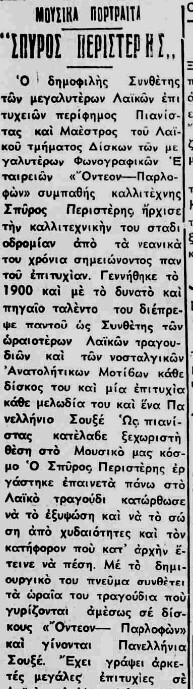
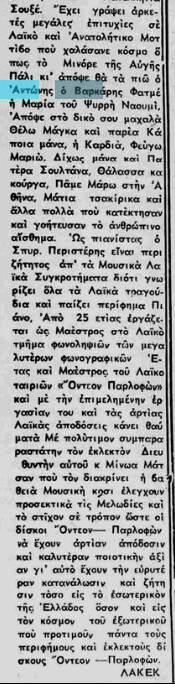
Ρε, τι “κουφά” βρίσκει κανείς…
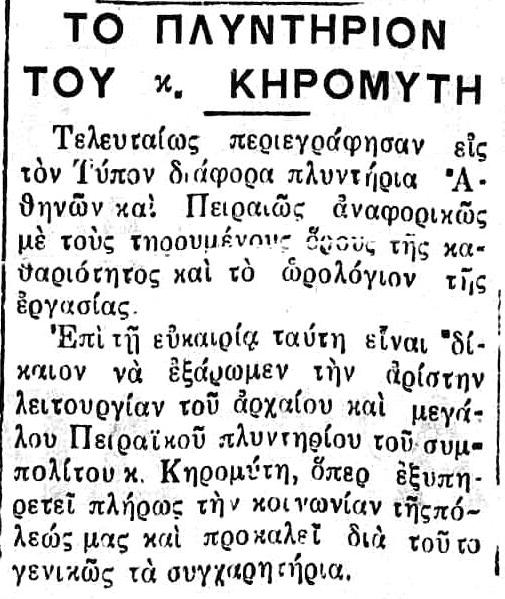
Υπεραξιωτικό κειμενάκι για το “αρχαίον και μεγάλο πλυντήριον” του πατρός Κηρομύτη
(ΧΡΟΝΟΓΡΑΦΟΣ, 26/6/1930)
4 «Μου αρέσει»
Δηλ. τι γινόταν με τα πλυντήρια; Τι εννοεί με το ωράριο;
Πιανίστας;
Είχα την εντύπωση ότι βασικά έπαιζε μαντολίνο, ένας μαντολινιέρης που παίζει επίσης και τα άλλα παρόμοια έγχορδα. Για πιάνο πρώτη φορά το ακούω.