Didn’t it strike anyone that there’s a family with small children in the photo?
That’s where they all lived. A “business” at the front and living quarters at the back (i.e. one room. Maybe a little kitchenette too).
After contacting Giorgos Kontogiannis, he told me the following about the photograph. It was found in Monastiraki, and when it was published in the magazine, they asked anyone who knew anything about it to get in touch with them. Someone then said that the photograph had been taken in Kaisariani during the interwar period. I would say that is quite likely, as the owner’s name is not among the names of the Piraeus tekke-keepers we know of. Giorgos believes that the woman on the right may be Rosa, but he is not certain, as the photograph is not in very good condition.
5 Likes
Thank you, Stavros!
I see you’re celebrating twenty years on the forum today.
It’s most likely a pole for the lantern (lamp) hanging from it, isn’t it?
Can you enlarge the photo Eleni uploaded if possible? It should then be visible.
Below the photo of the woman on the right, it says in capital letters PALAISTI (or something similar), and above it GOGO SKRIKA (or something similar). Further up, MANOSOF (or a variation thereof).
Sorry if the post seems like misinformation; I’m just trying to make out what it says as best I can.
And perhaps in the same lettering as the sign painter who did the “Sanatorium of Melancholy, etc.”
(I do wonder how your eye caught the other two! ?Gogo Skrika is plausible enough, but ?Palaisti is white on white, like sympathetic ink! Did you hold it over a candle flame?  )
Personally, I maintain that the instrument looks real to me. My only reservation is: who would hang an instrument outside in the wind and rain? Unless they did it for the photograph…
When all’s said and done, where does the certainty that it’s a tekke come from? It could just as well be a „sanatorium for melancholy“—or a wine tavern. In interwar slum neighbourhoods, I believe a wine tavern could quite easily have been housed in a rudimentary shack.
(Well done, Stavros! — quite apart from my queries…)
However inadequate it may be, the analysis allows us to discern that most likely NOTHING IS HANGING FROM THE POLE. Exactly behind the pole, on the lintel and to the left of the extremely faint photograph ( ; ) of a human head, there is a row of three plus one luminous points (parallelepiped, circle, “circular parallelepiped” and parallelepiped underneath), which of course I have no idea exactly what they represent.
Niko, this is probably glass, and we’re likely seeing reflections, possibly from across the way, or perhaps caused by the difference in lighting?
‘Perhaps, though, there’s another transom window on the rear side and we’re simply seeing the light from behind. In other words, a through-light.’
If the photo had been taken today, they would be stickers on the glass (e.g. from Tripadvisor). But given the circumstances at the time, …?
It seems to me that the dots are unrelated to the photograph; they look like what we used to call “burning”. I’m uploading the magazine cover here, along with G. Kontogiannis’s editorial in this issue. On the poster on the right, after zooming in considerably, I can make out the word PANASOS. Panasos is a village in Heraklion, Crete. I don’t know whether the name BALALAS has any connection with Panasos. I can also make out the name GOGO above the woman’s face on the poster, as well as the name PALAISTI below it, although I’m somewhat uncertain about the latter.


3 Likes
And the editorial says it’s an entertainment venue, not a tekke.
(“Panasos” is the village, not “the” [feminine form].)
1 Like
It says “Pantheon”, which was a cinema of the time. However, cinemas with that name existed in various parts of the country during the interwar period, such as Athens, Achaea and Magnesia, where the name Balalas is found. It is a poster for a work from that period, but I cannot make out what it is. There is also a photograph above the door.
3 Likes
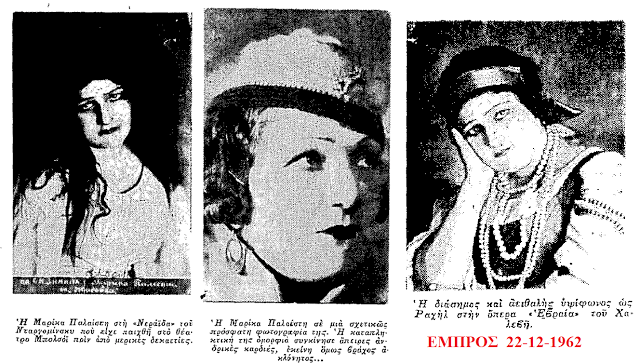
A hypothesis: the person depicted on the poster [if we are indeed reading the name correctly — which, compared with the rest, is more legible — — “PALAISTI”] could be the soprano Marika Palaisti (1888–1970), who became better known in our country from around 1925 onwards, giving 430 concerts throughout Greece, teaching singing somewhere near Syntagma Square, performing “Carmen”, writing songs with lyrics and music and performing them herself, etc. Until she “lost” her voice and began behaving strangely and making a fool of herself by trying to become involved in politics, etc.
Photos of her from the press, where I have the impression that the 3rd one in sequence resembles the one on the poster here.
All of this is merely hypothetical…
2 Likes
I agree with Stavros, and he does indeed write „Pantheon“. I also found it in Mesogeia when I conducted a search under that name, in addition to Achaea and Magnesia (Volos).
And of course, no one wrote „tekes“ or said that they had a tekes. Everyone referred to them as anything from coffeehouses to entertainment venues or dance schools.
"„For quite some time, on Psaromilingou Street, under the guise of a coffeehouse and bearing the none-too-laudable title of tekes, there has operated a den of the worst kind, inside which all the scoundrels and dregs of the capital regularly gathered, smoking hashish, playing cards, and committing all manner of vile acts.“
EMPROS, 13 January 1901
"„Day and night, wherever you went—past a coffeehouse, that is—you could hear the singing of the bouzouki or baglamas and smell the talmira (hashish), whether from a hookah or a hashish cigarette.“
The account of Nikos Mathesis
Source: Ο ΤΕΚΕΣ ΤΟΥ ΜΕΣΟΠΟΛΕΜΟΥ - Elefthero NET
“However, Kostas Tzovenos mentions that the song „Mésa stou Mánthou ton teké“ was written about another tekes, the tekes of Manthos Gravaris, which operated at a countryside entertainment venue in Agioi Anargyroi. (I. Volioti-Kapetanaki: Stray Melodies)”
In any case, since the only “source” is a post on Facebook, we can’t draw any conclusions. Maybe it is, but maybe it isn’t.
1 Like
We agree, Agis. In any case, the name “The Melancholy Sanatorium” also somehow recalls the name Batis gave to one of his own café-tekkes: “Street of Despair”.
That’s right, but even so, we still don’t know. Modern meze restaurants have names like that too, for example; a tavern could have been called that as well.
I made the connection too, though if it weren’t for Batis’s example, my mind would have gone to some trendy meze-joint sort of place in a gentrified former neighbourhood…
Well yes, naturally nobody wrote ‘teke’ on the outside of their teke (if they had, we wouldn’t be wondering about it now). What I meant, though, was that even in 2003, when the photo was published in Folk Song, there was no suggestion that it was a teke.
You might ask, what does that prove? Nothing, of course. It may have been a teke and the magazine simply didn’t think of it, or they did think of it but didn’t write it down for—I don’t know, any number of reasons. But the fact that they didn’t write ‘teke’ back then certainly doesn’t mean that wherever the word ‘teke’ is absent, we have a teke!
1 Like