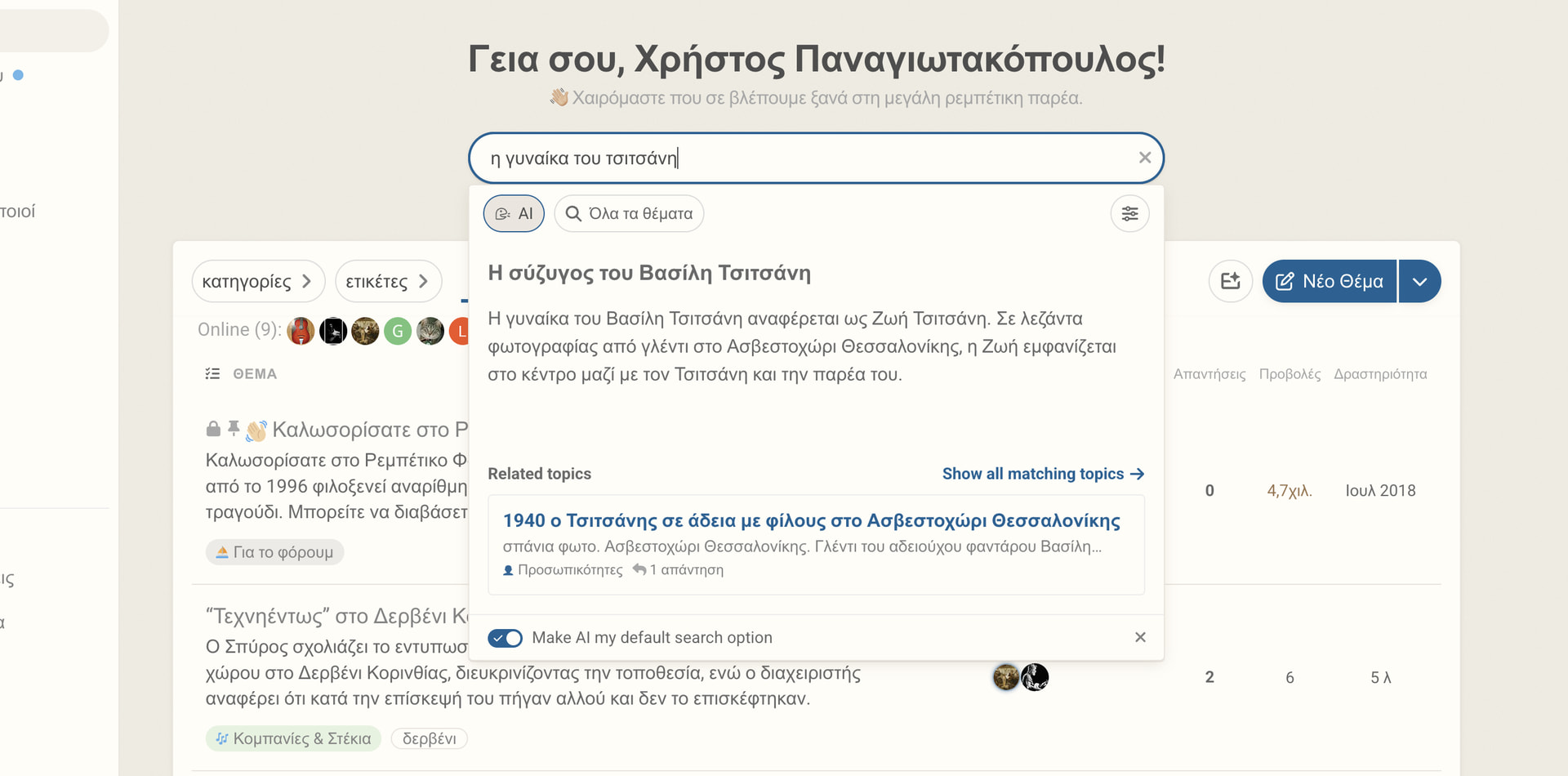
Good morning, everyone!
The forum now has an MCP server. In practical terms, this means that you can connect an artificial intelligence chatbot, such as Claude or ChatGPT, to your account here. The chatbot can then search and read our discussions on your behalf and answer you with references to the relevant posts.
We have more than 26 years of discussions (the oldest posts date from 2000) and thousands of topics. A chatbot like this can dig up things that you would have a hard time finding on your own using the search function.
What is MCP?
MCP (Model Context Protocol) is an open standard. It allows artificial intelligence tools to connect to external services. The chatbot does not “know” on its own what has been written on the forum. Through MCP, however, it gains a set of “tools” that it can use, such as:
- searching topics and posts, using Discourse’s familiar search syntax (
before:,after:,order:oldest,#category,@user, etc.) - reading entire topics or specific posts
- lists of the most popular or most recent topics, filtered by category or tag
- member profiles and their activity
- drafts: the chatbot can prepare a draft post for you, and you can read it, correct it and publish it yourself
The server address is:
https://rembetiko.gr/mcp
What the chatbot “sees”
The chatbot connects using your own account and sees exactly what you see. Nothing more. When you connect, the forum asks you to approve what permissions it will have (for example, read-only access, or permission to save drafts as well). You can revoke access whenever you like.
How to connect
Menus often change from one version to another, so treat these steps as a general guide.
Claude (claude.ai or the Claude Desktop app)
- Settings → Connectors → Add custom connector.
- Name:
Rembetiko.gr, URL:https://rembetiko.gr/mcp. - Click Connect. The forum page opens; sign in (if you are not already signed in) and approve access.
- In a new conversation with Claude, make sure the connector is active (using the tools button below the message field).
ChatGPT
- Settings → Apps & Connectors → Advanced settings, then enable Developer mode.
- Back in Connectors, click Create and enter the same URL.
- Sign in with your forum account and approve access.
There are other tools that support MCP as well (e.g. Claude Code, Cursor and VS Code). The process is similar: enter the URL and sign in.
Two real examples
Below are two investigations we conducted through MCP. I describe what was requested, what the chatbot did and what it found. All the results come from forum posts and include links to them.
1. “Find me the earliest discussions about the three-string and four-string bouzouki”
Question: What are the oldest discussions on the forum about the three-string bouzouki? I want to see how the “three-string or four-string” debate began.
The chatbot searched for τρίχορδο order:oldest, that is, posts mentioning it, from oldest to newest. It then read the most interesting ones. Here is what it found:
- 27 February 2000: the first relevant question, in the topic Bouzouki or tzoura?. A beginner who plays baglamas is thinking of getting a three-string instrument and is hesitating between a tzoura and a bouzouki.
- November 2000: the topic Bouzouki Instruction Book. This is where the question “Three-string or four-string bouzouki?” appears in full for the first time.
- October 2001: the half-joking, half-serious Detetrachordize the bouzoukia!, from a supposed “Radical Movement for Rebetiko Dechiotification”. Aris writes a long and very substantial reply there. He points out that “the damn four-string bouzouki wasn’t invented by Chiotis. It had existed for a very long time” and that what Chiotis added was “guitar-style tuning”. As early as 2001, he was already complaining that “new friends don’t take the trouble to ‘leaf through’ the older postings a little”. So here is a good reason for us to do exactly that!
- May 2002: in the topic Makam - Byzantine Modes, frank mentions that the oldest known photograph featuring a bouzouki is of Nikos Milanos (Kolatsis) in Portaria, Pelion, from 1892. He also writes that, according to Milanos’s grandchildren, he played “a regular, three-string bouzouki, with wooden tuning pegs, from around 1880”.
All of this came from one search and a few readings, in a minute or two.
2. “Study a discussion and summarise it for me”: the Piraeus mode
Question: What has been said on the forum about the Piraeus mode? How does it differ from Hitzazkiar, and which songs are written in it?
The chatbot located the topic Piraeus mode: 57 posts from 2018 to 2023, with contributions from liga_rosa, pepe, alk, icetelli, Nikos Politis, Peloponnisios and others. It read the entire topic and produced the following summary:
- Structure: it basically has the intervals of Hitzazkiar, with a permanently (or almost permanently) raised fourth degree, which returns to its natural position only in the final phrase. The melody also revolves around the fifth degree rather than moving from the octave down towards the tonic (liga_rosa, #10 and #50).
- Correspondence with a makam: there is no clear correspondence. Zirgkioulelî Souzinak with a permanent sharp on the fourth (Voulgaris), Sirf Hitzazkiar, and Tsiamoulis’s definition (#19–#24) have all been mentioned. Pepe notes that the Piraeus mode is probably the only case in which manes are named after a folk mode rather than a makam. He has identified 12 recordings titled “Piraeus” that are genuinely in this mode (#49).
- Tunings: mainly the Syros tuning (D–G–B♭), as well as D–B–G and D–B♭–B♭ (#20).
- Songs mentioned: O Memetis, O Bochoris, O Xemagkas, My eyes have seen many things, Your enchanted eyes, At Manthos’s tekke, At Perdikakis’s tekke, Karantouzeni, We were smoking one evening, and others.
- The most interesting discovery: in 2023, pepe wonders whether the Piraeus mode is “the only mode that the people of Piraeus did not cultivate”, since the classic examples are from Asia Minor (#37, #39). Peloponnisios replies with songs by Markos and Gogos (#40). Nikos Politis opens up the discussion of what “Piraeus school” ultimately means (#42).
If the chatbot tells you something interesting, ask it for the link and read the original post. The summary is a starting point, not a substitute for the discussion.
Other ideas for research
- “Find all discussions about Skarvelis before 2010 and tell me which topics keep recurring.”
- “What different versions of the lyrics have been discussed for this particular song?”
- “I want to buy a second-hand bouzouki. Gather the advice given on the forum about what I should look out for.”
- “What has member X written about tunings?”
- “What are the most popular topics of all time in the Instrument Making category?”
- “Is there already a topic about what I want to ask?” (Very useful before opening a new topic!)
A few tips
- Search is keyword-based, not meaning-based. If it cannot find something, ask the chatbot to try variations: with and without accents, “hitzaskiar”/“hitzazkiar”, “Tsitsanis”/“Tsitsani”, or even Greeklish for the older posts.
- Always ask for links. A good chatbot will refer you to the specific post. If something sounds odd, go and check it.
- The chatbot can make mistakes. It may misinterpret a post, confuse who said what, or “fill in the gaps” with its own knowledge. Check anything based on the forum. Treat anything without a link with caution.
Give it a try and tell us here what you found, what worked and what did not. Especially if you dig up some forgotten gem from the old days!
 So, in reality, the part where AI helped was retrieving relevant information — which is also what takes the most time.