I’m moving here a message I had started writing in a separate thread. By the time I realised this one existed, I had already written almost all of it. Normally I should rewrite it, taking everything above into account, but we can do that mentally as we read.
So, here is what I wrote:
What exactly is this melody?
It is usually referred to as “Cheimar(r)iótikos”, that is, from Himara in Northern Epirus, although the place is actually spelled Himara (the widespread spelling is simply an etymological misinterpretation based on χείμαρρος [torrent]). It is a seven-note melody, in kalamatianós rhythm, usually a fairly slow one, with a fixed succession of numerous musical themes (rather like the Politikos Syrtós, some instrumental zeïmbékika, the Great Kalamatianós {“Kalamatianós kerchief”}, etc.), some of which may also be sung.
A.
On Sealabs I find it in six old recordings (click). They are all instrumental. A clarinettist is always the lead performer, specifically: Kyriakatis 1928, Rellias 1928 (with Ogdontakis), K. Karagiannis 1931, Andreas Dougklias or Douklias 1935, Apostolos Stamélos 1936 and, after the war, Ant. Sakellariou 1947 (USA). I don’t know all of these people, only the first two and, of course, Ogdontakis.
More or less, they all play it the same way. So does Karakostas, in a recording I can’t find on Sealabs. I include it as an example:
The first theme, which moves in the lower part of the scale, is also played an octave lower than all the others. This is consistent in almost all performances. The order of the themes is also consistent, or nearly so. There is variation in the tempo (Karakostas’s is faster than most) and a little in how each performer embellishes it.
But this music doesn’t resemble Northern Epirote music in the slightest! How can a kalamatianós nigritz melody come from Himara, in the heart of the pentatonic tradition?
B.
There is also Papasideris’s “Mia melachriní” [A brunette], from 1940. Two of the many instrumental themes have been turned into songs; one of them is also used as an introduction, they are repeated over several verses, and at some point later another instrumental theme is inserted as well—the one that was originally first and was played in the lower register:
This may now be a personal adaptation by Papasideris: I take two of the six or seven themes of an instrumental melody and turn them into a song, cut everything else, but keep one particular theme as a kind of reminder, even outside its normal order. Or it may be an abbreviated performance of a traditional version: that is, they would normally play all the themes, occasionally sing over two of them, and Papasideris, because of time constraints, cut them down and kept only the sung sections.
C.
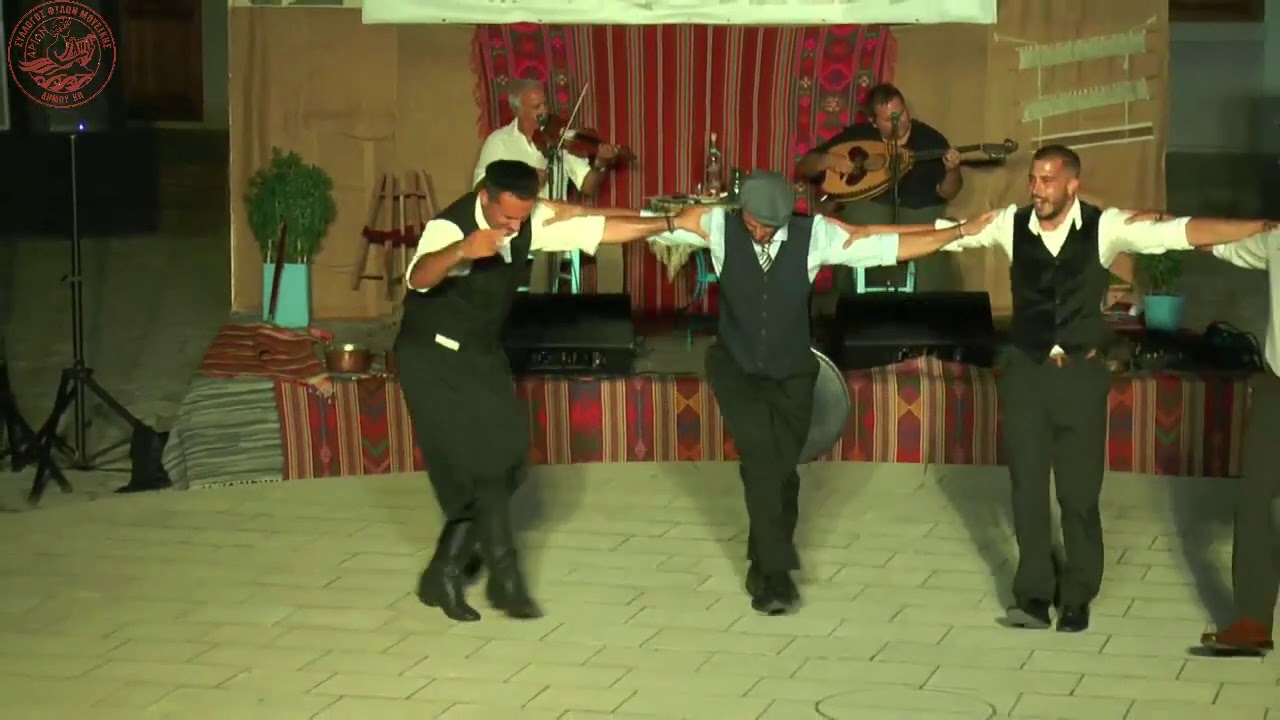
This is precisely the case with the Kalymnian Thymariotikos: they start normally from the beginning, play the first theme in the lower register and the following ones in the higher register, and when they reach the ones Papasideris sings, they sing them too. In Kalymnos, the Thymariotikos is a distinctive left-right dance. While they are in the lower register, they dance to the left, and in the higher register—which lasts considerably longer—they dance to the right, in kalamatianós style. In other words, roughly like this:
(We should take everything the presenter says at the beginning with the utmost caution. The performance itself is valid, though, and I have seen the dance performed more or less like this, without swearing to every detail.)
The current interpretation in Kalymnos of the title “Thymariotikos” is that it is a corruption of “Himariotikos”.
And yet the Kalymnians sing exactly the same couplets as Papasideris! This would initially suggest that they incorporated an old 78 rpm hit into their local repertoire. But Papasideris does not title it Himariotikos/Thymariotikos, but “Mia melachriní”, nor does he use the full melody, as the clarinettists and the Kalymnians do. Meanwhile, Kalymnos is one of the places par excellence where even today standardisation has not intruded into the order of the couplets. Even in very well-known songs such as Thalassáki, everyone uses whichever couplet they want. Except in the Thymariotikos!
Moreover, dancing an imported melody as a separate, unique local dance is certainly rather odd. Usually, everyone dances “foreign” tunes to whichever of their own dances fits best, which here would be the kalamatianós.
In Kalymnos there is also another, very remote variant of the melody, adapted for the tsampoúna. As far as I have seen, this is danced as a regular kalamatianós. Just two musical themes, both sung:
(Don’t ask how the melody came to be turned into this. It is the same one, even if it doesn’t seem so, but we won’t prove that here.)
D.
Now look at this: of the six old recordings on Sealabs, one is titled Thymariotikos rather than Himariotikos! It is the one by Kyriakatis, 1928, that is, the oldest of them all alongside the one by Rellias-Dragatsis, also from 1928 (which is currently titled Cheimar(r)iótikos).
So could it be that the Kalymnian “Thymariotikos” is not a corruption of the word “Himariotikos”, but the other way round? That is not at all unlikely, if we consider how little this melody resembles Himariotiko music.
E.
To make things even more complicated, I have also discovered and am posting here a Grevená recording from a feast, featuring a melody that is itself a variant of the Himariotikos, although that title is not mentioned (simply “I opened your door at midnight”, from the couplet). When the song comes in, it is almost pentatonic, while a strong pentatonic colour, though not 100 per cent pure, can also be heard in the instrumental sections.
Musically, Grevena is Epirus. Full-on pentatonic. The way they play it, I would believe that it was a melody from Northern Epirus.
This does not, however, prove whether such a version of the melody really exists in Himara, with the people of Grevena playing it faithfully while everyone else from 1928 onwards plays a variant in nigritz—or the reverse: whether the people of Grevena also play the pan-Hellenic, recorded Himariotikos, but, being accustomed to their own pentatonic tradition, make the nigritz of the original melody pentatonic too.
_________________________________
That is what I had written. Now let’s add the information about the Beratianos and so on from the old messages, which I hadn’t seen in time, and try to make sense of it all!!