The tsifteteli, also referred to by the Greek term diplóchordo, derives from the “double-string” technique on the violin. I don’t know what these words mean in Turkish, but I would call the ikitelli “two-stringed” and the other one “double-stringed” (as it is already called).
Alongside all this, there really is also the instrument tsifteli, but let’s not muddle everything up.
“Double-stopping” on the violin, where an additional string is added to the existing grooves, is one thing, and the cifteli is another. In any case, yes, when it concerns the violin, we are referring to this “extra” string, speaking of a double-stopped violin, and it was by analogy with this technique that the tsifteteli dance was also named.
I’m taking the initiative to move this brief discussion from its original location because there are elements that may give it interest in its own right.
So, neither Nikos nor Spyros is right about the double-string setup. I used to think the same as Spyros: that one string is moved into the other’s groove (only on the upper nut), but I forgot to write that down. Just as well, because…:
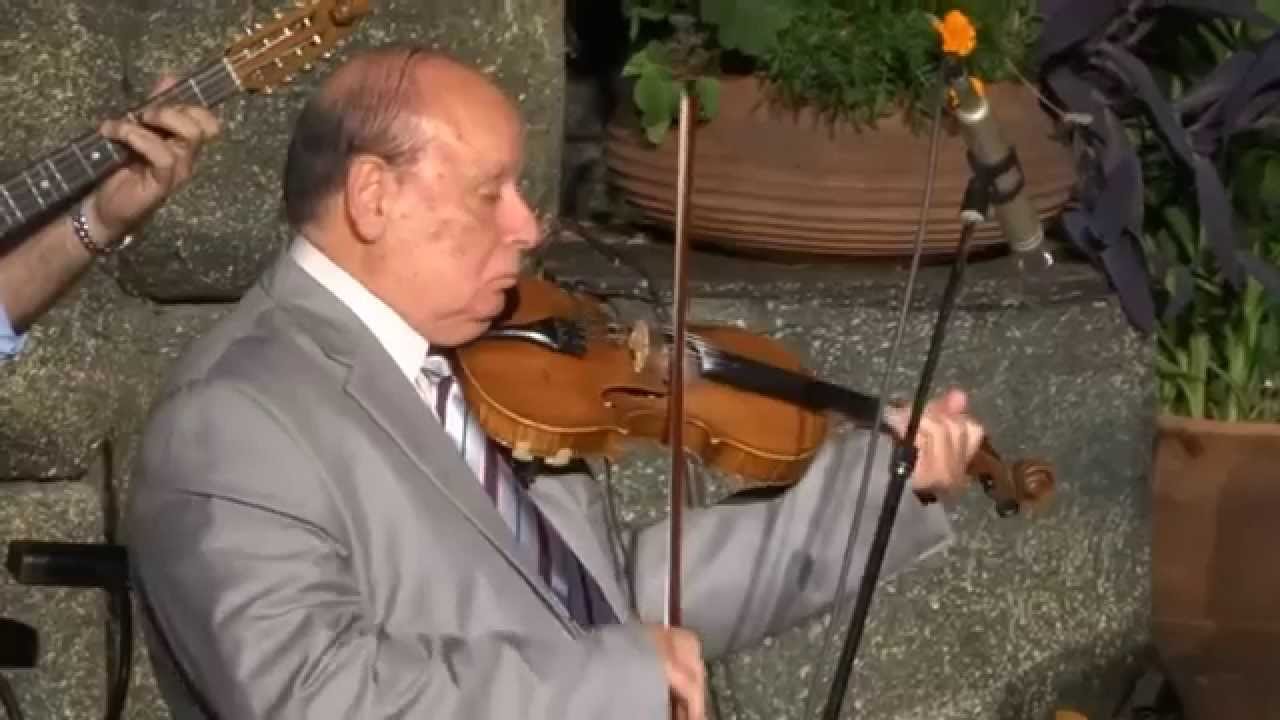
The video below, although it isn’t particularly high-resolution (the extra grooves cannot be made out), has some fairly well-judged camerawork. Once you know what you are looking for, full-screen playback and a few frame stops at the right points leave very little to the imagination.
Does one conclude that all double-string pieces will be in the key of E (or not)? I also have the impression that they are always in the usak dromos, so we are talking about a technique with an extremely limited purpose: only for E usak tsiftetelia!
Well, okay, you pull the la up towards the Mi and it sort of works, a little sharp up high because you lower it by a fourth and it sinks, but it’s okay—it has that effect.
Here, this string is also used as an ison:
I understand up to the point where he tuned the double course and is playing on the D string, with the higher string of the pair serving as the drone. But can he bow three strings at once? Or is he bowing the “bourdana” of the pair, with the higher-pitched string sounding only sympathetically?
Either way—or all three, if moving the second string makes the awkward angle negligible (if you see what I mean)—I’ve never seen such a technique before. His own invention?
He plays Hijaz on a bolahenk (mi), so it essentially has two single-string courses: the D string and the E string. In its basic range, he plays on D, shifting position frequently so that everything fits on one string, then goes up an octave and plays on E, now also pressing the fretted string so that the octaves can be heard.
He doesn’t play three strings. He plays the fretted string together with D or E.
He’s a master..
So, it doesn’t use the pair of high and low (lowered) E strings as a double string while playing a melody on the D, but as two separate strings, using the bass one as an ison?
And one I hadn’t noticed before. The taxim at the end is played on double strings, with the A string tuned down to E.
Could it be Ogdontakis, I wonder?
Another video where we can get a fairly good idea of what is going on:
Apart from the fingerboard, the strings can be seen clearly. The two treble strings (normally E and A) are close together, away from the third. So this confirms the extra groove in the lower bridge. They are tuned E–E an octave apart: that is, the normal E has not been altered at all, while the A has been lowered to E and moved over.
The strings cannot be seen at the level of the fingerboard, so it is not clear whether the two run in parallel (that is, whether the A that has been lowered to E also has an extra groove in the upper nut) or whether both pass through the groove for the normal E at the top. There is, however, a moment in the taksim, around 2:50, where he plays only the low E, while its partner, the high (normal) E, sustains a drone. This requires a minimum distance between the two strings along their entire length. If they were joined together at the upper nut, they would be so close to each other in the first-position fingerings that I don’t think he would be able to play just one of them—especially the inner one.
So, in the end, the entire description we saw above—extra grooves for A>E in both bridges—is confirmed.
I don’t think he goes below the tonic E at all during the entire six-minute solo. In any case, if he wanted to, he has the open third string, D, precisely for that purpose. It is a whole tone below the second string. Personally, this reminded me of the old lyres (Thracian, Dodecanese, and various non-Greek ones), where the third string is a whole tone below the first and is used only open for the Rast degree.
What I don’t understand is how that characteristic “whining” (out-of-tuneness) between the two Es is produced—the defining feature of the sound of a double-stringed instrument. If they weren’t parallel but were at an acute angle to each other, I’d understand it. But they aren’t.
Could it be that the A string, when detuned down to E, becomes so slack that it sags and throws the intervals out of tune under the pressure of the bow?
(Damn, if only I knew how to write this in acceptable Greek. I hope someone understands what I’m asking…)