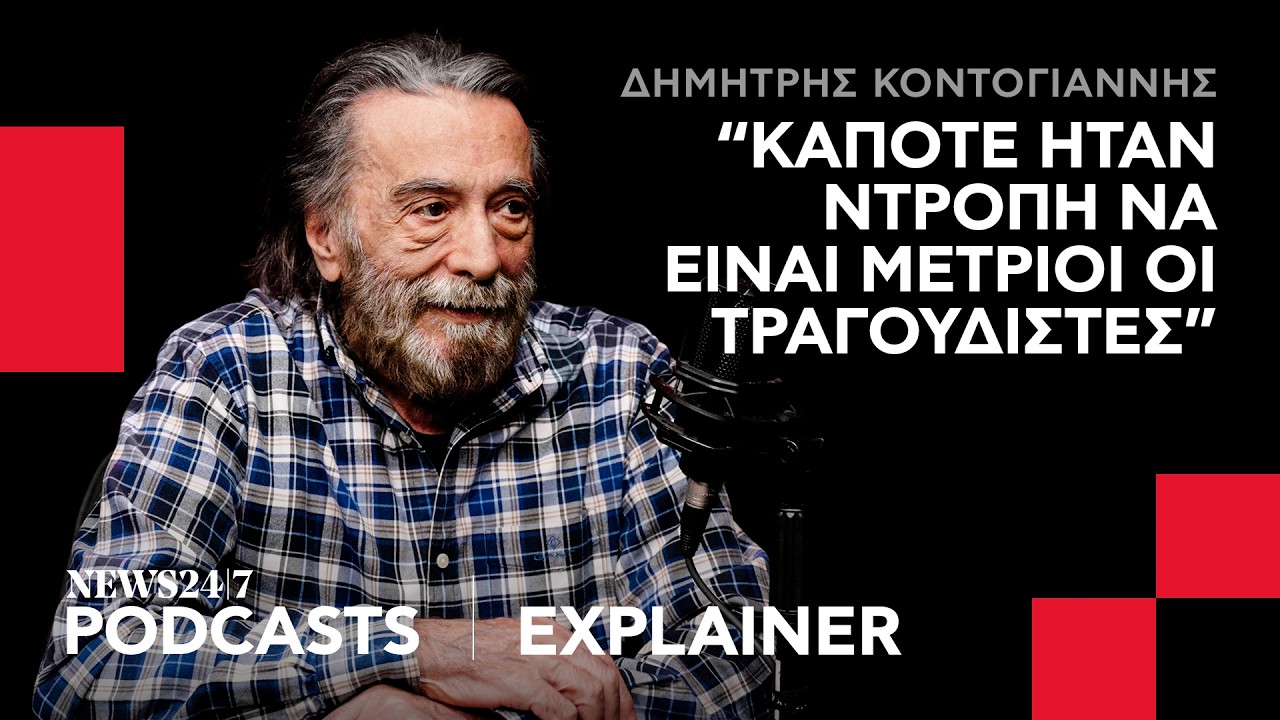
In this episode of News247’s “Explainer” podcast, hosted by Stavros Dioskouridis, the distinguished singer and musician Dimitris Kontogiannis joins the programme. Looking back over his long career in laïko and rebetiko music, he shares experiences, views on music, and stories about major figures of the Greek music scene.
Main Points of the Discussion
-
His early years and relationship with musical tradition:
-
He talks about his origins in Davleia, Boeotia, and the story of his grandfather, who was a well-known bandit chief of his time [01:14].
-
He describes Roumeli’s musical environment, with its festivals and major names in δημοτικό music, explaining how technically demanding and intricate δημοτικό music is [02:16].
-
-
Carpentry, instrument-making and apprenticeship:
-
He discusses his work as a carpenter and his construction of musical instruments [05:05].
-
He emphasises the importance of oral apprenticeship — “from journeyman to craftsman to master craftsman” — alongside older artists (Rou್ಕounas, Moschonas, Tsaousakis and Tsitsanis), which he often considers more meaningful than academic education, although he also studied the trumpet [05:39].
-
-
The Plaka era and the revival of rebetiko:
-
He describes the musical atmosphere in Plaka’s bouats, and his friendship with Vasilis Papakonstantinou, Saki Boulas and Yannis Zouganelis [09:05].
-
He explains how the historic Rebetiki Kompania was formed. The group played a leading role in the first major revival of the genre in the 1970s, drawing on songs collected from 78-rpm record collectors [11:46].
-
-
“The Revenge of Gyftia” and Manos Rasoulis:
-
He talks about meeting Manos Rasoulis and Nikos Xydakis, and how the landmark album “The Revenge of Gyftia” came together, produced by Dionysis Savvopoulos and featuring performances by Nikos Papazoglou and Kontogiannis himself [18:23].
- He comments on how Rasoulis’s unconventional lyrics radically renewed the subject matter of laïko music [20:51].
-
Memories of legends of laïko music:
-
Vasilis Tsitsanis: He praises his ability to “bring a venue to life” and create a reverent atmosphere [23:09].
-
Stelios Kazantzidis & Manolis Angelopoulos: He describes Kazantzidis as the ultimate “master craftsman” of a singer [25:06] and recounts previously untold stories from his friendship and godparent relationship with Angelopoulos [26:59].
-
-
His attitude towards the star system and the stage:
-
What it means to be a “meraklis”:
- To conclude, he defines a meraklis as someone who connects their soul deeply with their mind through music, experiencing an emotional and inner euphoria that changes their mood [39:17].