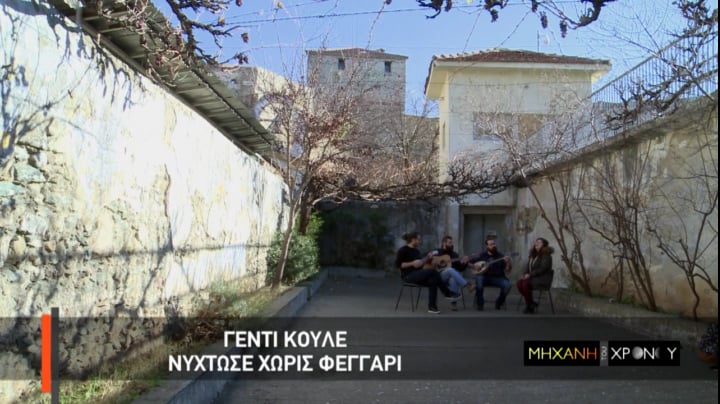
This recording features the song’s original lyrics, exactly as Apostolos Kaldaras conceived them in early 1945, while looking towards the Yedi Kule prison, where left-wingers were imprisoned during the Greek Civil War. It also incorporates musical and interpretive elements found in the song’s first recording, combined with performance and interpretive practices of the present day. It is available on all digital platforms through Fm Records and can be found here:
The recording took place at Polytropon Studio, engineered by Thanasis Kazantzis, while the editing, mixing and mastering were handled by Asteris Trakas at Fonografos Studio.
I’m giving this a heart because this incredible track, with Kaldaras’s intricate intro and its stunning lyrics, is very rarely heard.
The aesthetic of the recording (technically intact though it is) doesn’t move me, as I’m old school. But I’m genuinely glad that it’s available online, even in this form!
I agree with Ligas: I’m also glad that the original introduction is being played (not that I’m opposed to the classic shortened version; we simply shouldn’t forget the full one either), along with the original lyrics. As for the aesthetics, I agree regarding Zervoudakis’s interpretation (not rebetiko at all, purely entechno — but that’s not forbidden, especially since there is an explicit indication that it is an “arrangement”). The instrumental sections are entirely compatible with my own old-school aesthetic.
Is this “Night Fell in Genti Too” version documented? I knew the first line as everyone does, with the moon, which is, after all, also metrically more complete (or perhaps more traditional metrically, and therefore more likely).
Night fell in Gendi the darkness is deep only a young lad can’t get to sleep.
The first, second and fourth lines rhyme, while the third stands on its own and has one extra syllable after the stressed syllable. There’s nothing particularly unusual about it as a metre, but it is unusual for rebetiko. Even more unusual would be for one stanza to be like this and the rest to be different, especially with fifteen-syllable lines, which are absolutely archetypal in rebetiko (and in every kind of Greek song or poetry, for that matter).
Alternatively, we could read it as:
Night fell in Gendi the darkness is deep only a young lad can’t get to sleep
…, that is, two identical eight-syllable lines and one fifteen-syllable line, all three of which rhyme with one another. Just as unusual, exactly.
I’m not saying this to draw any conclusion. I’m simply noting it.
Regardless of official censorship, there was no way such lyrics could have been released during the Civil War, or even under the post-Civil War state. Several decades of exiles, torture and murders passed before the songs of the Occupation and the Civil War could be released freely. Likewise, „Chaidari“ (it was only just performed live before the junta), „Saltadoros“, „Ta Matsakia Pentochiliara“ (with censored lyrics), and various others. And now we’re going back again…
It is also interesting that in this case the ban was imposed (with the prefect’s approval) not by the gendarmerie as a whole, but by the commander of the Nea Ionia Gendarmerie, presumably for that particular district. What is more, he does not cite any government decree or other police regulation of general application concerning those three specific songs, but merely, “having regard to” the 1935 “Gendarmerie Organisation”, gives as grounds the songs’ “anti-Greekness” and the “concern of the armed forces and citizens”, while also generally and vaguely extending the ban to any other song “capable of causing concern or fear among the public” and, finally, threatening punishments by invoking laws from 1917 and 1946 as well as the Penal Code.
It is therefore clear that no Official Gazette entry is sufficient to establish what was banned and what was prosecuted during the post-war period, and that, quite simply, police arbitrariness reigned with the force of law — whether in the form of an “order” or even without one.
I’m trying to imagine what the whole process was like, how censorship worked, and I can’t.
Someone sits down and writes a song, with the sort of words they know would be cut. They go in and present it, thinking, “Do you reckon it’ll get through?”. But it doesn’t. As if it ever would, when the outcome was already predetermined and they knew it. They tell them, “You know, it’s being rejected because it undermines us. Change it so it doesn’t undermine us and submit it again.” The composer goes home like a gentleman, and next time comes back with harmless lyrics. And they tell them, “There, that’s more like it!”.
Er, probably yes, I’d say… I’m making the first attempt, knowing it won’t get through. But I really want us to find a way to get permission granted, for a whole range of reasons (and let’s not rule out making some money, shall we?). So I’m modifying the lyrics so they won’t have to reject it and, lo and behold: «Well, indeed!».
And when we talk about censorship and the state employees needed to enforce it, I cannot fail to mention the incident involving Savvopoulos and his well-known song about “the girls”: In one of its verses, he said
They ask their mother once a month
implying that they only got in touch with their mother when they needed advice on how to deal with problems that had just begun to appear, such as menstruation; otherwise, they had no contact whatsoever with their parents.
The censors rejected the phrase in question, suggesting “once every so often” instead, but that did not express what Savvopoulos wanted to emphasise. The poor man tried to change their minds, without success, and so at one point, disappointed, already wearing his overcoat but holding his hat in his hand, he rose from the chair he had been sitting in and prepared to leave, saying:
“What can I tell you, Mr Censor? You’re not a mother, and you can’t feel my pain!”
But why would I go and grass myself up as someone imbued with subversive ideas, at a time when I wouldn’t be able to express them publicly (and so would be incriminating myself)? Some people were careful what they said in their own homes, in case some ear at the window overheard them and grassed them up, while others went to the authorities of their own accord to grass themselves up?
I assume that, for every record release, the songs had to be submitted for approval first, right?
The facts, as I understand them, are:
-The songs have to be approved. If we don’t approve them, they’re cut or sent back to be reworked.
-We cut any songs that contain such-and-such words. (Okay, obviously not quite so bluntly.)
-And I go and show them a song that contains exactly the forbidden words!
The result isn’t simply that they’ll cut it. They’ll know that I’m not favourably disposed towards the regime—something they wouldn’t have known if I’d submitted the song from the outset in the sanitised version it was always clear to me I’d be forced to end up with.
In other words, I’m telling them: I’ll release a song exactly the way you like it, but you should know that you won’t like what I really think at all. But don’t worry, no one will hear it—only you!!.
A completely incomprehensible initiative on the composer’s part.