Μια καινούργια έκδοση που φαίνεται να είναι χορταστική (440 σελίδες) και ιδιαιτέρως ενδιαφέρουσα, μια και είναι γραμμένη από ένα μέλος της ΚΕ του ΚΚΕ, αν δεν κάνω λάθος.
Προς ανάγνωση λοιπόν
6 Likes
Λάθος δεν κάνεις.Και στο Ριζοσπάστη ήτανε και νομίζω είναι.Αν ανήκε σε άλλο κόμμα δεν θα ήταν ενδιαφέρον το βιβλίο?
1 Like
Το αν ΑΠΟΔΕΙΧΘΕΙ ενδιαφέρον ένα ρεμπετολογικό βιβλίο δεν έχει καθόλου βέβαια να κάνει με τον όποιο κομματικό εκδοτικό/συγγραφικό φορέα -αυτονόητα πράγματα!
Αυτό που ήθελα να επισημάνω είναι ότι η έκδοση αυτή φαίνεται να είναι ιδιαιτέρως ενδιαφέρουσα και μόνο από το ότι είναι γραμμένη από ένα μέλος της ΚΕ του ΚΚΕ (και Διευθυντή του «Ριζοσπάστη» καθώς φαίνεται), ακριβώς γιατί -τόσα χρόνια μετά τη συζήτηση που άνοιξε ο «Ριζοσπάστης» στα 1947 για το ρεμπέτικο- έχουμε σήμερα στη διάθεσή μας την εντελώς συγχρονισμένη και επικαιροποιημένη αριστερή αντίληψη για το ρεμπέτικο διά στόματος ενός εξέχοντος μέλους του ΚΚΕ, δημοσιοποιούμενη μέσα από τον εκδοτικό φορέα του ΚΚΕ. Σα να «κλείνει» δηλαδή ένας ιστορικός κύκλος που άνοιξε το 1947.
Από αυτόν ήδη τον λόγο καθίσταται, κατά τη γνώμη μου, ιδιαίτερα ενδιαφέρουσα η ανάγνωση του βιβλίου και όχι από το αν είναι ενδιαφέρον -εν τέλει και κατά περιεχομενική ουσία- το βιβλίο, κάτι που θα κριθεί εκ των αναγνωστικών υστέρων.
7 Likes
Do we have any information / a biography about the author?
… and very much so, indeed! But the thing is, we’re all full…
A very interesting event will take place on Sunday 10 September in Keratsini. Stefanos Loukas (author), together with Aleka Papariga and Dimitris Xekalakis, will present and discuss the book “Tracing Rebetiko” (published by Synchroni Epochi)
The event will feature musical performances by many rebetiko artists …
Grigoris Vasilas – musical direction, bouzouki, vocals
Georgios Ventouris – double bass
Panagiotis Galanis – bouzouki
Manolis Kalpakis – bouzouki
Theodoros Mermigas – vocals
Georgios Nikopoulos – guitar, vocals
Eva Xenou – vocals
Filippos Pahnistis – piano
Theodora Athanasiou – guitar, vocals
Aimilía Galiatsou – vocals
Lakis Orfanidis – bouzouki, vocals
Vivi Apostolatou – vocals
Argyris Nikolaou – guitar, vocals
Kostas Tsigonias – bouzouki, vocals
Georgios Zorbas – vocals
Giannis Lempesis – bouzouki, vocals
Noe Zafeiridis – guitar, vocals
Giannis “Vlachos” Papavasileiou – bouzouki, vocals
Alekos Arvanitis – vocals
Maria Kapetanidou – vocals
Thymios Stouraitis – bouzouki, vocals

10 Likes
I’m uploading the full video of the event for the book “Tracing Rebetiko” here, for those who couldn’t attend.

6 Likes
Let’s also include A. Papariga’s relevant speech, as published in issue 5/2023 of KOMEP:
I may come back to some points in the book concerning the Left’s approach to rebetiko.
2 Likes
When?
(and the necessary padding, which won’t add or clarify anything…)
The book contains a section entitled “The KKE and rebetiko” and refers to the period 1947–1976
2 Likes
In this section, the author advances the view that the KKE was, for obvious reasons, opposed to hashish songs, but was not opposed to rebetiko music as a whole. More specifically, as far as imprisoned and non-imprisoned communists are concerned, he claims that they sang rebetiko songs—provided they were not hashish songs.
To begin with, an informed reader will notice that the author is unaware of, and in any case does not “engage” with, key relevant studies, particularly Panagis Panagiotopoulos’s “Imprisoned Communists and Rebetiko Music: An Exercise in Freedom” (in the edited volume Rebetes and Rebetiko Music, Plethron, 1996), as well as Giannis Zaimakis’s articles “Bawdy Songs and Virtuous Politics: Ambivalence and Controversy in the Discourse of the Greek Left on Rebetiko”, History and Anthropology, 20/1 (2009), and “‘Forbidden Fruits’ and the Communist Paradise: Marxist Thinking on Greekness and Class in Rebetika”, Music and Politics, 4 (2010).
In order to substantiate his claim—as regards communists, whether imprisoned or not—the author cites two testimonies, without, however, referring to their books at all: those of Tr. Gerozisis and St. Skourtis. As for Gerozisis (A Partisan in the DSE, Synchroni Epochi, 2005), it is indeed mentioned that they sang rebetiko songs such as “Faliriotissa”, “Mother, Don’t Send Me to America”, “In the Mountains of Penteli”, “A Song from Algiers”, “The Moonless Night”, “Some Mother Is Sighing”, and “Along Life’s Paths”.
As for Stamatis Skourtis (Those Who Shamed Death, Giannikos, 1996), he does indeed mention that four men from Piraeus, on their way to execution at Corfu Prison in 1948, sang “Hail to You, Immortal Piraeus”. Stefanos Loukas then writes: “Skourtis also records other popular songs sung by the imprisoned and condemned partisans at Corfu Prison: ‘The Prisons Echo’, ‘Arab Women’, ‘The Wallet’, ‘My Double-String Bouzouki’.”
This is all the author says about the testimony from Skourtis’s book. However, when the reader opens the book, they come across testimonies on pages 308–311 that are curiously omitted by St. Loukas:
“But you see, it isn’t only the country lads; there are also the boys from Piraeus in the group. The guitar becomes a little bouzouki and the mood grows livelier. The beautiful, melodic strains rise high and then settle straight into your soul.
Two bells are ringing out
Syngrou and the shanties.
When Charon roams around
In the narrow lanes of Ahtinas.
Tell him to go to hell, boys,
And give him a kick in the backside.
These verses are by Panos. When he sang them for the first time, the applause went through the roof. But word of it reached the leadership. It was shocked in turn. Rebetiko songs were not suitable for militants. They were anti-popular, and only lumpen elements could sing them. And vulgar verses like the ones above were not suitable for the lips of people who claimed to be fighting for ideals. There was criticism of rebetiko, criticism of the improper words, and finally a lecture at midday to enlighten the militants more fully. The speaker sweated as he tried to prove that these songs were anti-popular and hostile, fabrications of the degenerate bourgeoisie, and that they reeked of hashish dens, dives, the underworld, and a whole host of other epithets.
When the hookah smokes,
You must not speak.
‘Admire the verse, the poetry, the ideas and the ideals. And until the comrades who gather and sing these sorts of vulgar and corrupt bourgeois fabrications come to their senses, we tell them that our leadership does not permit them and that they are therefore forbidden. If they nevertheless continue, the organisation will be forced to take measures to put an end to this disgrace once and for all. These few people have no right to provoke the fighting spirit of their comrades.’
“Another one is forbidden,” Alekos says, “and it’s more serious.” Lefteris, however, could not swallow it. A Piraeus lad, a sailor who had spent years away from home, in the port and at the quays, who knew and sang nothing but these songs, asked the speaker at the end of the speech: “Comrade, the sea hasn’t shaken you up, and you don’t know what it means to sit on the bow while the ocean waves beat against it. But where do you find anything tawdry or immoral in this little song:
A handful of plutocrats, a gang of fascists
Play games with our lives, with the blood of the poor.
They send us off to war like mute little lambs
So that they can grow rich and make their money.
Come on, please tell me, because I just can’t get my head around it—and I like these songs…”
“Comrade, I have explained everything I had to say in my speech. If you want further explanations, ask the leadership. If you want my personal opinion, I’ll tell you this: some of them may have beautiful words, but their music, melody and style remind you of hashish-smoking and lead you straight to the dives.”
The party ban has the force of law for the militants. The leadership knows what it is talking about; if it says so, that is how it must be. We who give our lives for higher ideals must not become vehicles for bourgeois notions of entertainment. […] Yet something is not right with the group. Some of them gave in, obeying the leadership’s announcement […] even though their hearts told them otherwise. These songs expressed them. They moved them. They could not understand a word of what was being drummed into them. They were baffled by the ban and, silently or inwardly, hummed the rebetiko rhythms. “What a beautiful song—and they don’t even like it,” old Uncle Mitsos the cobbler would say: A man’s strength is in his wallet / In today’s world, everyone knows this […]
The guitar, transformed into a bouzouki in Panos’s hands, becomes a whole orchestra, playing everything from Beethoven’s Ode to Joy to Maddalena and the laments of Batis and Tsitsanis.”
[Skourtis writes that one afternoon the cultural officer of the sector arrived, and while all kinds of songs except popular ones were being played, he could not contain himself and said]:
“‘Come on, Panagiotis, shall we not sing a Piraeus song too? Aren’t we Piraeus lads? Have you forgotten what we used to say back then?’
‘What do you want now? Shall we sing Down at the Lemon Markets so that you can summon us for self-criticism?’
‘No, lads… I didn’t come to grass on anyone. I came because I like it and I want to unwind too…’”
This is the complete testimony that the reader finds in Skourtis concerning the “reception” the “leadership” gave rebetiko. It is particularly important to stress that the speaker representing the “leadership” in the passage above does not limit himself to stigmatising the “reprehensible” lyrics, but also stigmatises the musical form…
I will also cite other testimonies from left-wing prisoners, which St. Loukas likewise fails to take into account:
Chronis Missios: “For years, those bloody bastards stuffed our heads, drumming into us that it was immoral to listen to the bouzouki and rebetiko songs in general, and even more so to sing them, because, they said, they were songs of decadence and pessimism. You’d think our lives were all optimism, and it was the music, apparently, that led the revolutionary astray from the right path […] They stuffed us full of kalamatianos, Argentine tango and saccharine chansonettes. All secretly and on the sly, with a thousand guilty feelings, we’d try to sneak in a little Tsitsanis or a little Vamvakaris…” (…And You Were Killed Young, Grammata, 1985).
Next comes the testimony of Minos Stavridis from Averoff Prison in 1949: “Amid the oppressive atmosphere of the prison […] a little laughter, a little joy, a little singing, an outburst of cheerfulness would spring up as something unavoidable and as a reaction to the profound grief caused by the unjust deaths of our comrades […] But here too the ‘wise’ leadership had a contrary line. Such manifestations were forbidden, it said, because they were unbecoming to communist militants. For example, a rebetiko song played on a little broom used as a baglamas was regarded as a capital offence” (V. Vardinogiannis and P. Aronis, Half Behind Bars, Filistor, 1996, pp. 543–544).
Next comes the testimony of P. Salapataras, about whom K. Tsakiris writes that he “could not tolerate the regime of discrimination and prohibitions imposed on the imprisoned militants by the ‘priesthood’ appointed by the KKE leadership. Salapataras played the guitar and sang, and he particularly liked rebetiko songs—especially ‘Faliriotissa’, since he was from Faliro. One evening, then, he told them, ‘I’m going to sing you a forbidden song!’ and began ‘Faliriotissa’, and they all sang it together throughout the sector. At the end he said: ‘What had that little song done to them for them to ban it? I wish the high priests of the leadership were here tonight to hear Salapataras singing “Faliriotissa” with all his comrades!’” (K. Tsakiris, Vourla: The Great Escape, Odysseas, 1994 [“Rebetiko Is Forbidden!”]).
Finally, in Th. Panagos’s book (Memories of History, Synchroni Epochi, 1986, p. 173), there is a testimony from female prisoners—of whom I would point out that they had internalised the “forbidden” use of rebetiko:
“In prison we sang, say, ‘classical’ or folk songs, but not rebetiko. In prison, it was forbidden by us ourselves. We didn’t like them. We didn’t consider them right. The words and the music were such that they encouraged pessimism and also appealed more to the instincts. In prison we gave ourselves whatever best helped us to remain standing under such conditions. Only exceptionally would we sing a rebetiko song, and then ‘unofficially’, round the back of the kitchen, just for a joke. It was ‘When You Enter the Taverna, Sit Down and Don’t Speak’, and this happened towards the end of 1955, when the prisons began to open and there was a feeling that we would soon be released.”
5 Likes
We thank Anthimos for his thorough presentation of evidence and documentation concerning the KKE’s stance towards rebetiko.
Those of us who have friends and acquaintances who belong to the KKE, and who are also somewhat older, may have our own view of just how negative their attitude was, particularly towards hashish- and tekke-related songs. Unless songs contained themes of struggle and class conflict, they were rejected outright.
Since my student days, I remember experiencing such situations.
In recent years, however, all rebetiko songs have tended to become accepted, perhaps because of the popularity they enjoy among young people, regardless of their political identity or orientation.
1 Like
Now that’s what you call a well-supported answer!
Thank you very much, Anthime.
For days now I have been standing somewhat awkwardly before this statement:
If the statement had been limited to saying that…
…I could discuss it.
And I could discuss it in a non-one-dimensional way.
That is, I could discuss it both from the standpoint of the authenticity of such subject matter, which, as such—that is, as genuine (and therefore itself also not one-dimensional)—gains recognition within the space that corresponds to it in the ‘body’ of rebetiko song…
I could also discuss it from the standpoint of the promotion of a consumer lifestyle likewise connected with this subject matter. As far as that promotion is concerned, I do not think the evidence, both from that time (that is, the era of rebetiko recordings) and from today, is insufficient. So I could discuss it critically both in relation to the negative attitude recorded in the statement (which I have no intention of disputing), and also critically in relation to the ‘categorical’ devaluation of that negative attitude.
But when the above statement is supplemented as follows…
…the matter is led towards a stereotype that is at some distance from reality.
First of all, from the standpoint of logic alone, there is a problem with the formula ‘a negative attitude towards hashish songs—if there was no class conflict, the songs were rejected’. Here, starting from a specific issue, everything is suddenly included by means of a verbal leap, and—as one might say—whatever one happens to like…
Secondly, beginning with this: my own experience from my student years (the 1980s) is quite different, speaking with certainty as far as this part of the statement is concerned—that is, the claim about ‘the outright rejection of songs that did not contain struggle and class conflict’…
…And taking my personal experience further back, I remember that during my secondary-school years (the second half of the 1970s), when I first heard rebetiko song ‘live’, I heard it at a KNE festival—where, as it happened, a schoolmate of mine was playing the baglamas in the ensemble—and even now I distinctly remember the impression made on me by Papaioannou’s ‘Before dawn, alone’. And—I ask now—to whom and for what reason should I ‘give an account’ of the fact that, at such an unsuspecting time and at a ‘central’ event, one among many rebetiko songs was performed that ‘did not contain struggle and class conflict’???
And if I am ultimately ‘giving an account’, the first and perhaps deepest motive is not political but personal. In other words, this is not about defending some political or party truth, but about defending a personal truth, the truth of my own life…
But my memory went further back, and I remembered that even earlier, before I was old enough to begin acquiring an ‘independent’ awareness of music and so on, I had heard a deep rebetiko voice singing over the loudspeakers at some KNE festivals, though I could not identify whose voice it was. To make sure now, I consulted the Hellenic Literary and Historical Archive’s newspaper archive, searched Rizospastis for the programme of the first KNE festival (September 1975), and ‘discovered’ that on the first day of the three-day event, on the festival’s one and only stage, there were, among other things, ‘songs by the artists Anna Chrysafi and Nikos Pergialis’ (I found some information about the latter here). And that Sotiria Bellou appeared on the third day of the three-day event.
I am posting the clippings ‘for the record’:
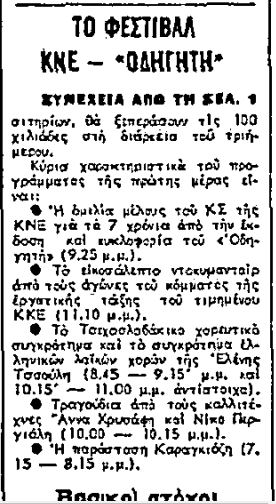
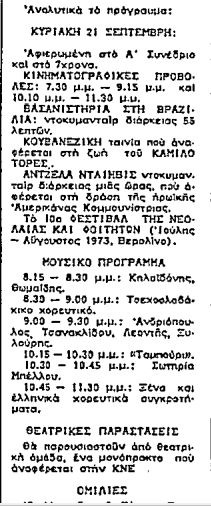
And so, at the same time, I am led to the issue raised by Stefanos Loukas’s book (which I have not yet read, at least) and by Anthimos’s quotations and references (in connection with which, about three months ago, I happened to read Gerozisis’s ‘A Rebel in the DSE’), and I am led to the issue in the following way:
If the ‘leadership’s’ approach was unequivocally the one described in the excerpts Anthimos quotes—and I have no reason to question the incidents described either—then how can it be that, the very next year, emerging from thirty years of illegality, the first KNE festival (with one stage rather than its present-day multi-part programme) devoted part of the programme to rebetiko on two of the three days?
The reading of Gerozisis’s book raises a similar question for me: there was ‘leadership’ in the prisons, but there was also ‘leadership’ in the DSE units in the mountains. In one case a particular attitude appears; in the other, it does not—and judging from the book as a whole (Gerozisis), it certainly does not seem that the author would have concealed his negative impressions, whatever their source might have been.
So I conclude that, broadly speaking, this non-univocal position that was expressed (and continued to be expressed at least up to Theodorakis’s popular orchestration of Epitaph) was the substance of the controversy expressed through the discussion of rebetiko familiar to many from the columns of Rizospastis in 1946.
That is all, and I hope I have not tired you with matters that have been much discussed in various threads on the forum—perhaps discussed to the point of repetition, but at the same time also ‘inexhaustible’.
PS If this happens to interest anyone, the following passage from the book ‘A Rebel in the DSE’ (Gerozisis) was unexpected (and moving) for me:
Katina from Kailaria—as I called her, because she used to sing a song that mentioned Kailaria—was perhaps two heads taller than me, cheerful, beautiful, with her curls, and sturdily built. (…) She carried a Bren gun, a Steyr automatic pistol, a pistol or revolver at her waist—I no longer remember which—along with a knife, a canteen, a rucksack and ammunition for all that ironwork. And on top of it all she walked lightly, as though she were completely free of any load.
She took a liking to me, and we became friends. (…)
She would put her arm around my shoulder, and we would sit there quietly singing a little song of the time that the soldiers used to sing. She changed it: where it said ‘the little soldier’, Katina made it ‘the little rebel’, and she changed ‘Athens’ to ‘Kailaria’:
The little rebel tonight once more,
is lovesick and has been drinking,
because it has been days since he received a letter,
from his girl, and he is worried.
He wants to go to his captain,
to ask him for some favour or other,
but he is afraid that he might refuse him.
His captain is a fine fellow,
he too has a heart of gold,
he knows him from Kailaria,
where they lived in the same neighbourhood.
The reason for my personal emotion is something my mother told me—also at an entirely unsuspecting time—about how distressing she found it in those years to hear this song by Mitsakis, given that one of her brothers had been executed and three other brothers were in prison. (I add ‘distressing’ here as an addition, to convey the gap between the little soldier’s sung lament and her own pain, which she had to suppress at every hour and every moment.)
But beyond the personal, I think there is also something more general in this function of popular song and in the way it is altered so as to express the same desires under—at first sight—‘diametrically’ opposed circumstances.
2 Likes
The excerpts cited by Anthimos refer to inmates—prisoners. The conditions we are talking about are not something simple. „Security“ is something essential and necessary, especially for people who faced death every day.
Associating with criminals created the need for „compartmentalisation“, for reasons of secrecy and survival.
The use of criminal prisoners by the security services—the prison administration—and the role they played are well known.
And let us remember the tekke (τεκές) on Gyaros, where the torturers played rebetiko songs, smoked hashish and then tortured the prisoners.
Anthimos takes a very particular situation and elevates it into a general rule. This is not true. There was no single „line“, something that, according to his logic, would prove the KKE’s hostile attitude towards rebetiko. There are corresponding accounts of exactly the opposite happening.
As Agis also says, the facts show that there was no uniform approach. Everything depended on the circumstances prevailing at the time.
However, I would also like to dwell on something else.
If the song with the lyrics described in the excerpt had survived:
„A handful of plutocrats, a gang of fascists
They toy with our lives, with the blood of the poor.
They send us off to war like mute little lambs
So that they can grow rich and make money.
Would it be rebetiko or not?
Please show me where in my writings I did anything like that.
All I did was cite the studies and testimonies that the author of the book under discussion ignored/left out.
Certainly, everything depended on the circumstances that existed each time, but the “subjective factor” also influences how each set of specific circumstances is dealt with.
And it is true that the lives and coexistence of political prisoners in prison, under the conditions we are referring to, necessarily came under “condensed” disciplinary rules, but that in itself does not answer questions about whether the handling of each specific incident or situation more broadly was correct, or whether, in one approach or another, only objective necessity counted, or subjective views as well, and so on.
Indeed, I think that within the necessarily “restrictive” framework of the rules governing coexistence, the various subjective views could exert a strong influence, and perhaps this is one of the reasons why accounts of certain events reflect that intensity, whereas “outside”, those same subjective views (and the differences between them) could be confined to the context of an ideological confrontation. Inside prison, however, the various views are transformed (sometimes necessarily and sometimes not— in my opinion, there is no general answer to this) into answers to the questions of what we do and do not do, how we behave and do not behave, and this makes things more difficult.
Would you perhaps like to “expand” a little on the meaning of the question? In my view, yes, it could “be rebetiko”, but perhaps the meaning of the answer lies in the meaning of the question.
First of all, Anthime, you’re right, and I shouldn’t have attributed that particular interpretation to you. I had just read Stefanos Loukas’s critique of Vlisidis and Kounadis, which I’ll post in future posts. In a way, you got caught in the crossfire.
What I wanted to focus on in your post is the following expression:
What you write raises questions. What does „περιέργως“ mean? What exactly are you attributing as the author’s intention? To gloss over a situation? To ignore something because it doesn’t suit him? Very often, the way something is written leaves room for insinuations, and that is how I understood your sentence above. Unless you expected Stefanos Loukas to respond to everything that has been written about the KKE and rebetiko, and he disappointed you.
Agi, the question was rhetorical, in a way. I remembered the discussion about „Bezentakos“ and the objection as to whether such a song belongs on the rebetiko forum.
In my view, the lyrics above could quite well be a rebetiko song—and, more specifically, a prison song.
Regarding this observation, I feel that it imposes an external view of things.
In other words, it is by no means «absolute» that there was a «prohibition» which the imprisoned women had «internalised», and that—on the contrary—it was not to a very large extent a pre-existing internal attitude that was being expressed in the form of «a prohibition imposed by us ourselves», as the source puts it.
I will once again invoke—although I do not feel entirely «comfortable» doing so—the testimony of my mother, who (I may have mentioned this in another thread) came to Athens at the age of sixteen from the mountainous regions of Roumeli, with the folk tradition and ancestral customs of her homeland in her soul.
Things which, to put it that way, were incompatible with the «fine, spirited woman» whom her fellow factory workers at Peiraiki-Patraiki would sing about right alongside her the very next «moment» («shhh» when a supervisor appeared, and the singing would stop), and it took a fair amount of «exposure» for rebetiko and popular song to stop triggering negative internal reactions in her…
Let me extend this to an opposite aspect as well: During the same period, around 1950, that same woman—or rather, girl at the time—would finish evening school, and one of her fellow students, an Athenian, would accompany her: handsome, polite, well-educated, and perhaps showing some interest in her, though he did not yet know where she came from…
When they reached the bus depots, they found themselves confronted with a scene in which the «ticket collectors» and drivers had put together an impromptu «concert» of folk songs.
And at the very moment when this was balm to my mother’s soul, her Athenian companion chose to make a joke and mock the «Vlachs who have filled Athens».
Her attraction to him vanished instantly…
I do not know how these things «read» to a third party, but to me their significance lies in the fact that so many diverse and multifaceted factors come together in the entire ideological dispute surrounding rebetiko and popular song that any perspective interpreting it in narrowly political terms is very limited.
The customs and culture of the countryside versus the customs and culture of the city; the customs and culture of the urban middle classes versus corresponding working-class and proletarian customs and culture; the interaction between working-class ideas and those of the educated intelligentsia—all these things (along with still others) merge within the political organisation of the workers’ movement as «secondary» differences compared with the «main» shared objective, and an entire process is required in order to overcome them.
Anything else would probably be unnatural. So each person (and I am also referring to the sources that have been cited) personally decides whether they would prefer to become involved in this process «to the end», or whether, at the «first» (or second, or twentieth) similar conflict and confrontation, they would «declare their position» and remain on «their own» side.
This too is a difficult and multifaceted issue that allows no simplifications, but it also—as the complex issue that it is—has a certain significance both for the subjective stance people take towards their experiences, which constitute a «source» for us, and for our interpretation of those sources.
I hope I am making myself clear: I am neither ignoring nor bypassing them. And this is not an opinion on St. Loukas’s book. To have an opinion on it, I would have had to read it. So I am simply discussing the issues that were raised, and the way they were raised, through the quotation of these accounts.
1 Like
As I said in message #17, I’m posting here the book’s references to Kounadis and Vlisidis regarding their attitude towards the KKE.
However, I should apologise, because although I initially intended to transcribe them, due to various circumstances I simply took photographs of the pages instead.
Let’s start with Kounadis.

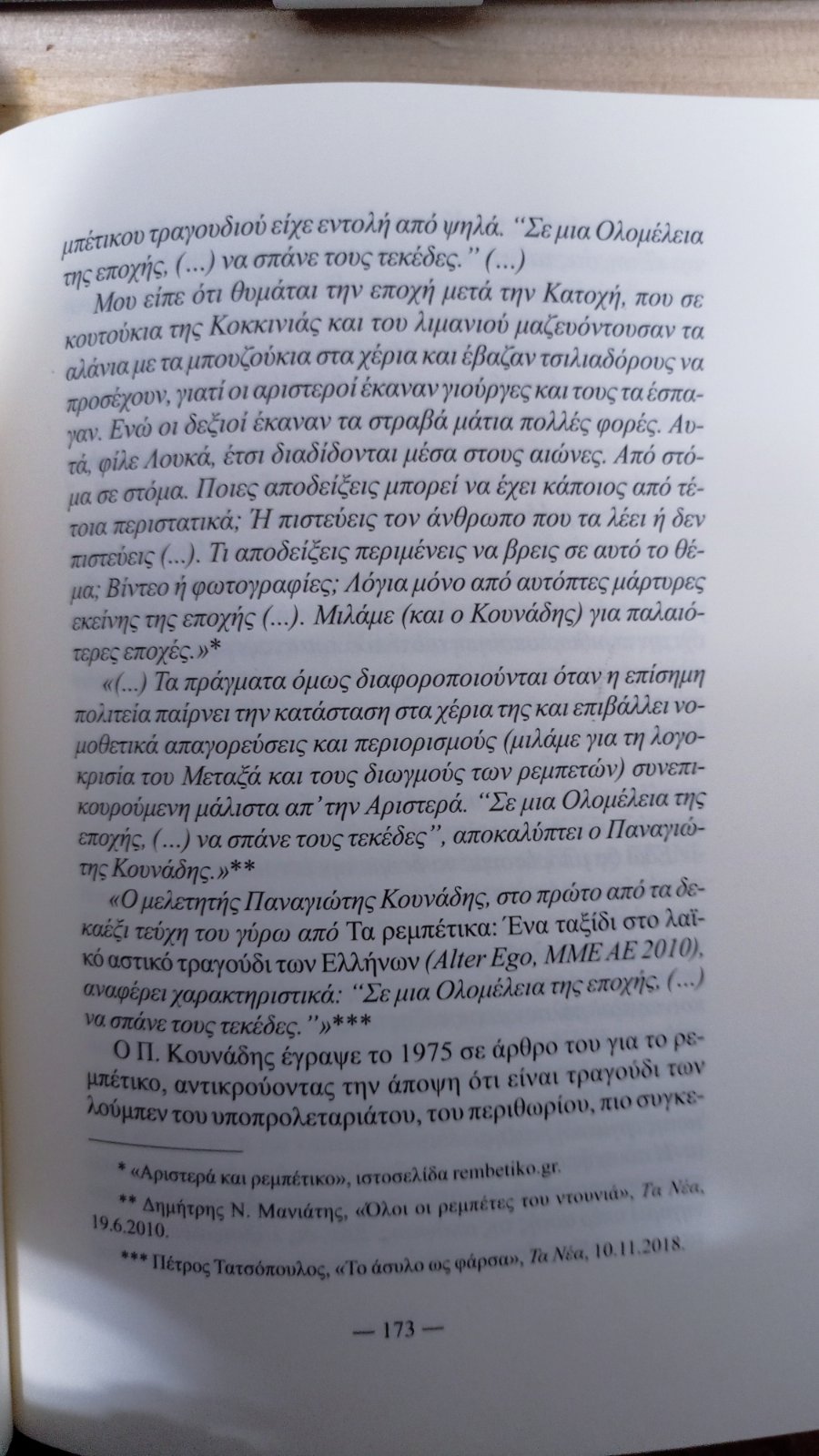

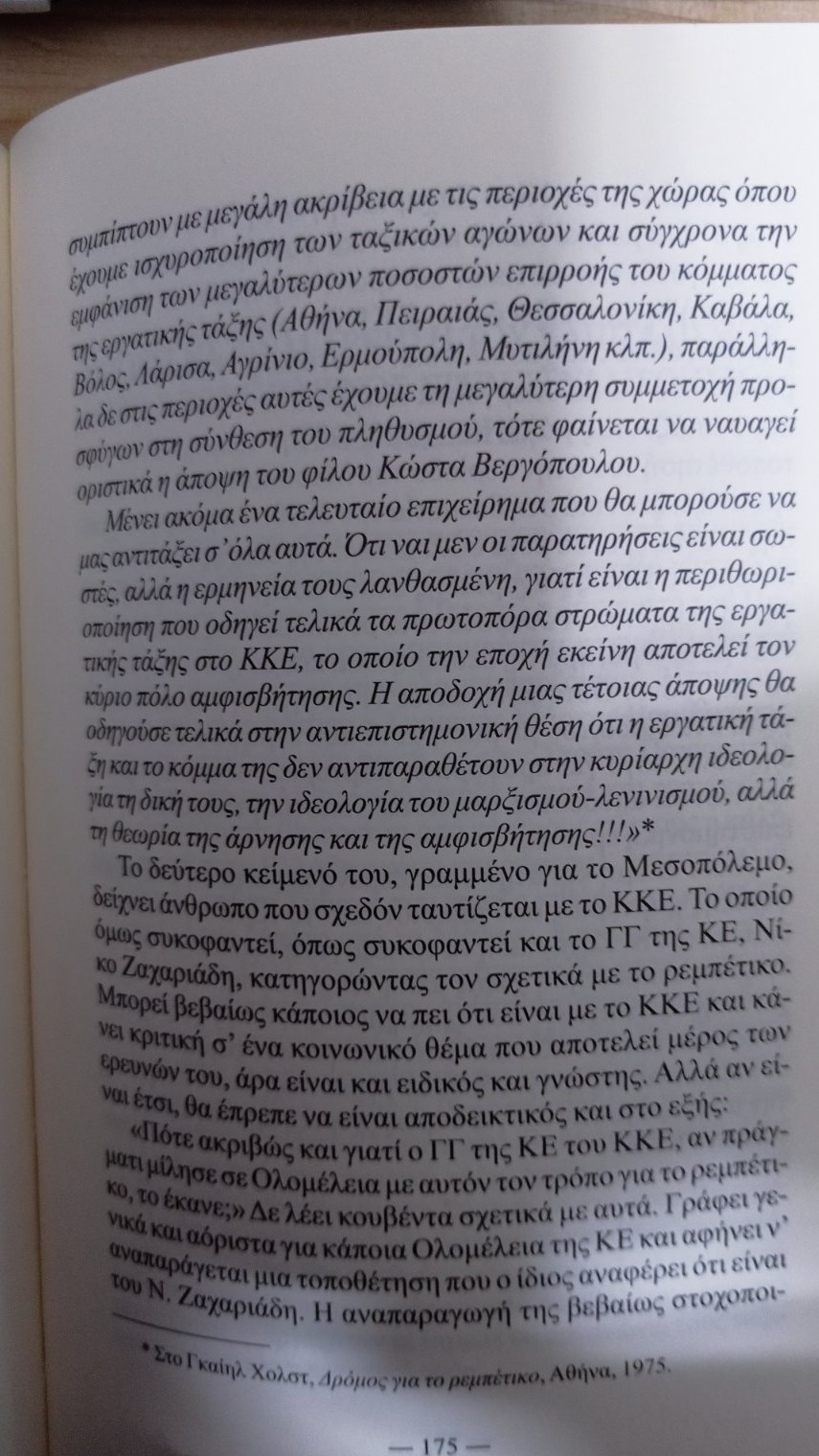
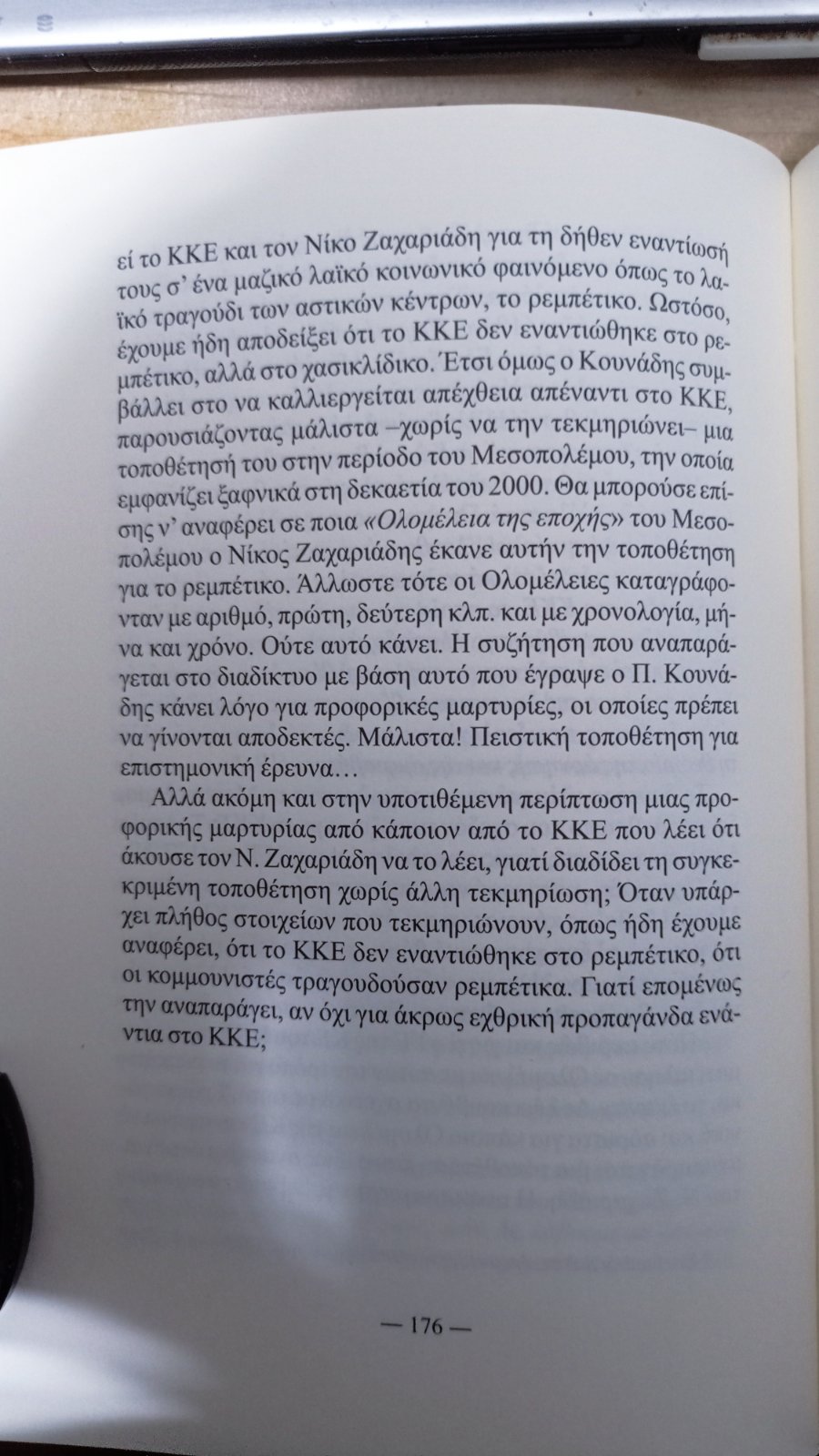
1 Like