My Vasiló, your pistols?!
I wouldn’t have imagined that, before Protopsalti’s relatively satirical “Malamó, with your fury / fire your pistols”, from the ’80s, I suppose, there had already been another similar one so long ago!
My Vasiló, your pistols?!
I wouldn’t have imagined that, before Protopsalti’s relatively satirical “Malamó, with your fury / fire your pistols”, from the ’80s, I suppose, there had already been another similar one so long ago!
But doesn’t Papadiamantis mention it as well?
In any case, a record bearing the song title “Βασίλω μ’ τα κουμπούρια σου (Καλαματιανός)” was released by The Gramophone Co. in 1909.
And an authentic traditional folk song (i.e. “bearing Simon Karas’s stamp”, Kymi-style) here:
https://www.discogs.com/release/23277566-Various-Από-Το-Αρχείο-Του-Simon-Karas-Κουμιώτικα-τραγούδια?srsltid=AfmBOoqqrRNsE5TSJ3nnUXF_lKXsZRuXLcc8qJ3G8LVljqG4dQORimz4
Quite interesting!
Hmm, I don’t know… In any case, while Karas was alive, he only gave his seal of authenticity to whatever was released. Of the countless unreleased recordings, we don’t know which ones he would not have approved and which ones he simply didn’t live long enough to release.
I have this record. Not here, but I do have the songs here as MP3s. They are re-recordings by the SDEM orchestra-choir, made after Karas’s death and based on his own unreleased recordings (audio? written? The liner notes will clarify that, but I can’t remember offhand). The whole record has a strong urban character, and this is also pointed out and explained in the notes, based on the history and cultural identity of the Kymi area (= northern Karystia, very different from the “wild” southern Karystia, the Kavontoros. Karystia as a whole, north and south, makes up southern Euboea).
An exact re-recording of the record’s re-recording, here:
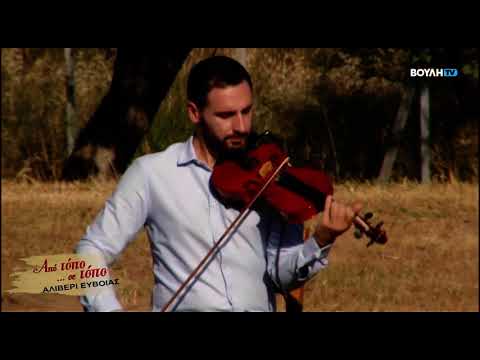
In other words, it is a variation on the syrtos “Sit still, schoolmistress”.

I only learnt about this particular recording of “The Schoolmistress” very recently; I posted it in “What song are we listening to now?” and commented that, if we focus only on the melody and ignore where the syllables of the lyrics fall, it resembles “Who, my darling, who?”, which we all know as a Parios song, of course, but which existed previously as an island song. In fact, I think @koutroufi once shared a recording of the pre-Parios version of the song with us.
(For the rest, I knew “The Schoolmistress” from a Chian recording by S. Karas—again!—which is clearly the same song, but I had never thought that it sounded like “Who, my darling, who?”, just as Vasilō with her pistols doesn’t sound like it either.)
Oh!
And here’s a teacher with guns: Stasinopoulos, 1928!

The song, certainly involving a teacher—but why not Vasiló as well—also includes a verse which Stasinopoulos hints at without saying it outright, although it is written incorrectly in the video:
Teacher, who cut your alatzas so narrow
that my hands can’t fit around your tits?
(alatzas = a type of fabric. I assume that, by synecdoche, it would also refer to a garment.)
Therefore, to return to the point, it is hardly surprising that the Karditsa newspaper writer #589 rails against the ‘mewlers’ and the ‘wine-daddies’ with their songs.
We can see that in America, where the classic small 10-inch 78s (= approximately three and a half minutes of music) coexisted with the 12-inch ones (= almost five minutes), the former cost $1 and the latter $1.25. Very logical, of course, but since I had never happened upon this information, I had never thought about it either.
Isn’t it amazing, today, that people paid a little more for a song that was slightly longer?
Oh, come on, Pericles, my dear—what could be more logical? The more you listen, the more you pay, and vice versa. There was a time when, in order to listen (on a gramophone, either your own or the gramophone man’s), you had to pay. There was no radio. And shellac cost so much per kilo.
Well, that’s why I say “today”. The last time songs were sold on a physical medium—CDs, or LPs before that—extra playing time wasn’t charged for.
By 1925 standards, that’s perfectly understandable, of course. What’s remarkable, though, is how different these figures are not only from today’s, but also from those of the relatively recent past.
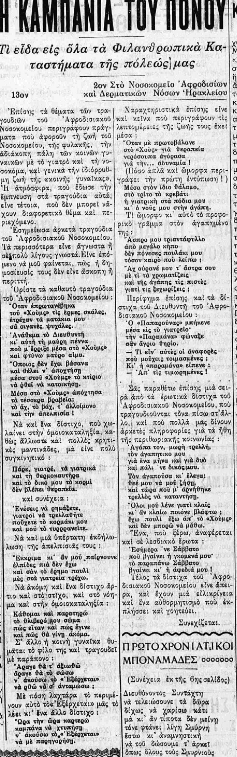
Interesting collection of songs that were played at the Venereal Diseases Hospital of Heraklion, Crete, in 1935 (DRASIS 1/1/1935)
The well-known poem by Kostas Varnalis, “The Fated Ones”, in a different format, newspaper Empros (27.9.1928).
Εμπρός 27.9.1928 Οι μοιραίοι Βάρναλη.pdf (533.7 KB)
Kálmán’s Bayadere, in the karsilamas rhythm
Empros, 1 October 1923 Bayadere.pdf (614.4 KB)
, from 1923. (Empros, 1 October 1923)
Philomousa: interesting material on the Athenian night of 1922, and right beside it an interesting text by Faltaits, which also contains
Εμπρός 21.7.1922 Φιλόμουσα.pdf (449.3 KB)
a critique of the authenticity of the unattributed songs. (ΕΜΠΡΟΣ 21.7.1922)
Captive Zeybeks from Smyrna, used to build Parnithos Road, 1919.
Εμπρός 17.11.1919 Ζειμπέκοι.pdf (521.3 KB)
Now, of course, how you’ll manage to dance the foxtrot with the barrel organ playing in karsilamas rhythm is another matter, however elegant a couple you may be…
In any case, I’ve heard seven-beat (~kalamatianos) tangos from the period when tango was fashionable in Greece, and they really were tangos! It’s a bit difficult to imagine it from a description, and I don’t remember any specific songs to link to, but to the ear it not only sounds completely smooth, you might not even notice that it’s in seven beats.
Could this be the well-known Parnithos Street that runs from Kypseli to Patisia via Galatsi?
It probably refers to the road that climbs up the mountain, which originally ended at the refuge. They’re talking about construction, not improvements, resurfacing and so on.
But here he’s talking about karsilamas, a nine-beat rhythm…
And generally speaking, I find it rather far-fetched to record an album of kalamatianos or karsilamas, sell it so that someone can buy it to dance the tango to, and expect the album to be bought and used…
I don’t know about the karsilamas, let alone this particular one. I simply wanted to point out that a musical metre that we have always associated with a particular rhythm and dance can, under certain conditions, fit perfectly smoothly with another rhythm and dance, in a way that you wouldn’t imagine if you hadn’t seen (= heard) it. I certainly don’t mean that this can be done with just any unrelated rhythms and dances. Sometimes, though, it works.