I recently heard this song from Samos and really liked it! I’m posting here an on-location recording by ERT from 1986, featuring just two female voices, which may not be so well known.
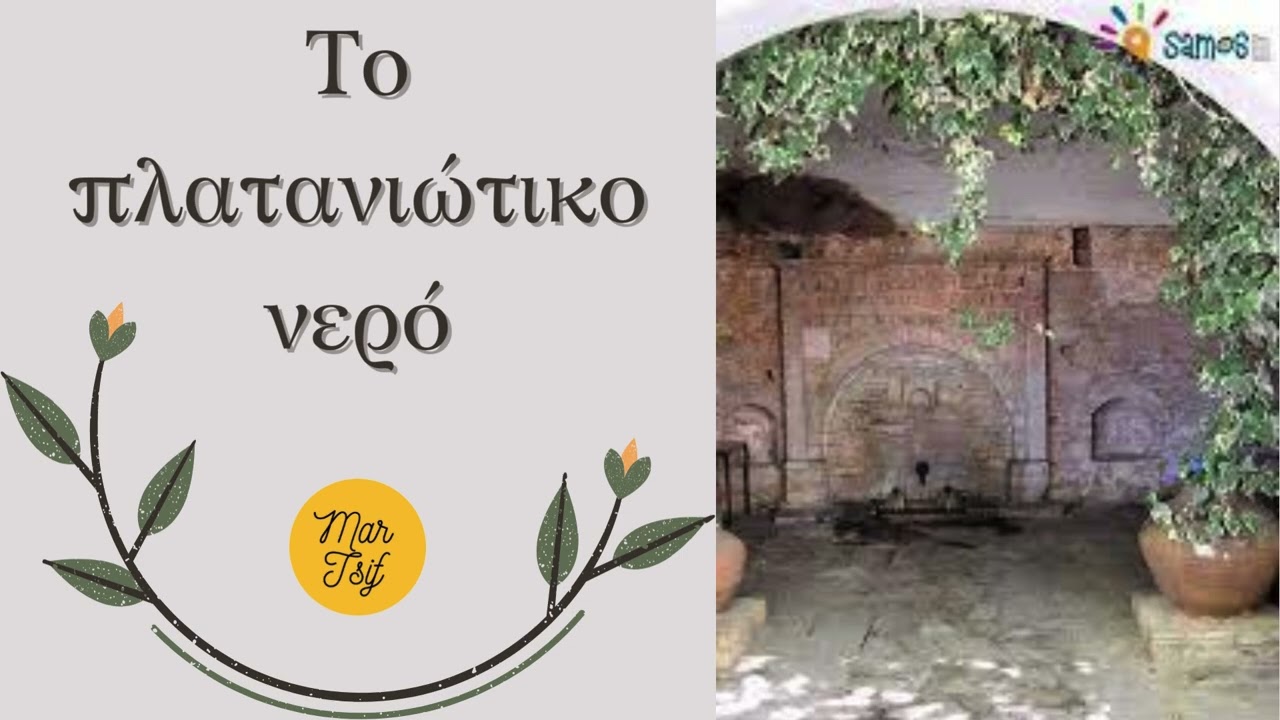
I recently heard this song from Samos and really liked it! I’m posting here an on-location recording by ERT from 1986, featuring just two female voices, which may not be so well known.
Kosta, what a great find! A field recording featuring just two female voices has something wonderfully warm about it, and recordings like these rarely reach us. Do you know which village the singers were from, or which ERT programme it came from?
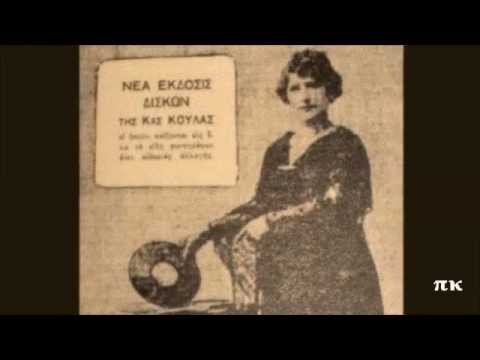
The song also appears on 78 rpm records. The thread about the release “Samos on 78 rpm” has the complete list: it includes “To plataniotiko nero” performed by Giota Lydia (1956), as well as a “Samiotikos syrtos, ‘Plataniotikos’” performed by Mrs Koula (c. 1919). Could it be the same melody?
No.
Mrs Koula’s Samian Syrtos is a rare curiosity. It is a tune in 10/4 time, unlike anything known today from Samos or anywhere else. The melody has a few rather coincidentally similar passages (because they use the same modal path) to the well-known Platanιώtiko Water, as the two ladies sing it around here and as it is generally known in Samos and throughout Greece. In Mrs Koula’s version, the lyrics belong to the same stock of couplets from which the newer, contemporary performances of Platanιώtiko Water also draw.
Therefore, to an unsuspecting ear it may sound as though Mrs Koula is also singing the familiar Platanιώtiko Water, only „a little differently“, but in reality she is singing something else.
It is not known what dance this 10-beat „Samian Syrtos“ is, and, if I remember correctly, the book accompanying the edition „Samos on 78s“ contains an extensive note on this mystery.
Or perhaps 10/8?
It’s the “10” that matters; it characterises the entire piece, while the /4 or /8 is secondary. In any case, I’d be very interested to see how this ten-beat “syrtos” is danced. Can anyone find a relevant video?
See above:
twenty distinctive characters
resource-intensive search…
… For a comprehensive musical and dance analysis of the ten-beat syrtos/rhythm (10/8 or 10/16), the approach should focus on the way the time is “broken up” (subdivided) into long and short beats, as well as how the movement of the feet expresses these particularities.
In Greek traditional music, the ten-beat rhythm belongs to mixed or heterogeneous metres (such as 7/8 or 9/8).
1. Musical Analysis: The two basic forms of subdivision
In your analysis, you can distinguish between the examples based on the internal structure of the ten quavers:
A. The 3 + 2 + 2 + 3 structure (the iconic “Plataniotikos”)
B. The 3 + 3 + 2 + 2 structure (the Epirote and entechno rhythms)
2. Dance Analysis: The relationship between rhythm and movement
In a dance analysis, the focus is on how the body responds to the asymmetrical beats.
3. Comparison Table for Your Analysis
You can use this structure to show the differences between the two versions in your paper:
| Feature | Type A (Cretan/Plataniotikos) | Type B (Epirote / Entechno) |
|---|---|---|
| Time signature | 10/8 or 10/16 | 10/8 or 10/16 |
| Subdivision | 3 + 2 + 2 + 3 | 3 + 3 + 2 + 2 |
| Sense of movement | Circular suspension (beginning and ending with a long beat) | Forward-weighted (two long beats at the beginning, quick close) |
| Representative piece | “Nero apo tin apoikia” | “Palio Zagorisio” / “Aspra karavia” |
Somewhat extensive, yes, but it doesn’t shed any light on the mystery…
Well yes, of course. Things are very clear: we know for certain that this is an unknown, lost dance about which no information has yet come to light. The only clue is this particular recording, together with its title. We are not expecting an answer that we have somehow overlooked.
The book accompanying the release “Samos in 78 Revolutions” mentions that this ten-beat rhythmic structure of the Plataniótikos with Ms Koula “is indeed rare in the Greek folk repertoire, but is often found in compositions of Ottoman art music”.
It is therefore a borrowing which, it seems, was not incorporated into the local tradition. The way in which this Plataniótikos syrtos was danced — the one referred to in the sources — has now died out, and only the occasional local dance group attempts to recreate it at events.
Does the book say that?
The one thing we can be sure of is that it did not survive to the present day, nor to the lifetime of anyone who could tell us about it. That does not mean it was never incorporated, though; after all, we do not know how old it is. It may have been danced for 100–200 years, but by Mrs Koula’s time it may have been in its final years before being abandoned—you never know.
In any case, let’s point out that the ten-beat metre here is 3-2-2-3, and that semai, a learned Constantinopolitan form, has the same metric structure, but nevertheless this sounds nothing like semai, just as a waltz does not sound like a tsamiko, even though both are in 3/4 time. Tzourtzouna also uses 3-2-2-3—it is a folk dance from somewhere in what was then the Ottoman Empire, I can’t remember where, perhaps Armenian?—and it may occasionally have been used as a loan in learned Constantinopolitan music too, but again it sounds nothing like it. It is not just a matter of the numbers we can use to represent the metre; it is also a matter of how the melodic phrases are articulated. Well, they are articulated differently here, differently in semai, and differently again in tzourtzouna.
In another video featuring the same recording, I read something in the description that may have been lifted from the book. If anyone has it to hand, please confirm:
This recording is of exceptional interest, since none of the Samians to whom it was played recognised anything in its melody or rhythmic structure. As it appears, the steps of the Plataniótikos as it is performed today cannot fit its rhythm. We should note that the Plataniótikos, being a dance in decline, forms part of the current repertoire of dance groups, and through being taught by these groups it is being reintroduced into the island’s festivals. It is danced,
apparently because of its lyricsto the tune of Plataniótiko Neró, which is an ordinary syrtos, and can of course be danced as such. However, according to information available, the dance seminars of the last twenty years contributed to the revival of the Plataniótikos, with the interventionist adaptations that the logic of reconstruction usually imposes.
Let’s pay attention to exactly what it says, because it may not be clear to everyone:
α – This recording meant nothing to any Samian.
β – There is a dance known today as the “Plataniótikos”, but it cannot fit the rhythm of this recording. Therefore, this recording was not danced in the same way as the Plataniótikos is today.
γ – The Plataniótikos known today is in decline, meaning (if I understand correctly) that it has stopped being danced at actual festivities. It is kept alive by the dance groups, and through them it has started to make its way back into live practice to a limited extent—but only secondarily, as a revival.
δ – When they dance the Plataniótikos, they use Plataniótiko Neró as the music (the tune the two women sing in the video in the opening post). Musically, Plataniótiko Neró is an ordinary syrtos. Therefore, it can also be danced as an ordinary syrtos (something I can confirm happens), rather than only as the elaborate Plataniótikos dance, which has practically disappeared from live practice. Indeed, there is an implicit question as to whether Plataniótiko Neró (the tune) was actually the original music for the Plataniótikos dance, since the writer says that it is “obviously” chosen “because of its lyrics” (therefore not because we already knew that this tune fitted this dance).
ε – Finally, some reservations are expressed about the authenticity of the Plataniótikos performed by the dance groups. But it makes no difference, because the Plataniótikos performed by the dance groups—whether accurate or altered—was certainly not the dance for the ten-beat tune mentioned by Mrs Koula.
Thank you very much, Christos! I completely agree with everything you say! Unfortunately, I don’t know either the women’s village or the ERT programme for which the recording was made. I happened to find it while looking for recordings of this particular song, since when I started the thread I heard this song for the first time, performed by Eirini Konitopoulou, and liked it very much.
I’d also like to thank you very much for mentioning Ms Koula’s recording, as well as everyone who replied with all these details, since I had never heard it before.
Indeed, as Periklis says, and as anyone can easily establish, Ms Koula’s Plataniótiko Neró and Plataniótikos Syrtós are different songs in terms of melody and rhythm. So how this ten-beat version came about remains a mystery. Personally, I think that, despite having different melodies and rhythms, the two songs are related. And by „related“, I mean that they are based on a common original song. The ending of the melody in the verses is the same, and the lyrics are shared too. Of course, you might say that there are many cases of traditional songs with the same lyrics but different melodies. But here we have the same mode and exactly the same melodic ending at the end of the verses. Could that have happened by chance?
Song: Pagonyo K. Christou,
Eleni I. Menega, Despoina Morou
Recording: ERT/External crew – Kostas Balabanis, Tasos Toumpekis. Field recording 29.7.1986
Research – material collection: Fevronia Revynthi
Technical supervision: Stamatia Soulti
From the ERT archive/Unreleased recordings
The presence of Febronia Revynthi, always a guarantee of quality!
I think that in the case of Samos, the village is not all that important. Although it is a large island, with many villages and rugged terrain (= some difficult transport links), and despite its well-known population drawn from all over (characteristic village names: Mytilinioi, Arvanites, Pyrgos [Ilia]), it nevertheless has no major internal differences.
If somewhere we read “field recording in Rhodes”, without the village, it would be incomplete information. Not so for Samos.
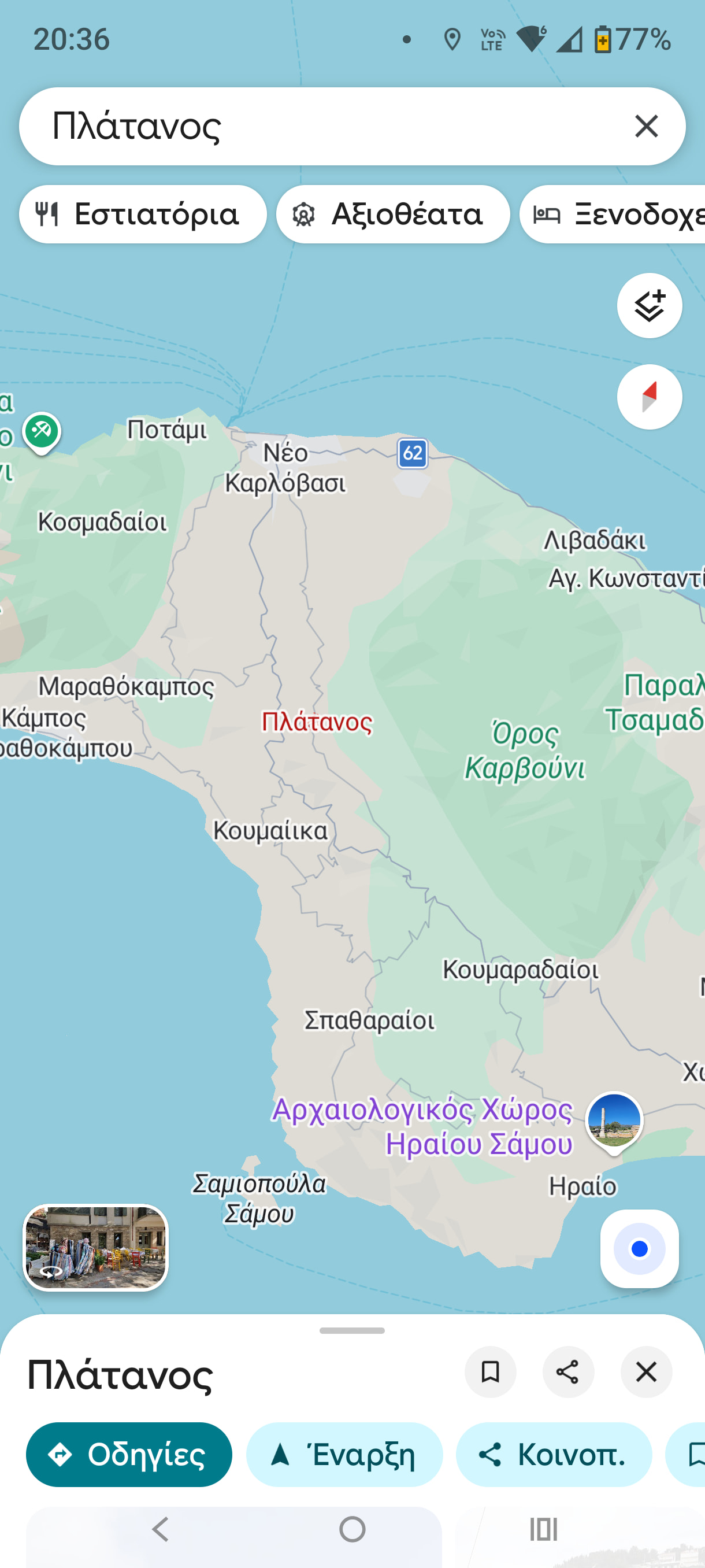
Oh, come on… The existence of a 17th-century fountain merely shows that there is water there (if there weren’t, they wouldn’t have established a village there). And the song shows that the people of Platanos love their village and think of it while living abroad.
Besides, I’ve heard that the song refers to a fountain by a plane tree in another village, not to the village of Platanos — I can’t remember any more details…