Καλησπέρα, να ρωτήσω κάτι όχι και τοσο σχετικό με το φορουμ αλλα΄ενδέχεται να ξέρετε να μου απαντήσετε.
Εκανα μια μικρή έρευνα για μια gibson es335 (όχι για προσωπική χρήση) και βλέπω πολλά μοντέλα της εταιρείας αυτής ίδια με αυτά της Epiphone και σε ονομα και σε εμφάνιση (από ποιότητα οργάνων και ήχο δεν μπορώ να κρίνω) (πολλά ονομάζονται παραλληλα gibson epiphone)
εδώ και δεκαετίες η epiphone απλά βγάζει τα μοντέλα της gibson σε φτηνή έκδοση, όπως αντίστοιχα η fender έχει την squier. πάντως διατηρούν μια ποιότητα για τα λεφτά τους.
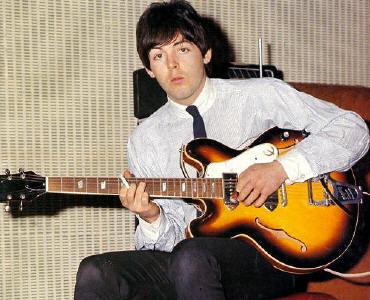
I hadn’t taken any of the above into consideration. (Nor could I have: I’ve never been involved with guitar companies.) I discovered all this in astonishment when I came across a reference to Paul McCartney’s Epiphone Casino guitar, and, remembering that Epiphone was a renamed version of House of Stathopoulo, I googled it to find out what was going on.
Based on the English Wikipedia articles Epiphone and Epiphone Casino, I found a summary of the History of Globalisation! Specifically:
In 1873, Anastasios Stathopoulo opened a workshop? small factory? for musical instruments in Smyrna, making mainly ouds, lutes and fiddles (violins? lyres?).
In 1903, he moved to New York and added mandolins to his catalogue.
He died in 1915, and was succeeded by his son Epaminondas, Epi to his American friends.
In 1917, Epi named the company House of Stathopoulo (If I understood correctly, it didn’t have a specific name before then.).
They also began making banjos. In 1928, Epi renamed it Epiphone, after himself. More precisely, Epiphone Banjo Company.
In the 1930s, they entered the guitar market, and soon began competing with Gibson.
Epi died in 1943, and was succeeded by his brothers Orphie and Frixos.
In 1951, the company moved from New York to Philadelphia. Those employees who did not want or were unable to follow set up the Guild Guitar Company under Epiphone’s former vice-president.
In 1957, if I understood correctly, it was bought and became a subsidiary of CMI, which also had Gibson as a subsidiary. (In 1957 the company was acquired by Gibson parent company CMI.) After that I lose track of things somewhat, but Epiphone continues to exist as a subsidiary of Gibson. It produces some Gibson models and some of its own.
From the 1970s onwards, Epiphone put its brand on cheap guitars manufactured in Japan, later Korea, and, from 1997, China and Indonesia.
The Epiphone Casino is an electro-acoustic hollow-body guitar, first produced by Epiphone in 1961, when it was already a Gibson subsidiary. It is popular among a host of rock guitarists. In the special section on its use by the Beatles in the Wikipedia article, we learn that McCartney got a ’62 Casino model in ’64, while Lennon and Harrison followed him in ’65 by buying the ’65 model—two identical ones, as far as I understood. This was the period when the Beatles began moving away from live performances and exploring the possibilities of the studio in greater depth.
However, in ’68 the latter two sanded down their guitars, while in early ’70 Lennon changed the tuning pegs (I swear!!!). Paul has kept his as it came from the factory, and still plays it from time to time.
I think we should also go onto the wiki and write what we know. Let’s not expect everything from other people. I went onto Maneta (Μανέτα) and corrected something about the eight-string bouzouki.
Yes, it is open. But quite often I’ve opened an article’s “discussion” page, only to find so much being said about Wikipedia’s rules and principles that it becomes a bit off-putting. They seem to be numerous, complicated and not self-evident. You have to go in there with your own personal constitutional lawyer…
You may well write whatever you like, but there need to be references; otherwise, the next person can delete whatever they like. And the English-language wiki has its problems, especially with contentious/controversial topics.
So, for example, information about the eight-string bouzouki that someone might know simply because they’ve played it all their life (and which other players would recognise as correct) can’t be included without a citation?