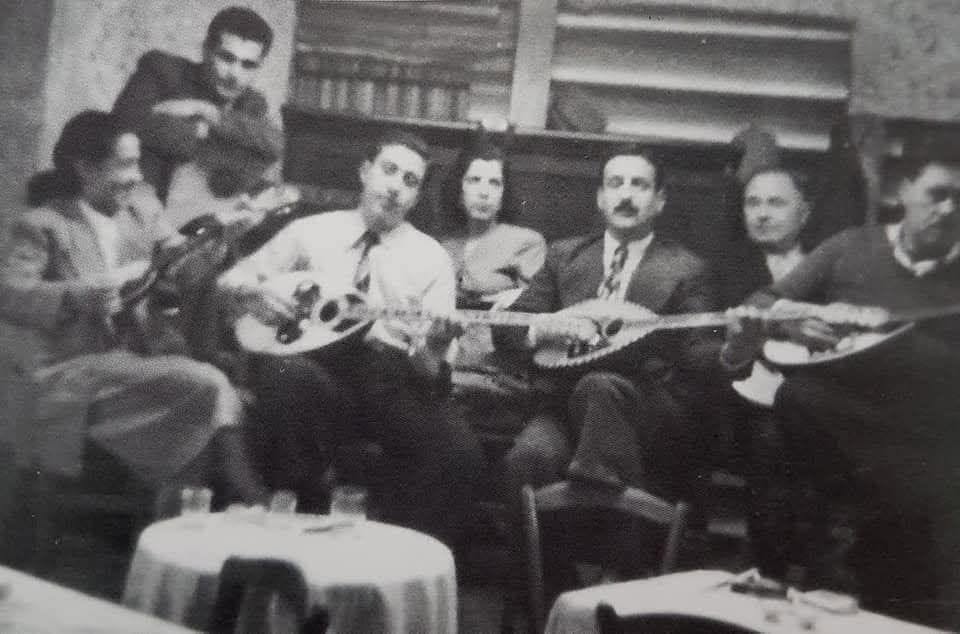
“From left to right, pictured are: Sotiria Bellou, Michalis Matthaiou (from the Trio Bekanto), Argyris Vamvakaris, Lili Nikolesko (in the back, at the piano), Skoularikis (with the bouzouki in the middle), Kostas Karipis (in the back, with the guitar), and Markos, at Panagakis’s taverna, in 1949.”
Personally, I consider Karipis the best guitarist of his era. He has a clean, staccato style of playing and plays only what is absolutely necessary. Without, of course, underestimating the other giants of the period.
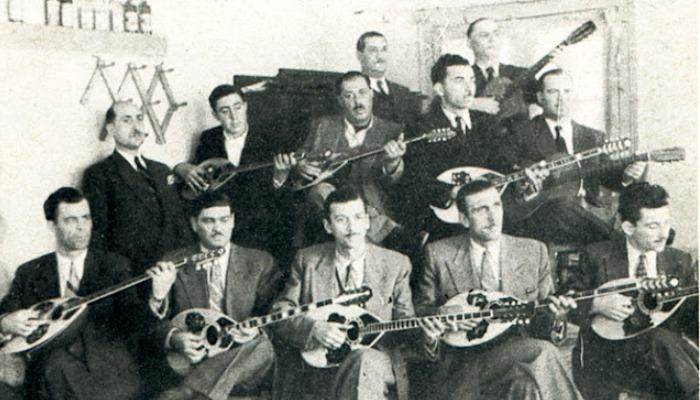
I don’t think I’ve ever seen this kind of photograph (ensembles playing in venues of the period) where there weren’t a lot of musicians. Two or more bouzoukis, for instance, seem to have been an inviolable rule. As for chordal instruments, it’s never just guitar, but also piano, or accordion, or both, plus sometimes the baglamas (here presumably an accessory of Bellou’s; I don’t know whether it played any meaningful role in the orchestra — basically, did she actually play it?). And sometimes we even get the inflation of 8–10 bouzoukis, whose purpose I can’t imagine.
Generally, always orchestras. Did nobody ever put together a simple duo or trio, or at least a quartet of musicians? Or did that only happen in periods when reporters and photographers weren’t interested in rebetiko?
Obviously, the more well-known artists were featured in these photographs, the better!
This particular photograph, however, isn’t the “classic”, staged and carefully arranged one that venue owners of the time used to “advertise” forthcoming or current appearances by artists at their establishments. The best-known example was the famous photograph from the “Kalokairino” in Tzitzifies, featuring all the “big-name bouzouki players” of the period (the late 1940s), bouzoukis in hand, with the piano as a “backdrop” against the wall and Peristeris (the “Artistic Director”!) standing on the left by the wall.
This is simply a hastily taken photograph, probably on the occasion of some “special” evening, or perhaps merely for Panagakis’s archive.
A passage from Vradyni [on 19/9/1949] tells us that this “Panagakis” tavern operated in a different location in winter than in summer:
“…it closed its summer premises in Moschato and moved to its winter premises… 82 Alkmenous Street”
It should be noted that this tavern is also mentioned by M. Hadjidakis in his famous lecture on rebetiko, on 31/1/1949:
“…I could also talk about the taverns and the entertainment venue ‘Marios’, as well as ‘Panagakis’ near Saint Panteleimon, where every evening Vamvakaris and Bellou practise their art. I could talk about rainy nights when the shadows of a crowd were lit by petroleum lamps, and everyone sang together quietly, as though they believed in eternity. I would also talk about the dance of the komboloi, in which a young man with a carnation in his mouth becomes a little coil around the bright amber komboloi—I could say so much that whole hours would not be enough for me to talk, as if I were all alone.
But all this is a fascination…”
Of course, M. C. is “caught” here not fully informed: “Marios” was not an entertainment venue; it was a café, and what is more, it was on the mezzanine of a multi-storey building, where many musicians used to gather for coffee and a chat, but they did not play.
Especially here, I imagine that the most prominent and renowned musicians might each have played for a short while every evening, rather than all together as an orchestra.
My dear Niko, Bινis says in his biography that he himself, Keromytis, Lavkas and, I think, some others played for hours on end at Mario’s. I don’t have his biography to hand.
As for M.X., perhaps he meant Mario’s little bar as a place of entertainment for the artists themselves, who used it as their regular haunt.
[Of course, I’m only speculating, but he would certainly have known the place—if not from the inside, then he would definitely have formed an opinion from patrons’ descriptions].