Good evening to everyone in your lovely community.
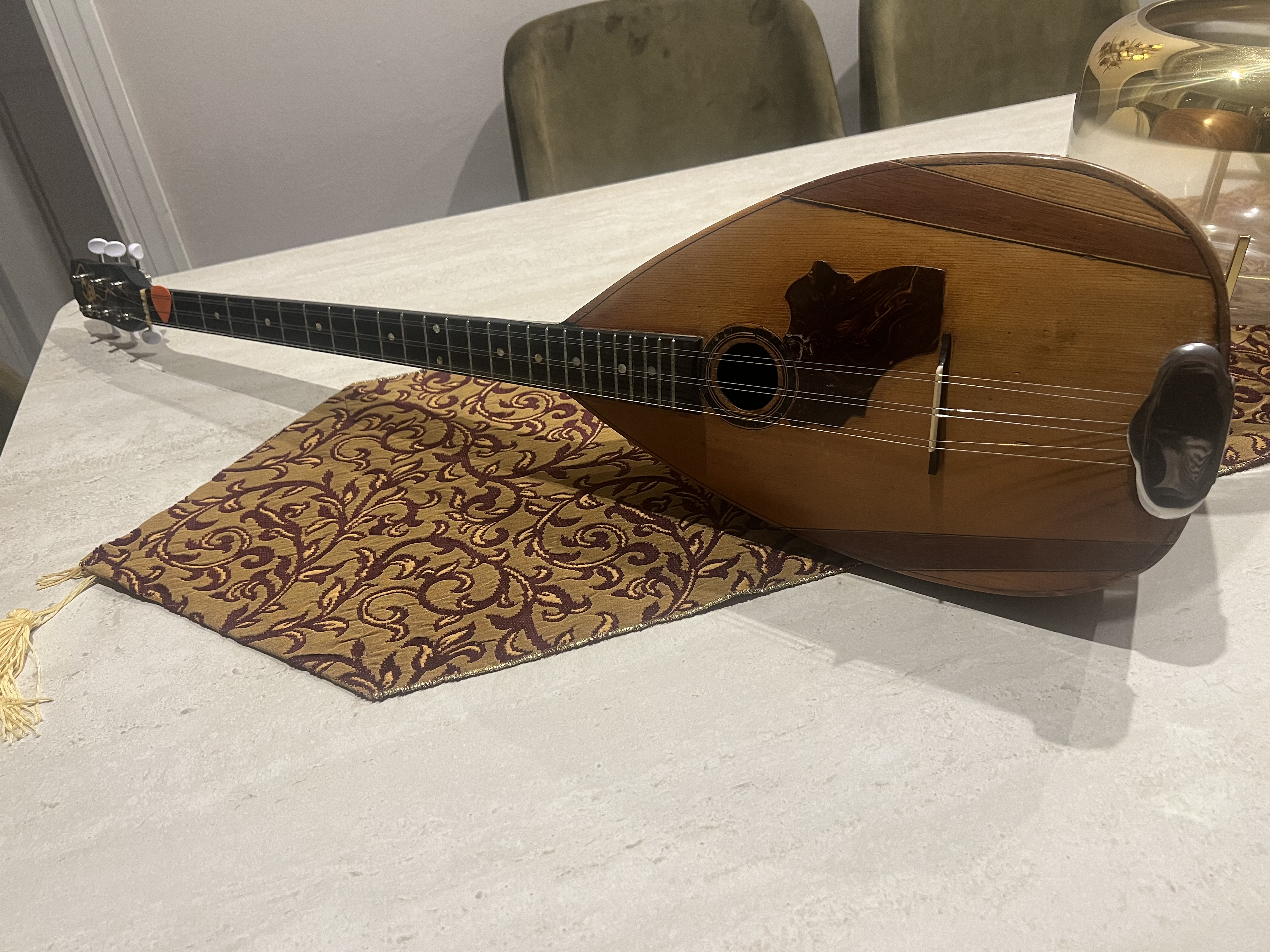
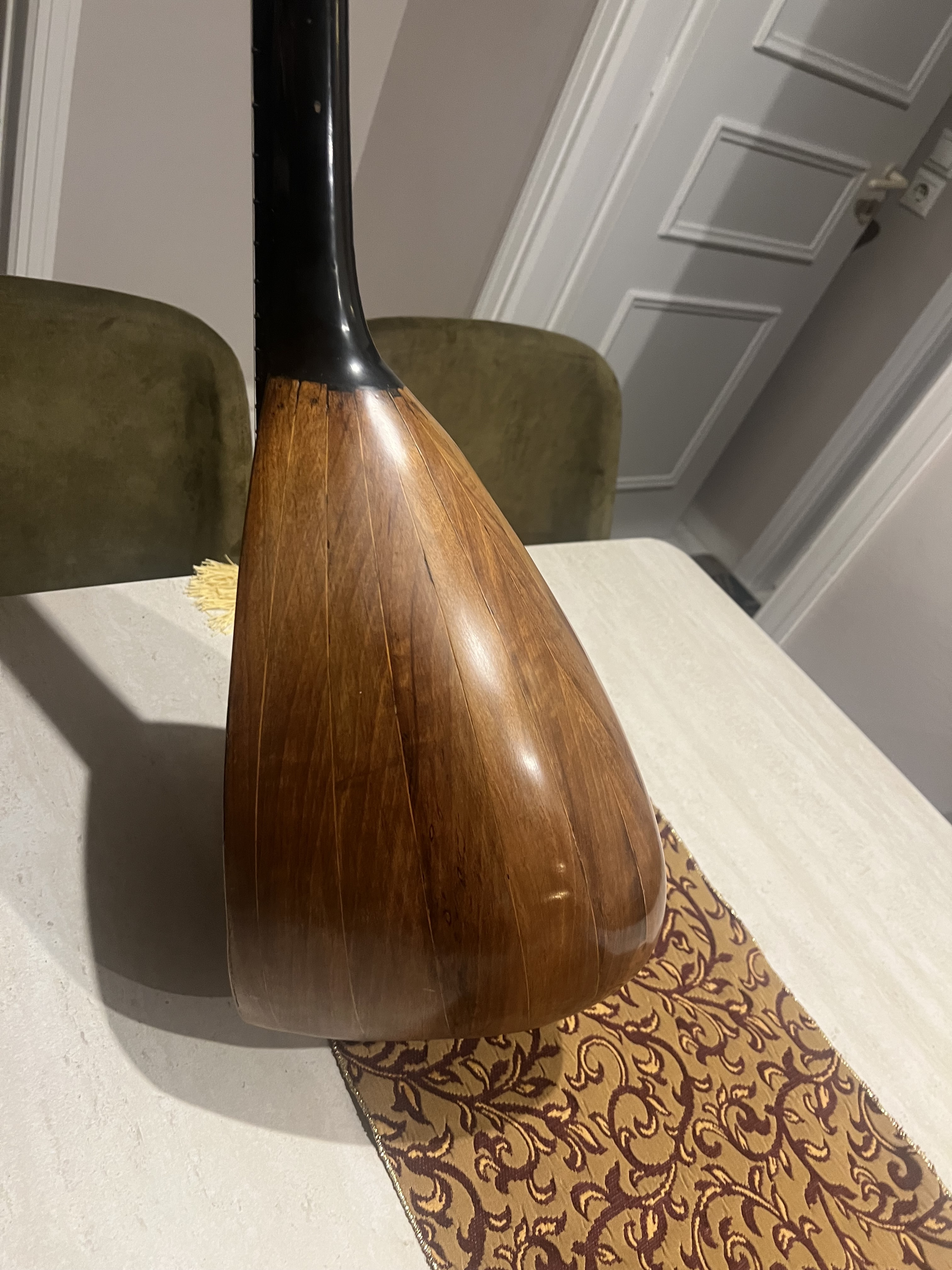
I would like to ask for your advice about this bouzouki. It belonged to my father, and I know a few things about it, but I would appreciate more information if any of you are knowledgeable about these instruments. Unfortunately, the system won’t let me upload any more photos. There is a label inside stating that the last repair was carried out in 1934 by PAPAZIAN & TSAKIRIAN. Of course, it has been fully repaired since then.
Welcome! A striking entrance with a historic instrument—thank you very much. We would appreciate it if you could share more photos and details, if possible.
Papazian and Tsakirian were leading instrument makers of the interwar period. The double name dates from the period of transition and collaboration from Papazian (teacher) to Tsakirian (student).
Do you happen to know who carried out the more recent alterations? At first glance, it looks more like a renovation than a restoration, as though the neck and fingerboard and the bridge and string-holder have been replaced…
Thank you very much for the welcome and for your time.
I will come back with more details regarding the interventions that have been made immediately. However, I know that the last intervention was carried out by Mr Karolos Tsakirian several years ago.
That’s good, because Charles Tsakirian is a member of the family and a skilled craftsman. At least the instrument’s soundboard was saved. We look forward to the information with interest, and if you know who in the family played, beyond the instrument’s history, as well as any material from the period that may be available (accounts, photographs, etc.), please share it. Such information is rare, and we have much to learn!
It seems you have a very unusual and old three-stringed mezobouzouko! The fact that its last known repair was carried out in 1934 by Papazian & Tsakirian indicates that the instrument is of considerable historical value. These instrument makers were well known in their time for making and repairing high-quality traditional folk instruments.
The body and fingerboard appear to be in good condition, and the carved wooden decoration is particularly impressive. If you have any further information about its origins, such as who originally made it or whether there is an engraved maker’s name, that would be very helpful.
If you are considering having it appraised or conserved, it would be a good idea to visit an experienced luthier who specialises in traditional string instruments.
If the time frame is correct, you have an extraordinarily distinctive instrument. It is one of the instruments from the transitional period, which bears many characteristics of the tambouras on the soundboard and ribs, but has the neck and the philosophy of the bouzouki. It represents the other school of construction that did not prevail; instead, the more refined mandolin body construction is the one we see in bouzoukis. Extremely rare! But I would venture to say that the neck may have been added later, or at least that the fingerboard may have been fitted at a later date. The pegbox and tuning machines also look new..
Basically, I would have expected to see an eight-string pegbox.
As we learned here, back in those days there were sometimes bouzoukis with four pairs of strings, alongside the three-course ones that became standard (until much later, when the four-course instrument was reinvented as something new); while, on the other hand, three-course instruments also had some strings that were triple or even quadruple. So, an eight-string mandolin pegbox, which for some time afterwards remained on standard three-course instruments (three pairs), with simply two of the eight tuning pegs left unused.
It is not so much the eight-string pegbox as the fact that—judging from the photograph—the materials look very new. The tuning pegs themselves look new, and the wood appears to be painted. It would be very helpful to have a better photograph of the karavolo.
As an instrument, it seems to bear the characteristics of a tamboura, and if it really is as old as claimed, it is an exceptionally rare piece! But we may be looking at a reconstruction—to some extent, at least.