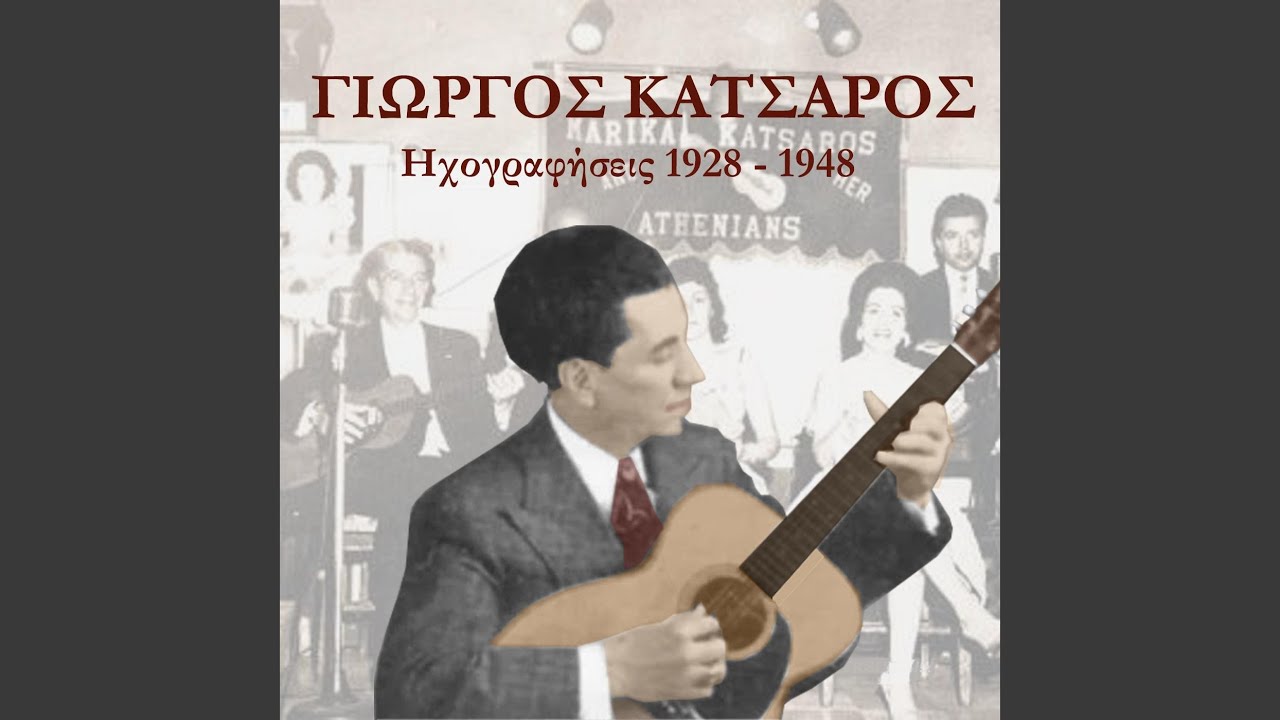
Hello! This is my first time on the forum, and I’m making this post because I need help with the modes in the following songs (I’m putting both here so I don’t have to make two posts).
Really, is there also a “Majore” dromos? The fact that there is a major scale is, of course, well known. And what is the difference between the Majore dromos and the Rast dromos if we use an equal-tempered scale?
ZARAZ
(Κουνάβης Ευώδιος, ποιητής (εκ του προχείρου και εν πλήρει φορμαλισμώ))
4
But, the hardness and the foundation on Rast’s fourth. Happy birthday!
I was expecting that question! A major mode is when we have major harmony (I–IV–V7) and dyads, but at the same time also have modal behaviour (Rast, Segâh movements, etc.). For example, Whatever I Say, I Don’t Forget You or One Night You Called Me a Rascal.
While we’re on the subject, I’ve now looked at them with an instrument as well (previously, only by ear). Although both are light songs, they are probably in a mode rather than in a major scale. Katsaros’s song has some of these elements (pulls towards the 3rd and 5th degrees), while Papagika’s could even be called Segâh, since it resolves to the 3rd.
P.S. Happy birthday, namesake — wishing you many more years, always in good health!
In the singing or on the guitar? I also only listened to it by ear, without an instrument, but although there may be all sorts of things on the guitar that I didn’t notice, I’d be surprised if I’d missed such attractions in the singing. But even with attractions—which, in the end, aren’t exactly the exclusive preserve of the popular modes (we’ve heard them in completely Western styles of music too, from time to time)—it sounds to me like plain major: a scale, not a major mode. Particularly the phrase “and the fares”, which is repeated one degree higher in “I didn’t have”, where the chord changes on the third of the four syllables, strikes me as typically major and non-modal.
As for Papagika’s, okay. It’s reminiscent of many simple-major-segah, traditional-sounding songs, e.g. Lemonaki myrodato and Misevo kai ta matia mou.
(And a comment on the rhythm of Katsaros’s: if we try to smooth it out so that it doesn’t have groups of three in some places, groups of four in others, and a stray two or even one elsewhere, but the same metre throughout, it won’t come out as a waltz, which seems to be what it was intended to be, but as four-four time! Give it a try.)
What is the most recent thread where we had this discussion again? We’ve certainly been over it many times, but here I notice something new, while leaving this thread to its own topic.