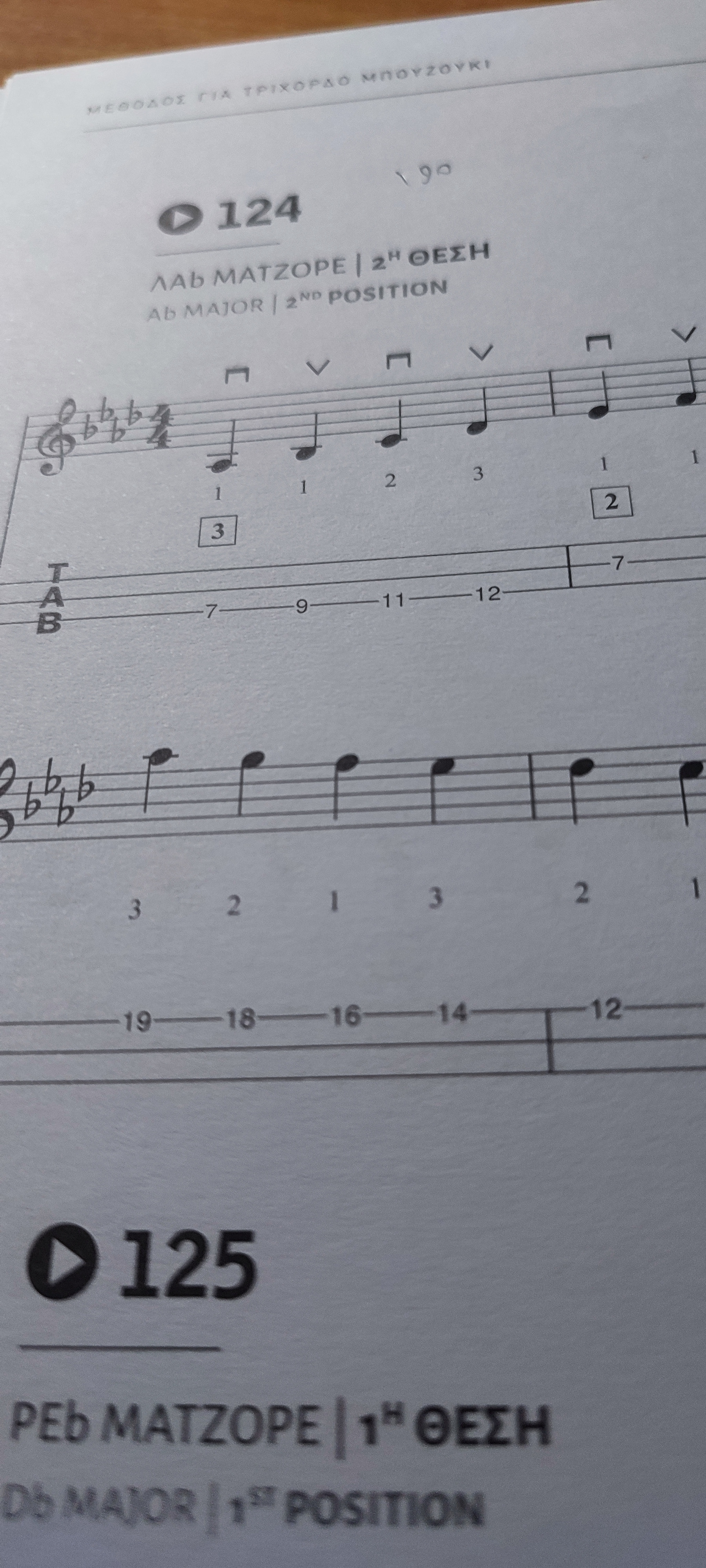
Good evening, I’m studying scales from Mr Pafranidis’s book. I’d like to hear your opinion.
I happened to look at it yesterday, when one of my students had bought it. At first, it has some good material on plectrum technique and certain fingerings, but once it gets to the scales, it’s just copy-pasted from piano manuals. I’ve seen this in every method—could it have something to do with the brand-new bouzouki qualification? I mean, I see no point in listing, one after another, all the scales with sharps and flats, major, natural minor and harmonic minor, even melodic minor scales that haven’t been used since Bach’s Bourrée…
For me, it’s useful for someone to learn the basic keys of the bouzouki, namely the first two from each row of fifths (C, G–D, F–B♭), along with the related harmonic minors. From there, they should understand how to transpose keys on fretted long-necked lute-like instruments (that is, by shifting the fingering patterns backwards and forwards along the fretboard) and learn the open positions well, since they are the soul of the instrument.
From that point on, the emphasis should be placed on trichords, tetrachords and pentachords, as well as the dromoi, with the scales understood through them. In other words, the natural major scale as two identical tetrachords (T–T–S), and major/minor as dromoi rather than as scales. After all, someone wants to play the bouzouki—not the mandolin or the guitar.
2 Likes
Thank you for your views. What puzzles me is that in the photo, the A♭ scale starts at the seventh fret on the mourgkana (μουργκάνα), which I think is A…
1 Like
A classic copy-and-paste mistake that slipped through the editing and proofreading process; there are mistakes like this in other books too.
1 Like
The numbers 124 and 125—what do they mean? Have 123 other scales come before, and we’re still in major?
That’s a lot of material, honestly!
Really, in a large-format book of 230 pages, around a hundred are just copy-and-paste material on scales: major, natural minor, harmonic minor and melodic minor. As for modes, not a word; if I remember correctly, they’re announced for volume 2, which still doesn’t seem to have been published.
And that’s a shame, because, as I said at the beginning, it has quite a few good points. I had leafed through it and noticed some progress compared with other bouzouki methods. If it falls into my hands again, I’ll be more specific.
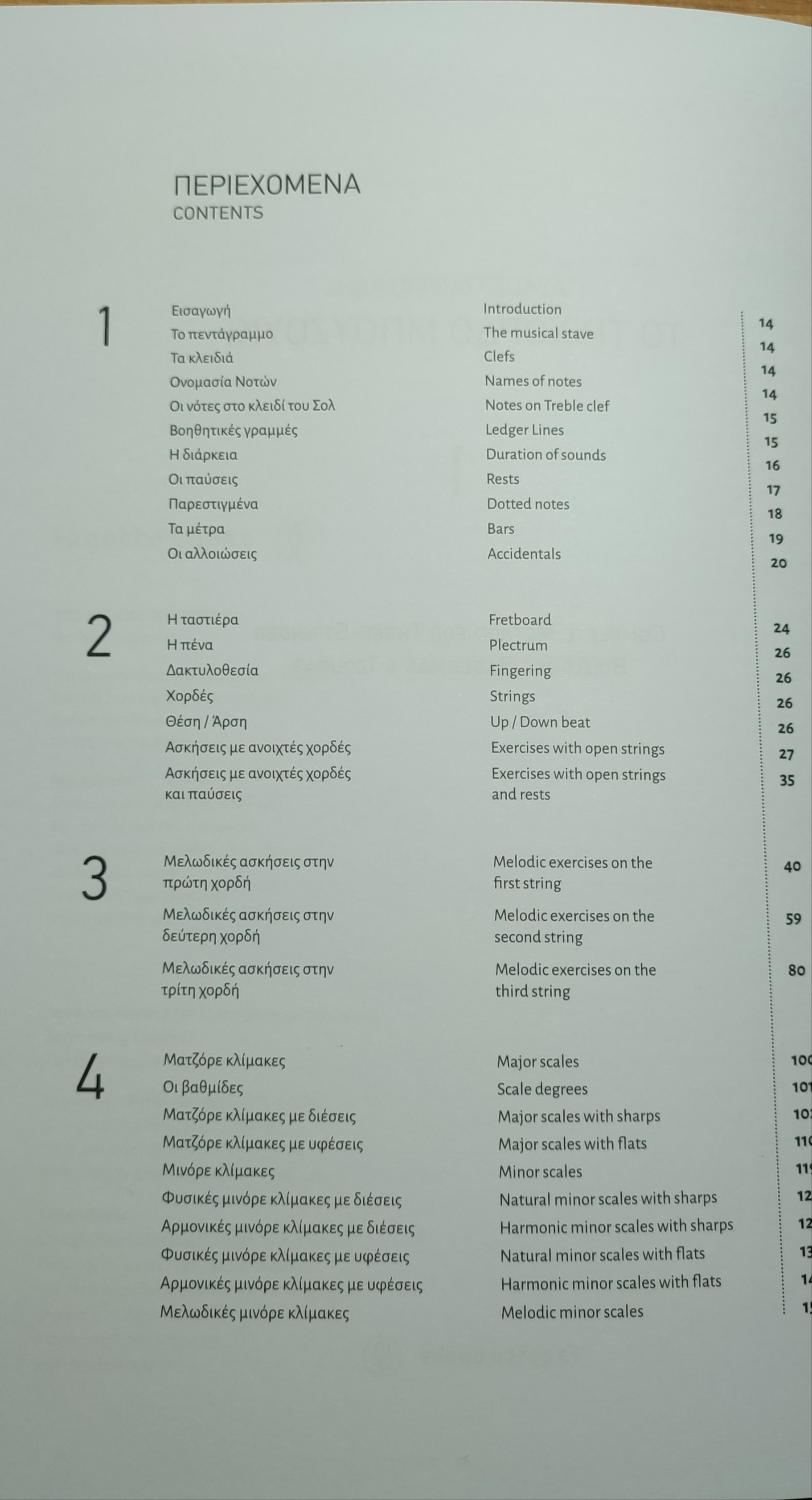
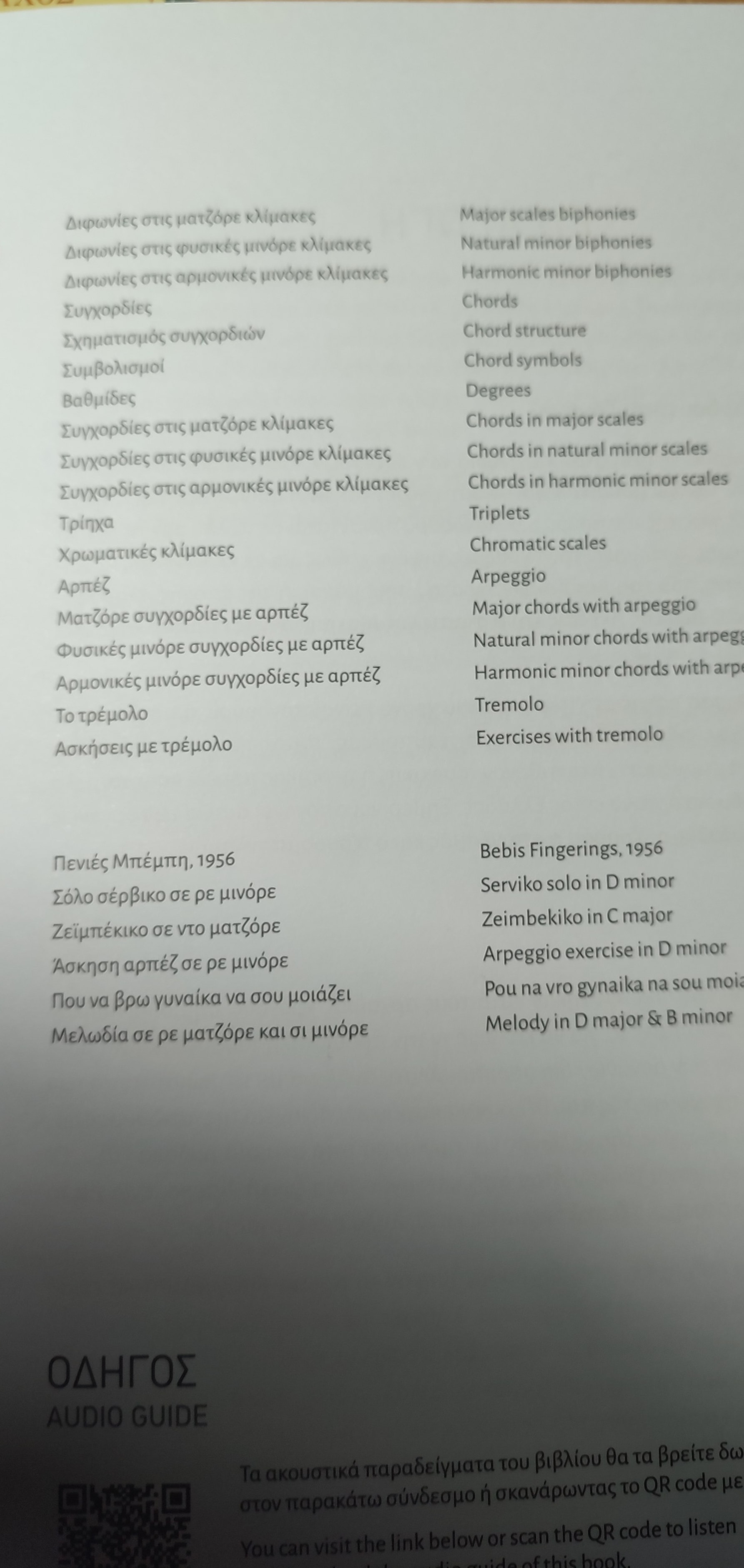
Here are the contents, too. It contains quite a few similar fingering errors. I liked that it included tablature and an indication of which finger to use, but it isn’t reliable. Given its price, I expected it at least not to contain any errors.
The same goes for Trigas. Good material, which is unusual (most of the methods out there seem to think the bouzouki is a guitar), but then it’s all major and minor in every key, as though someone learns the bouzouki in order to become the bouzouki player in a symphony orchestra. I think one should focus first and foremost on D and G and their related modes (F major, A hijaz, etc.), and then, thanks to the tuning, any transposition that’s needed is easy.
2 Likes
Yes, and Trigas’s method has many good elements (pick, finger placement, how to hold the instrument, and so on).
The contents of chapter 4 could be included, word for word, in a book on European music theory. At most, it would say “major–minor” instead of “majore–minore”. I don’t know what happens further in, but since the contents are usually among the first things a reader or prospective reader looks at, they don’t give you any indication that this is an instrument whose music is not European (however many elements it may share with, or have borrowed from, it).
The same goes for the contents of chapter 1, but that is justified: since the staff is used throughout the book, a chapter explaining how to use the staff comes first, and those instructions really are the same as in European music. Chapter 2 is the one that opens up the main subject, the bouzouki. I assume it will contain musical examples (even if only to show the tuning), written on a staff, so this chapter could not come first: the chapter that ultimately comes first had to precede it.
But in any case, none of this makes it at all clear that this instrument is used in Greek folk music, which has its own rules, different from those of European music, all of which revolve around one central concept: the dromos. Of course, this may be clarified further in. After all, you can’t talk about an instrument without talking about its music.
_____________________________________
Edit: I wonder whether, in the second volume, when it gets to the dromoi, it will indicate their fixed accidentals in the key signature. Or will the key signature be based only on the conventional major and minor scales, with everything else written as a chromatic accidental? For example, will it write D Hijaz with a key signature of E♭ and F♯?
1 Like
Although I agree, let me raise one concern: the needs of each bouzouki player, especially a four-string player, may differ slightly from tradition nowadays. In other words, is it really out of the question that you might go somewhere for a gig and be told: transpose the song down a semitone? It would certainly be unusual, but I think we now also hear music played in difficult keys. If someone wants and needs those keys, perhaps it is a good thing that there is material available to practise them. In my limited experience with modal music, this has always been my limitation: to play with a singer in the key in which they want the instrument to be played, I often have to change the tuning, which is not done as much as it used to be and brings its own problems. Since we are not changing the tuning, perhaps we should work on other foundations.
But I never said that nobody should learn them all, or not know the key signatures and so on. That can happen over time—not simply by listing all the keys in a beginner’s book. Especially without explaining how to transpose them onto the fretboard, and without even including the circle of fifths, which is an essential tool and contains the whole theory and harmony in condensed form.
@alk, as I wrote above, you learn the first five basic keys (in very general terms, one fingering that can be moved along the entire fretboard is enough). Then, using this simple method of shifting positions and marking the 1st–5th–8th on the fretboard, you can play all the keys—even those “in the cracks”, as we say.
1 Like
Quite right. I was particularly struck by the fact that the main body of the book doesn’t contain a single piece as an example—let alone any introduction to the repertoire.
I agree with this approach too: there should be an understanding of the modes, and this should be reflected in the key signature.
If you have played and studied ALL the major scales across the fretboard, you have gained something truly unique on the bouzouki.
To understand this, you have to have done it.
If you haven’t done it, you can’t understand it.
If a method doesn’t convince you, that’s your problem.
If you want to skip this stage, that’s your right; you may still learn to play the bouzouki without it.
That’s all from me.
I don’t disagree; knowing the key signatures and positions in all 12 keys by heart has helped me too. However, do you think it’s the first thing a beginner should learn? Before playing pieces, before learning scales?
The author supports this too. Before you move on to the modes, he says you should learn these as a way of mapping the fretboard. Since I’ve bought the book, I’ll learn them. What I haven’t understood, though, is when I should move on from them to progress further. At the moment, I can play the major scales at 260 bpm, and I’m trying to play them without looking at the fretboard. Isn’t that good enough?
Yes, why not?
If a child starts learning bouzouki at a young age with a structured goal, let them practise scales if that’s what the method their teacher follows recommends.
Do you think they’ll go to the tavern and the group will expect them to get everyone in the mood? 
Of course, combined with a few selected songs in some of the scales…
I’ll share my own experience with regard to tonal hierarchies: when you play Western music, all the keys are more or less equal in our heads (okay, apart from some that we know never come up). So, when I started learning traditional violin as a self-taught player, I would play whatever key each singer asked for, with the added confidence of being able to transpose, which I considered a kind of virtuosity I possessed. I then went to my first lyra seminar with Voulgaris. He told me: “We’ll tune the instrument down a whole tone so we can play an open C.” I naively replied: “Come on, teacher — you don’t think I can produce a fingered C?” And yet, within a day or two, I realised that the man wanted to teach me the hierarchy of the strings, harmonic consonances and, in general, a modal approach whose existence I hadn’t even known about. These days I almost refuse to play in very closed positions, even when I know I could manage them by reading. If the singer wants Uşşak from C… well, it can also be from B, where the instruments ring out. It won’t hurt anyone. With that in mind, if I were teaching someone to play, I would start by explaining this philosophy. Not that this is where music ends, but the technical support for any method should be aimed at something. What is the point of playing G-flat major? For me, none whatsoever, so I’m not going to sit down and learn things I’ll never use; I’d rather learn what I need. If someone needs G-flat, then it’s a good thing the book exists. There are now 1,002 different things and styles of music being played on the bouzouki.
2 Likes
Babis, didn’t this post cover that for you? I’m not saying he should never play from G♯, just that he should know how to play it from G or A, which he’ll know well on the instrument.
I feel I need to repeat the clarification about what I wrote…
In classical music, these are necessary because there are pieces that move through different keys. I think that, in the past, this was also the skill of a Western improviser in a prelude or cadenza: to move into various other keys and manage to return. Just as in Eastern music, we can move into other maqams and so on.