Good morning. I’ve been playing the bouzouki for a year and a half now (I’d say fairly seriously).
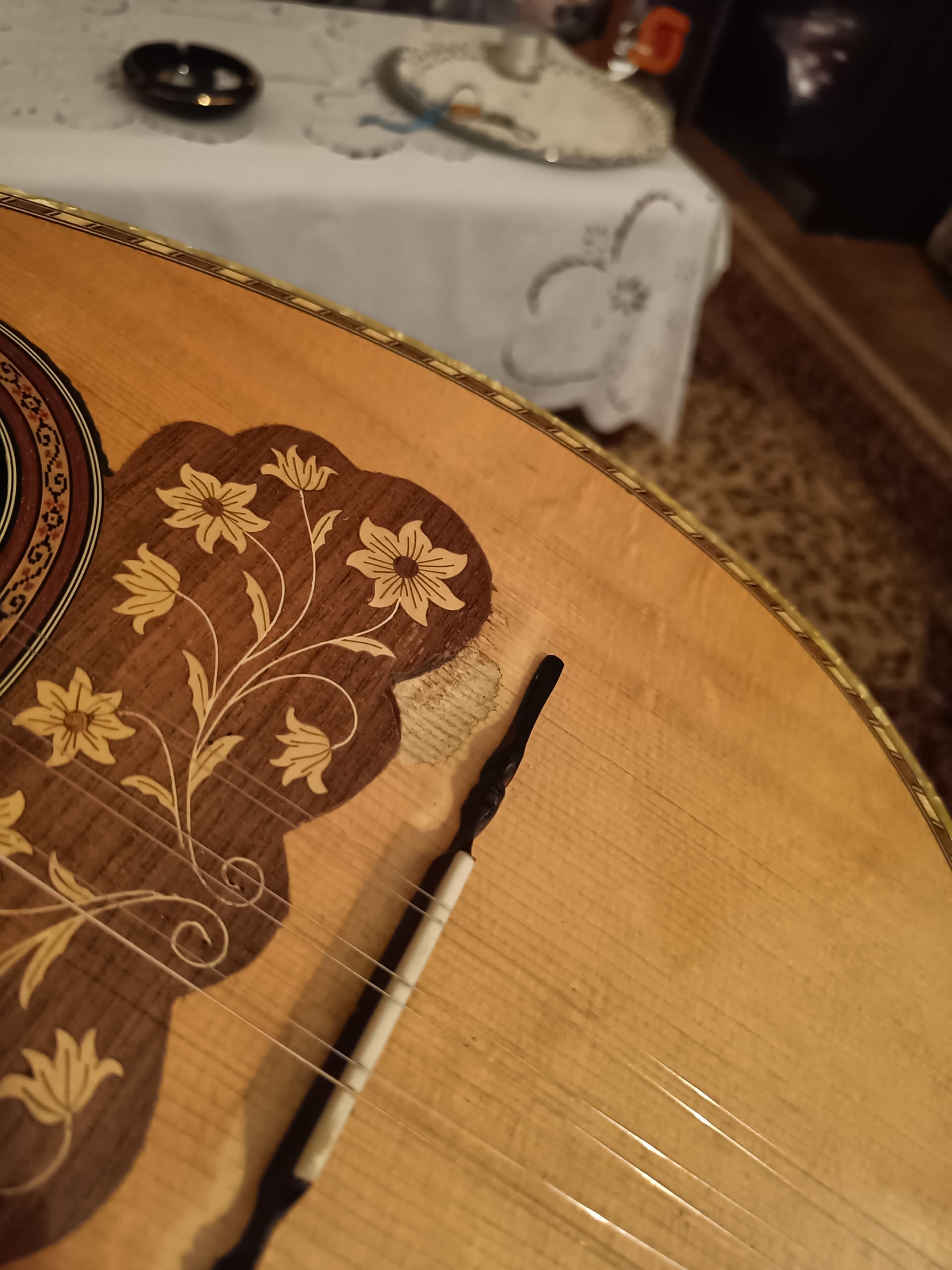
This instrument belonged to my father (made by Tomkagloglou), and I “inherited” it with this damage … it’s a very good instrument.
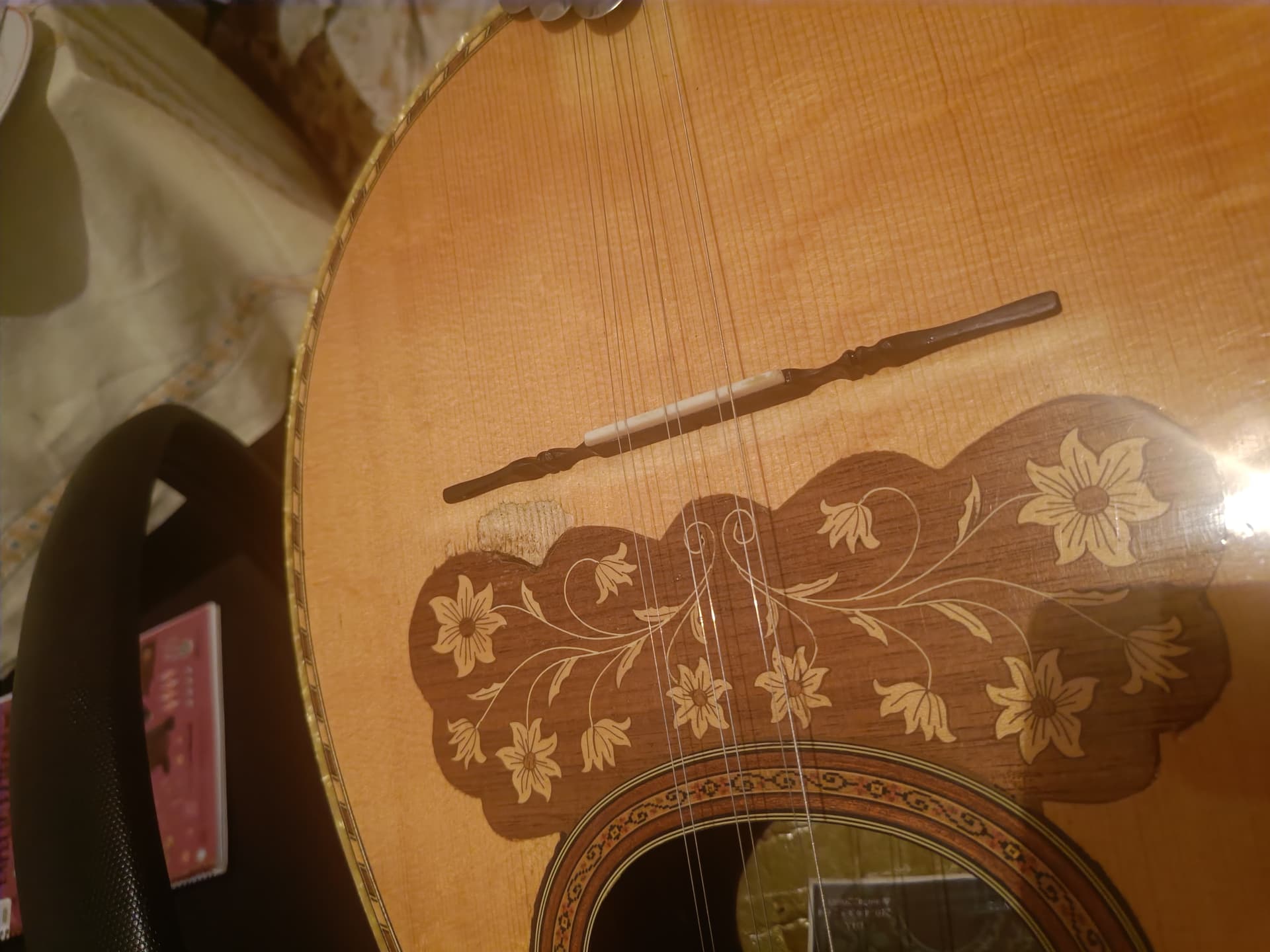
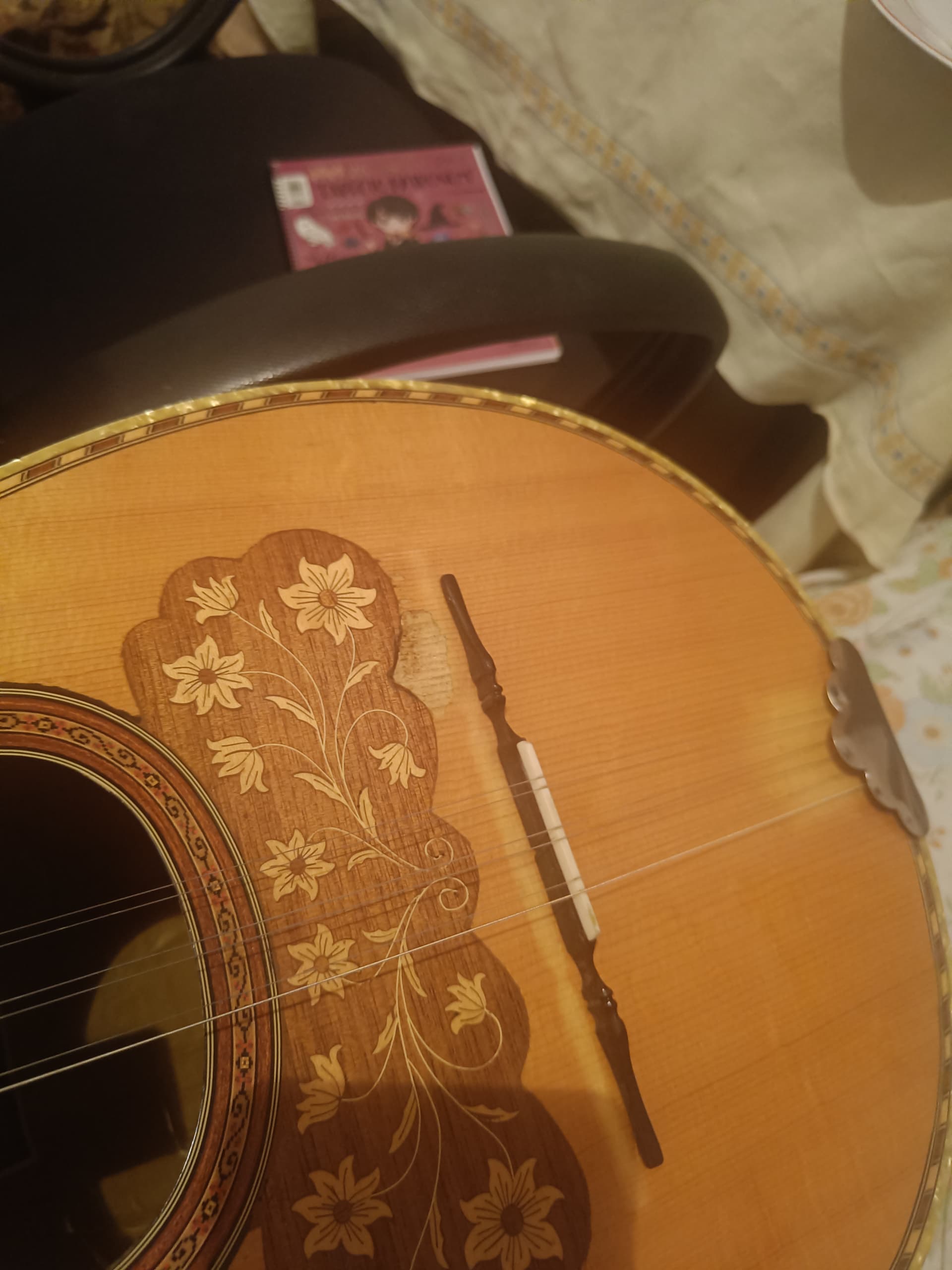
It has this damage on the soundboard … it’s quite deep for a knock to the soundboard, but functionally it has no issues …
Also, since this bouzouki was bought 13 years ago and, until the year before last, had only been played for 30 hours (the case practically ate it), over the course of its life the bridge has left its imprint (discolouration).
Can this be fixed?
I wanted to ask whether it can be repaired, and how?
Sorry if I’ve bored you
Thank you.
*I know you’ll tell me, “Go and find a luthier now …” OK … we’re just having a chat; I’d like to hear some opinions too.
Let’s have a chat then
The mark left by the bridge may well be where it was positioned correctly, so perhaps you should first check its exact placement.
I am surprised, though, that you say the mark appeared while the instrument was in its case, because exposure to light can usually cause this kind of change in colour.
In any case, it’s funny to seek aesthetic improvement in something so minor. Yes, theoretically it can be fixed, but not only would the cost be prohibitive, you would also be interfering with the instrument’s authenticity for no substantial reason.
The wear on the soundboard also concerns me. It looks as though it has been worn away by a plectrum because some wood is missing, but obviously I can’t say that with certainty.
In any case, you need to make sure that the instrument is structurally sound. It may be possible to improve its appearance a little, to the point where it doesn’t catch the eye from a distance. You, holding it, will still see it.
A more general thought. Violin making has more than a century of tradition in artificial ageing as part of the construction process. So you can buy a new violin that looks as though it is from the 1700s.
My own instrument, too, although modern, had undergone a little artificial ageing. One day I dropped a music stand on it and, just as you have now, I went and asked a maker to reverse the damage, as though I had never caused it. The man smiled understandingly, repaired the instrument and returned it to me as an instrument that played well; the damage I had caused was still visible, but not completely—it had been properly attended to.
Now, 20 years later, I’m not sure I remember which marks were made by my music stand and which were artificial marks added to age the instrument.
At 13 years old, a difference in colour under the bridge is perfectly natural, even if it has been kept in its case. The Tokgmakis workshop is still operating normally, so it wouldn’t hurt to have its maker, Kyriakos, take a look at it.
As for the bridge mark, I’d also suggest checking whether it’s in the correct position. Unless it had shifted after spending all those years in its case, and you’ve now put it back in the right place.
As for the damage to the top, it was probably caused by some kind of knock, followed by a simple repair attempt—most likely by the previous owner. It doesn’t look like pick wear to me, because it’s very close to the bridge’s old mark. That would mean the bridge was being hit with every strum.
Either way, they’re purely cosmetic issues and nothing more. I wouldn’t touch them at all.
The correct position of the bridge isn’t necessarily the same as it was 30 years ago. That’s why they make them adjustable, so you can correct the position whenever necessary.
The correct position in each case is where the octave harmonic sounds exactly the same as the regular octave note (at the 12th fret). Shall I explain what a harmonic is, or do you already know?
The bridge may not be the original one, as its footprint/mark looks slightly larger than the existing bridge (unless the photo is deceiving me).
I think that such a large deviation from the mark, if the instrument plays properly, means that either it has warped or the fingerboard and scale length have been changed. If the octave is out of tune at its current position, it probably needs to be returned to the old mark.
Finally, in my opinion, the damage to the soundboard was caused by playing; someone must have been playing close to the bridge…
The discolouration from the bridge is nothing to worry about—just leave it, it’s normal. In fact, it’s useful to be able to see where the bridge sits when you change the strings, or if it ever comes off. As for the other area, where the wear is, that was caused by your little finger and fingernail while playing. It can be repaired. Take it to a luthier. They’ll either use spruce dust mixed with glue, or a wood filler in the same colour, then apply another coat of varnish over it. Alternatively, they might fit a small piece of wood, as shown in the picture, but it won’t look uniform…