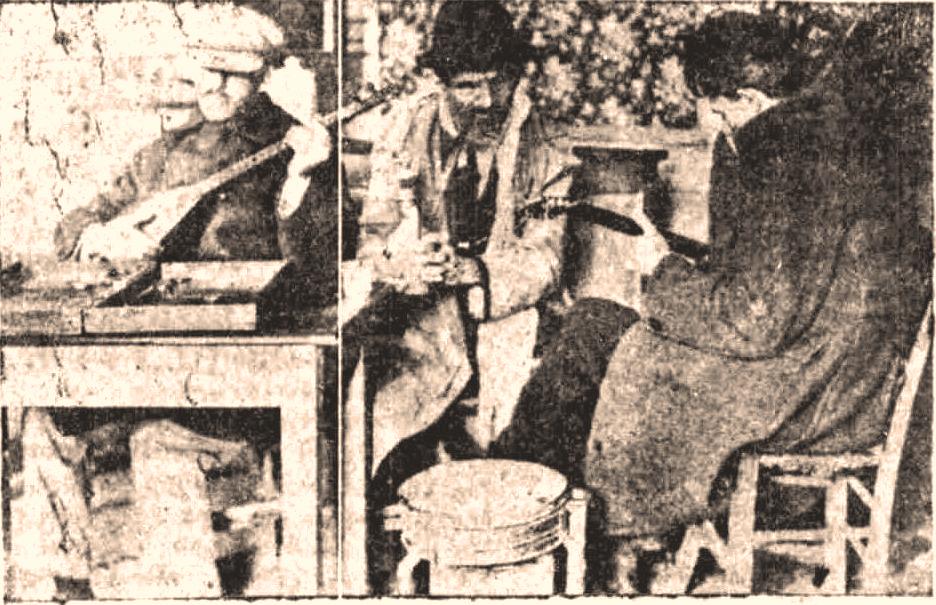
Nikos Skrivanos, a common criminal.
– Pleased to meet you.
Photograph of Tsarouchas and Skrivanos, from an article by Theodoros Drakos on the investigation “The Big Knives”.
Bayianteras gives us quite a lot of information about Tsarouchas through Chatzidoulis, who also told me various unpublished stories that Bayianteras had recounted to him.
According to Petropoulos, Skrivanos was called Agathakis; the articles, I see, list him as Agapakis.
30.08.1952, AKROPOLIS newspaper, p. 1
The following day, there were other figures, such as the renowned tekke keeper Poly kandriotis (see the interview with Lefteris Papadopoulos in the book “Arrest the Smoke”) and the well-known tough guy Panagiotakas.
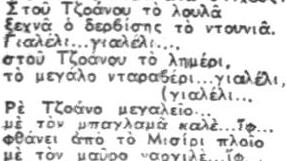
The investigation continues over the following days with similar material, while the 4 September 1952 issue, p. 5, contains an interesting reference to Tzoannos and his shop, as well as the now-famous story involving the cadet and the celebrated verse.
1 Like
18.09.1952
AKROPOLIS
Reference to the tekkes and Seirinakis with a corresponding couplet (p. 5)
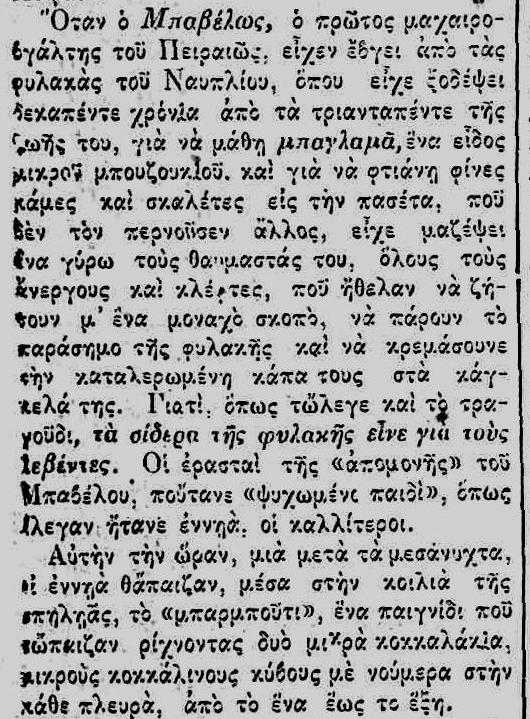
Perhaps the earliest reference to the baglamas in the press appears in Spyros Melas’s emblematic novel The Black People of Piraeus, where the gang is based in Arethousa’s cave in Kastella (ASTY, 28/1/1907):
2 Likes
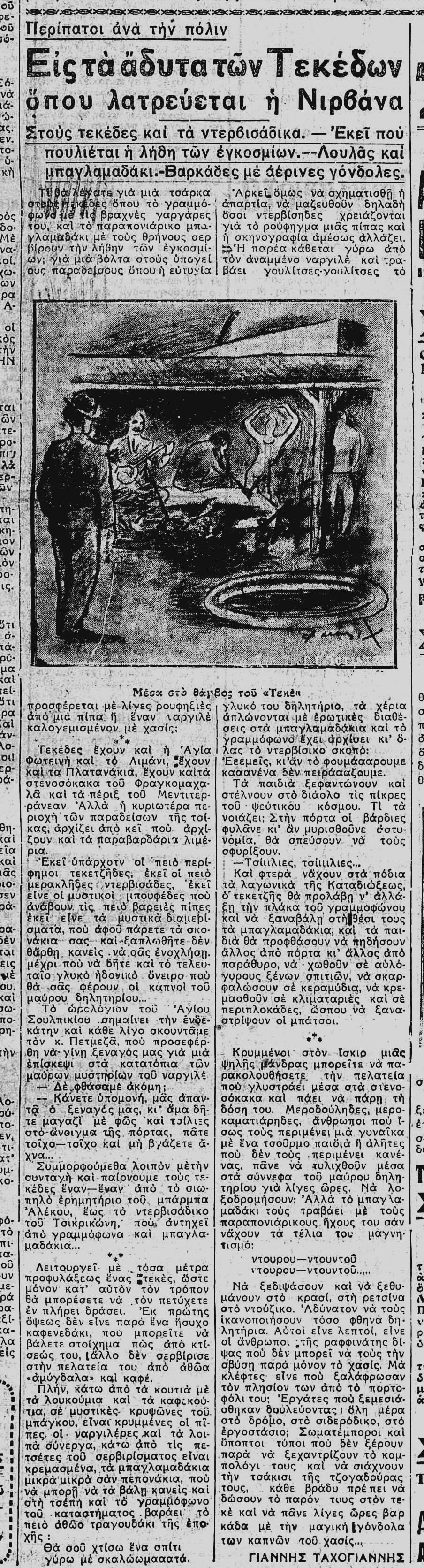
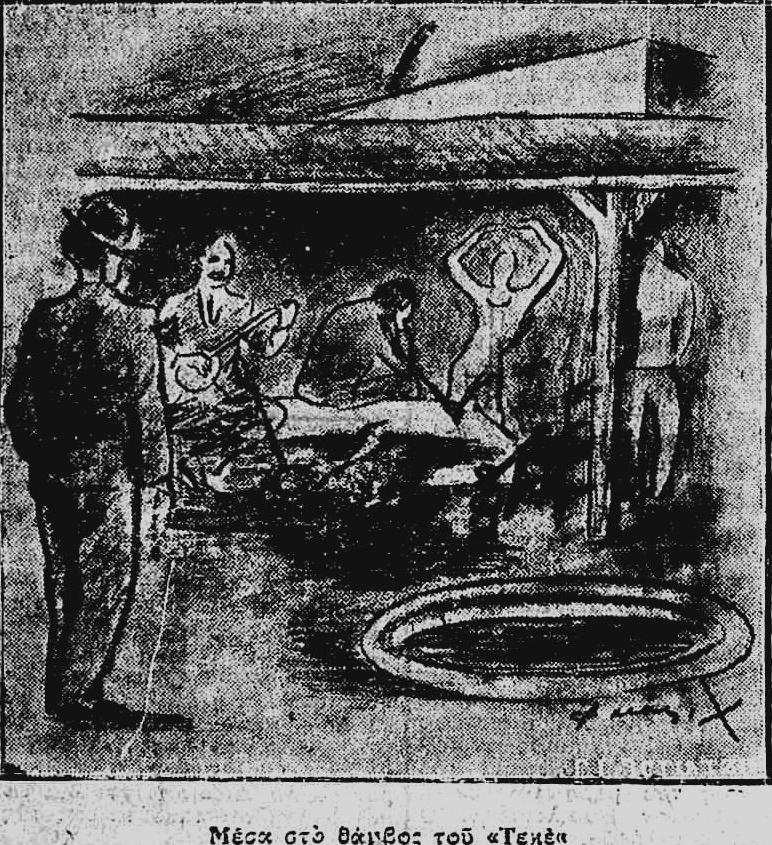
The excellent journalist Giannis Tachogiannis takes us on a tour of 1933 Thessaloniki’s tekes scene (and what a brilliant sketch!)
(MAKEDONIA 18/8/1933)
2 Likes
Give me a break, guys! At the rate you’re posting ALPs, how is anyone supposed to study them with even a modicum of seriousness?
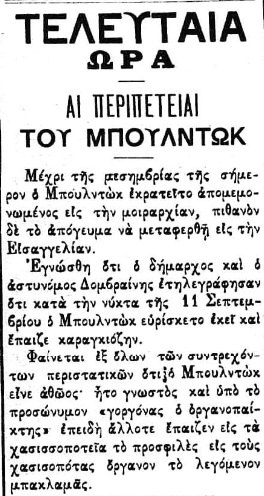
The earliest reference I found to the baglamas (written as baklamas) in the press dates back to 1905.
27 September 1905, SFAIRA, p. 4
3 Likes
What are you saying, guys! So no references to baglamas in the nineteenth century have been found? That surprises me.
1 Like
It must be hidden somewhere, but it doesn’t appear among the most immediate results when the word is varied.
1 Like
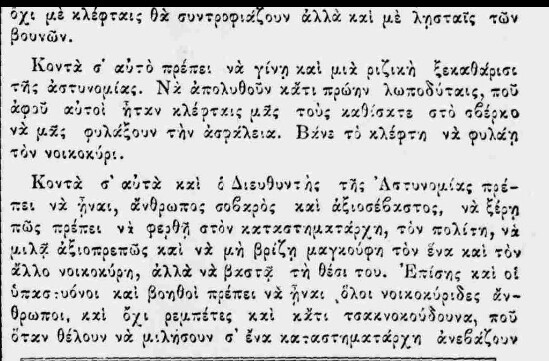
10.02.1883, Palianthropos (ΠΑΛΗΑΝΘΡΩΠΟΣ), p. 3
The first appearance in the press of the word “rembetes”, related to the word “rembeta”.
2 Likes
I notice the word «τσακνοκούδουνο», which nowadays we usually call «σαχλοκούδουνο». It also exists as «τσακλοκούδουνο». One of the three must be the original, and the others folk etymologies.
Τσάκνο means a little straw or a thin twig. It doesn’t make clear sense to me.
We obviously know what σαχλός means, but it seems somewhat too easy.
I have no idea what «τσακλο-» could be.
It’s unlikely that a word with a clear etymology would become corrupted in such a way that it no longer suggests anything at all. So, if it were «σαχλός + κουδούνι», it wouldn’t have changed. One of the other two must be the original, even if I can’t make sense of them.
After a somewhat dubious-quality search online, of course, I think the word you’re looking for is “sachnos” (Σαχνός), meaning tender, soft, or slender.
01.02.1979, FONI, pp. 2, 4
Tribute to Giorgos Batis
1 Like
In any case, I think the first confirmed baglamas player (the instrument isn’t named, but is described) is Nikitaras at the height of his powers. I also wonder whether he later played in Athens while begging…
1 Like
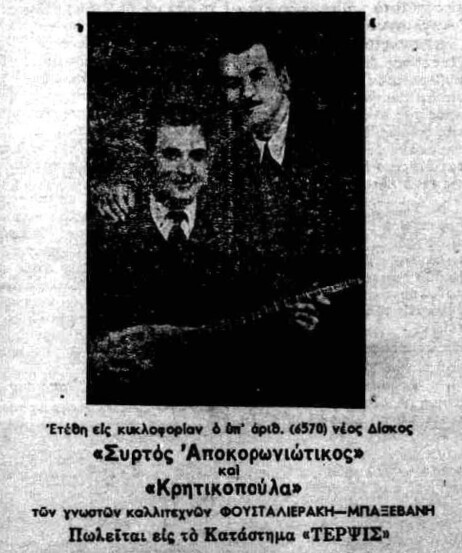
Advertisement for the 78 rpm record by Foustalierakis and Baxevanis, “Apokoroniotikos Syrtos – The Cretan Girl”. The record is one of Foustalieris’s two rarest records.
16.10.1940
ESPERINOS TACHYDROMOS, p. 2
3 Likes
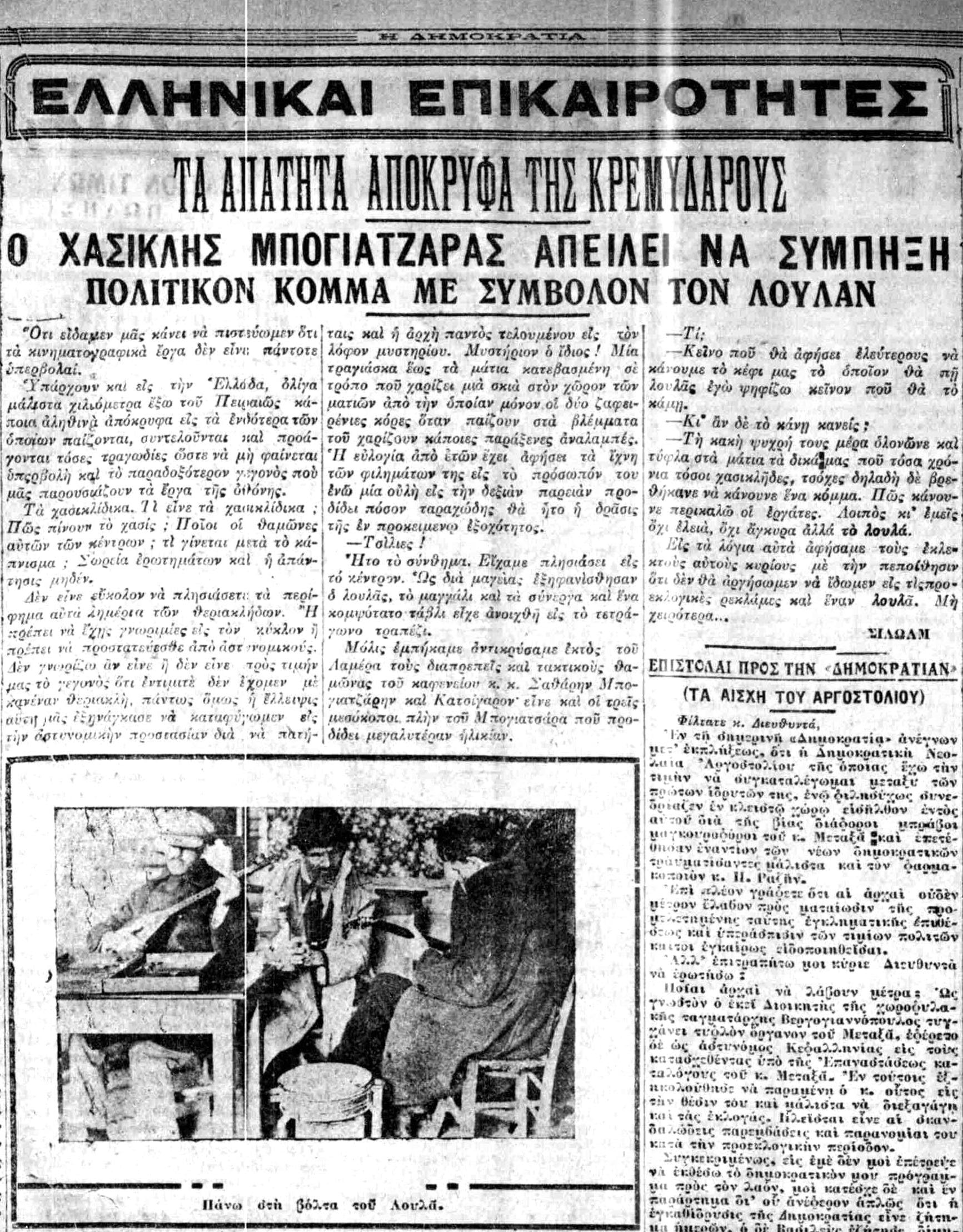
Let me remind friends about the hashish smoker Boyatzaras of Kremmydarou (no connection whatsoever with the ancient bouzouki player Mimiko Boyatzis), in whose case we owe a relevant report from Lamera’s den, complete with photographic evidence (DIMOKRATIA 1924):
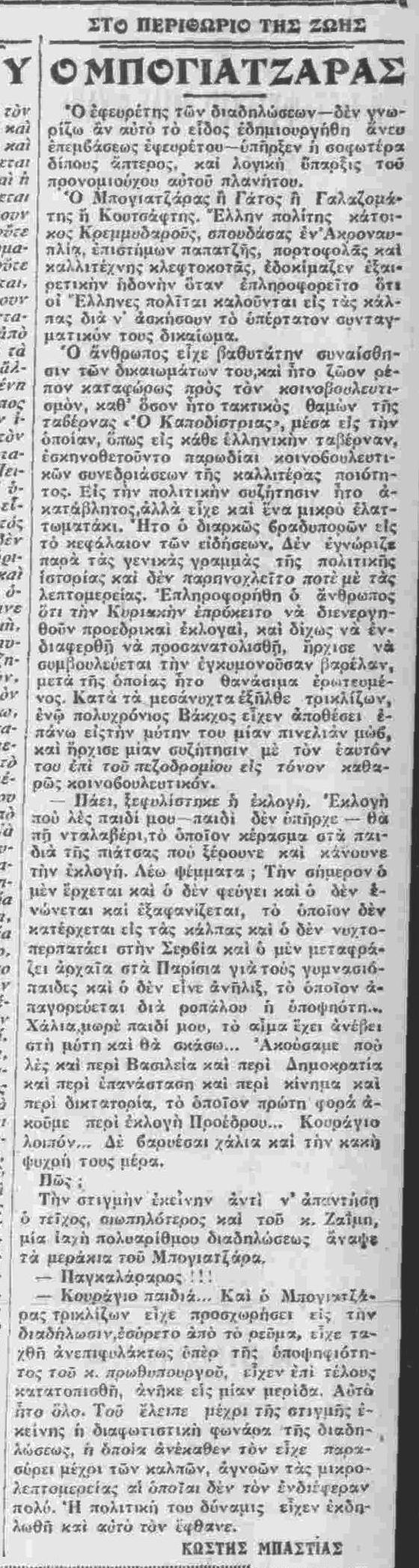
Boyatzaras also became a character in Kostis Bastias’s novel The Night Bird (1925), while in a related text, again by Bastias, we learn more about him and his nicknames (ELEFTHEROS TYPOS, 6 April 1926):
Fantastic photo. If only we’d had it printed a little better than it comes out in the newspaper’s coarse-grained printing!
Two bouzoukia, so the music doesn’t have to stop while each musician has a drag. One is tambour-shaped, with striftalia (στριφτάλια); the other is more modern. The first is without a plectrum, and this time it seems almost certain that they really were playing at the moment the photo was taken, rather than posing. We don’t know about the second.