Behind this somewhat unusual recording, I believe there must be a Greek popular song from the interwar period through to the 1950s. Does anyone recognise it?
Thank you!
Behind this somewhat unusual recording, I believe there must be a Greek popular song from the interwar period through to the 1950s. Does anyone recognise it?
Thank you!
I don’t think so, Pericles! The structure of the melody is unmistakably folk, with a very simple, repeating alternation between the first and second musical phrases, leaving no room for the elaborate verse–chorus format.
I would say that the performance of the melody is folk in the following sense: the musician does not necessarily care about the symmetry of phrases… It is something we have discussed recently in relation to the Cappadocian feast, Cemil Bey, and Katsaros, among others.
That does not mean that another version of the melody could not consist of four-bar phrases. It simply seems that in cultures removed from the demands of the studio, some musicians are not particularly concerned about whether the phrases come out complete, or even whether the rhythmic structures are complete.
In any case, Melikis has found quite a lot of waltz in
Tinos

Could it be this?
I don’t know who Melikis is, but this isn’t a waltz; it’s a four-beat rhythm, of course…
The little waltzes from that era—many of them—follow certain compositional formulas, such as the one in Pame san allote: changing from major to minor in the same key; if the piece is entirely in major, a temporary shift of the tonic up a fourth and then back again; and so on. Simple things once you get used to them, but far too complex for a folk tsampouna player. So he leaves out anything he cannot play at all, changes whatever he can play partially, and may even retain a few notes unchanged here and there. Also, as @alk says, he makes them less square, because in his aesthetic, symmetry does not count as a measure of musical quality.
Making all these mental reductions, I hear something much closer to Pame san allote than to any ordinary tsampouna song.
But it isn’t Pame san allote. The first two bars are similar; after that, it goes somewhere else. (Like before.) It is something else following the same logic.
What do you mean by «this»? It’s a one-hour programme. With a quick two-minute scan along the timeline, between the 40th and 48th minutes I find a karavals waltz that could hardly be more strongly in triple time, a Greek traditional Western-style rhyme set to a waltz tune as well, a tango and a polka.
As for Giorgis Melikis, over the past few decades he has been known for the programme «The Place and Its Song», featuring tributes to the musical and dance traditions of various places — Tinos in this case — sometimes excellent, sometimes less so. He has unearthed a few gems; for example, he was the first to make songs from Drama public in the local “forbidden” Slavic dialect.
Previously, from the 1980s onwards, he put on the historic «Folk Winters» in Thessaloniki.
He’s very important in general, and since you don’t know him, Niko, I’d wholeheartedly recommend getting to know his work. Search for “The Place and Its Song” on YouTube. And if you’re put off within the first 10 seconds of the first video you happen to open, give it a second chance. In the end, it will reward you.
https://www.youtube.com/results?search_query=ο+τόπος+και+το+τραγούδι+του
It would help if we knew whether they mean the C as a sharp or a natural, because I imagine it would have roughly a position on the instrument, and it isn’t clear to my ear (if we’re looking for something Western).
Anyway, from what I can see in Meliki, the little waltzes they play aren’t necessarily hits; they’re simply Western-style tunes in 3/4 played locally. Of course, they also come from somewhere, but I’m not sure this is a case of sound being transmitted through commercial recordings.
What makes you think it’s something that exists in our ears more generally? And why Greek?
I mean the famous four-beat Uşşak motif that begins “The Place and Its Song”:
I think it is also related to the equally famous Constantinopolitan Silivrian syrtos (“You have two black, large eyes, sweetly kneaded with milk”).
Well, there are some slight similarities in the direction/contour of the melody to this..

@Νίκο: Well, Alexander didn’t say that Melikis in Tinos found exclusively waltzes. It’s a one-hour programme, which of course also includes regular island folk songs, such as the wedding tune at the beginning. Obviously, that isn’t what Alexander meant by waltzes.
@Αλέξανδρο:
I’m simply assuming that it’s more likely that the song was Greek. There would certainly have been Greek songs that were translations of foreign ones, but how would the original foreign song have reached the villages? Only if it was instrumental.
As for the possibility that it wasn’t a hit but something local, I admit I hadn’t thought of that.
I wonder whether @koutroufi might have anything useful to tell us …
(Something happens to the @ and the names…)
All right, my Pericles, I’ll add him to the list of those “under investigation” — though there are quite a few on it that I haven’t explored yet… In any case, the fact that he released songs from Drama in a Slavic language is indeed a very positive point in his favour.
And a great fire-walker too. At the konaki in Langadas, he is the very first to step on the coals (after the chief anastenaris). Unrelated to the subject, but important for research and information.
I’ve been listening to the Tinian waltz with the tsampouna these days, hoping it might jog my memory, but no luck!
Some more general (though probably not very useful) comments.
The little waltzes (and the polkas, too) didn’t first appear in the interwar period; they must have emerged earlier. They were of art-music/Western origin and made their way into popular festivities (both urban and rural). I think they reflect the influence of musicians from the Ionian Islands. For example, “Proïan se eidon”, which Georgia Vassiliadou also sings, and little waltzes from Constantinople (“Ena trechantiraki”, “Manió mou”, “Menexedes kai zoumboulia”). In his autobiography, Markos recalls a waltz from his childhood in Syros which must be this one. The Sifnos “Fengaráki” in message 9 must be of this origin too (just my hypothesis; I haven’t located it in the discography). Nonikos, where we come from, also played the famous “Waves of the Danube” by Ivan Ivanovici.
Since Melikis was mentioned, here is a little waltz that he recorded in Serifos. Where we come from, “Mamousnaki” was played and sung almost exclusively by the late Koutsounas.
(When you think about it, “Agni Parthene Despoina”, “Ánoixon, déomai, Agní” and the Karpathian syrmatikos can also be danced as little waltzes.)
But they aren’t, any more than the various Epirote tunes (e.g. Kontoula lemonia), Simera gamos ginetai, or To xenaki eimai kai tha ’rtho are. As for the last one, there is an exceptionally beautiful old recording of the tune from Rhodes, on the CD accompanying Folk Songs, vol. 3 by Peristeris–Kyriakidis. And although the melody is no different from the commercially well-known version, the rhythm bears not the slightest resemblance to a waltz. It’s somewhat awkward to provide a reference, but it sounds a bit like this more recent one:
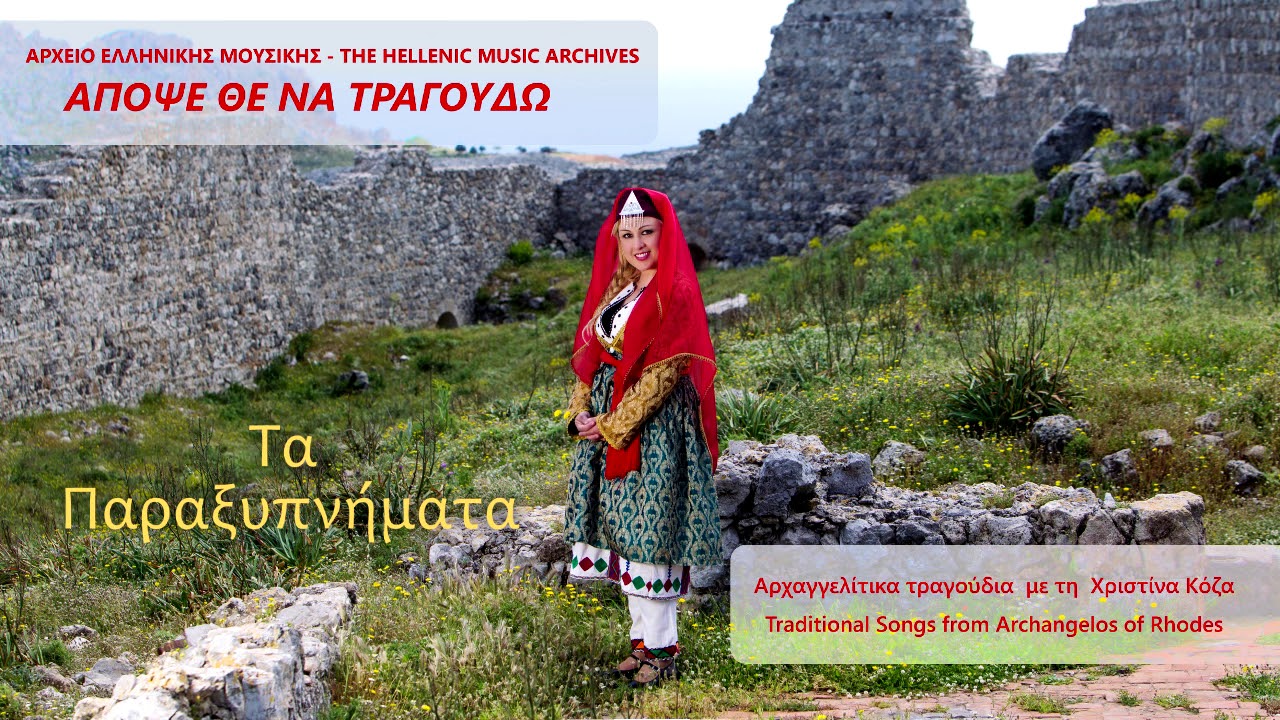
Folk musicians throughout Greece played many waltz-like triple-time rhythms, but apparently it never occurred to them to accompany them with a boom-bah-bah rhythm. We can see this in Krinos’s doumbek player, his brother, too: what he plays is anything but a waltz.
The fact that Trechantiraki, Menexedes, the Epirote tunes and so on are played with a boom-bah-bah rhythm today must be a more recent European influence.