Alexis Politis: Philologist who made a major contribution to traditional folk song dies

“ He died in the early hours of the morning: Alexis Politis, an iconic philologist who had worked extensively on Greek folk song.

Alexis Politis was born in 1945 in Athens.

He studied Modern Greek philology at the Aristotle University of Thessaloniki and the University of Paris IV (Sorbonne). In his doctoral dissertation, he examined the discovery of Greek folk songs in depth.

From 1976 to 1989, he worked at the Centre for Modern Greek Studies of the National Hellenic Research Foundation, and from 1989 to 2012 at the School of Philosophy, Department of Philology, at the University of Crete.

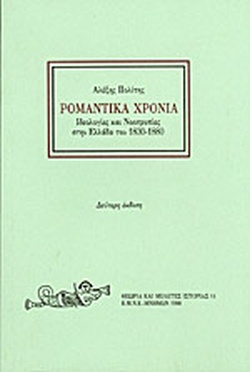
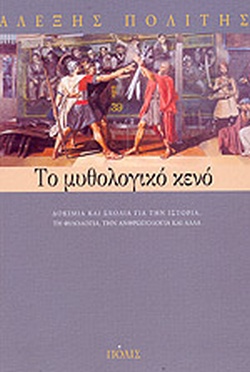
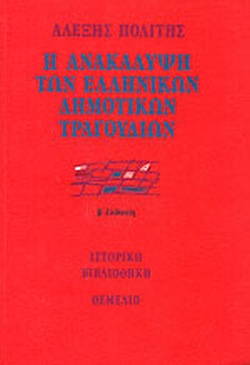
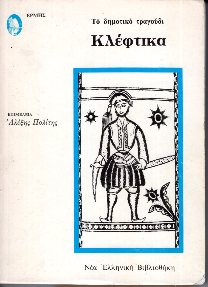
Selected standalone works: Folk Song: Klephtic Songs, Athens 1973, 3rd ed. 1985; The Discovery of Greek Folk Songs, Athens 1984, 2nd ed. 1999; Romantic Years: Ideologies and Mentalities in Greece, 1830–1880, Athens 1993, 3rd ed. 2003; Claude Fauriel, Greek Folk Songs, Vols. I–II, Heraklion 1999, 3rd ed. 2000; The Mythological Void, Athens 2000; A Handbook for the Modern Greek Scholar: Bibliographies, Dictionaries, Handbooks, Catalogues, Indexes, Chronologies, etc. (in collaboration with Triantafyllos Sklavenitis and Maria Mathioudaki), Heraklion 2002, 2nd ed. 2005; Imprints of Time, Athens 2006; Folk Song, Heraklion 2010; The Memoirs of General Makriyannis, Vols. I–III, Athens 2011 (edited, in collaboration with Georgia Papageorgiou).
Source: Αλέξης Πολίτης: Πέθανε ο φιλόλογος με τη σπουδαία συμβολή στο δημοτικό τραγούδι | Η ΚΑΘΗΜΕΡΙΝΗ

5 Likes

2 Likes

Here is his thesis:
https://thesis.ekt.gr/thesisBookReader/id/2468?lang=el#page/1/mode/2up

May he rest in peace

3 Likes

Our condolences to his brother, our very own Nikola.

10 Likes

His dissertation has been published and is available in bookshops.

1 Like

Thank you so much, my dear Nikola! Here’s to us!

11 Likes

Alexis Politis was indeed an important scholar of folk songs. This is not merely something we say in praise when someone dies; we said it while he was still alive:

He was the first — together with Guy Saunier, initially his teacher, if I am not mistaken, and later his collaborator — to undertake a general critical re-examination of Nikolaos G. Politis’s theory of folk songs, a theory that was groundbreaking in its time but undoubtedly outdated by now.

This is what I know from what I have read of his work. Clearly, I have not read all of it.

May his memory be eternal.

My condolences to his family, and our thoughts are with Niko.

2 Likes

May his memory be eternal, and may it of course live on through his works. May you have strength, and may you always remember him! :cry:

1 Like

The pain of loss is heavy for his loved ones, but his important work lives on.
My condolences, Mr Niko.

2 Likes

Niko Politis, let me express my heartfelt condolences for your loss.
We cannot escape these sorrows. Unfortunately.
Let me tell the forum members about the Politis family’s continuing contribution to Greek culture.
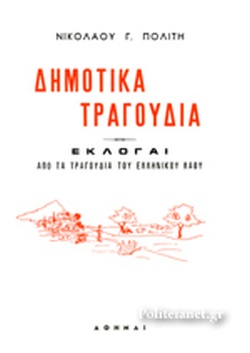
How many of you know this edition?
The grandfather of Alexis and Nikos Politis.

2 Likes

My condolences, Mr Politis. His important body of work will nevertheless live on; I have read some of it and wholeheartedly recommend Klephtic Songs and The Discovery of Greek Folk Song.

Why, everyone, Mr Spyros. It is the best-known work of Greek folklore. And even those who do not have such interests will have studied some texts from it at school.

… which, unfortunately, are, to a fairly considerable extent, „distorted“, even by N. G. P. himself and by his grandson. Let me explain:

From the time (the early nineteenth century) when a certain (German-speaking) von Haxthausen and the much better-known Frenchman Fauriel began publishing Greek folk songs, the European literary elite began taking an interest in them, albeit at a secondary level. Before long, other researchers also began working to showcase these verses and, of course, to collect and catalogue them. Since these researchers almost always had more than one transcription of the same song at their disposal, originating from different sources and, consequently, different geographical regions—often ten or more—the practice was to spread all the existing transcriptions out on the desk, with the collector „creating“ a new version by selecting what they considered to be the most beautiful / accurate / best variants of the individual lines. However, this practice meant that the „folk“ text ultimately published, presented, of course, as a genuine folk creation, had never actually been performed in that form. N. G. P. followed this practice as well.

5 Likes

My heartfelt condolences too to dear Niko…

My deepest condolences, Niko, to you and all your relatives.

Let’s include an in memoriam and three of his texts:

“Towards a corpus of folk songs. A survey of 19th-century collections”

View of Για ένα corpus των δημοτικών τραγουδιών. Έρανος συλλογών του 19ου αιώνα

“Seeking the objective in subjective information. Travellers of the mid-19th century: J.-A. Buchon, Edmond About and others”

View of Αναζητώντας το αντικειμενικό στις υποκειμενικές πληροφορίες. Ταξιδιώτες των μέσων του 19ου αιώνα: ο J.-A. Buchon, ο Εδμόνδος Αμπού, και άλλοι

“A klephtic song recorded in 1694”

View of A Kleftic song of 1694

3 Likes

Announcement from the University of Crete about Alexis Politis.


Posted by Giorgos Margaritis on Facebook.

2 Likes

My dear Niko, first of all, my condolences to you too. I have the first edition (1984) of the book “The Discovery of Greek Folk Songs”, which I bought from the “Katoi tou Vivliou” bookshop in Thessaloniki, and it is still a reference book for me.

As for your comment, I would add that both Fauriel and the pioneering Greek folklorists also overlooked the social/community contexts (social context) of folk songs in their research, such as performance (the way they were sung), music (the melody and any instruments), dance, and, generally, all those things that had no connection with the song as a text. On the other hand, from a purely linguistic point of view, it seems that there is a kind of “common language of folk song” that transcends the local pronunciation of each region. I am citing two articles: one by Sotiris Sarakis, in the 2006 issue of Mikrophilologika, and one by Peter Mackridge on academia.edu. In other words, although there were differences in the words/lyrics and content depending on the region, it seems that local singers adapted their pronunciation to a more “pan-Hellenic” or “common” pronunciation. For example, Sarakis writes that his brother in the village sings “Kitsios’s mother sat on the bank of the river”, whereas in everyday speech he would say “tou poutám” rather than “to potámi”. In other words, as far as the pronunciation of the words is concerned, this “homogenisation” may be due more to the local peasant informants than to the (urban) collectors, which I find remarkable and interesting.
https://www.academia.edu/2087480/Η_πανελλήνια_προφορική_γλώσσα_ο_βόρειος_φωνηεντισμός_και_το_δημοτικό_τραγούδι

Sarakis’s article is available here (issue 19):

Eva

1 Like

My dear Eva, thank you so very much! It is a great loss, of course—especially for me, there’s no question about that—but what they did lives on…

It wasn’t only the Greeks; all Europeans viewed folk songs as mere dry texts. The “trinity” so familiar to us—music, song, dance—was unknown to them. You see, it took a very long time for sound recording to be invented.

Of course, every “local” singer would adapt every “new” song they happened to hear so that it would fit what was familiar and known to them; and if an expression familiar in the region from which a song had begun to spread did not feel right to them, they would change either the pronunciation or the word itself to something more familiar. However, if, when singing a song, the singer says “στο ποτάμι” rather than “στου πουτάμ’”, as the local dialect familiar to them would have it, that may be because they believe the latter pronunciation would mark them as an “uneducated peasant” in the eyes of the foreigner listening to them—and they did not want that, whereas of course this was…

1 Like

And how is he supposed to say “stou poutám”, with three syllables, when the metre requires four syllables at that point in the verse? Indeed, even if the informant deliberately adjusts his pronunciation for the reasons Nikos gives, and says “sto” and “po-” like an Athenian rather than “stou” and “pou-”, whether or not he “drops vowels” in accordance with the norms of his dialect is not determined by his choices.

In all the regions of Greece where such dialects are spoken—dialects that “drop vowels”—the general rule is that they do not do so in songs. Thessaly and Roumeli, which are the principal cradles of the klephtic song tradition (along with the Morea, which does not drop vowels in this way anyway), do not do so. In Thrace, they may do it a little more. In Samos, Lesbos and Samothrace, where people speak that way too, they do it extensively in carnival songs, obscene songs, or simply humorous ones—but only there.

A line such as “den kelaydούse san poulí” has, in all the versions I have heard, never become “den kilaydούsi san tou pli”, even though there are ways of restoring the metre when a syllable has been lost.

Ha! What’s that little joke about the parrot in a cage in a solicitor’s waiting room, which a provincial patient hears saying something, and he immediately turns round and comments: «Blimey, I didn’t know you were a bird too, guv’nor solicitor!»?