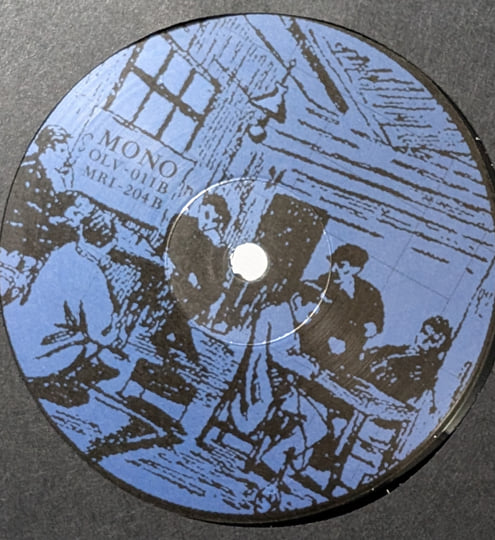
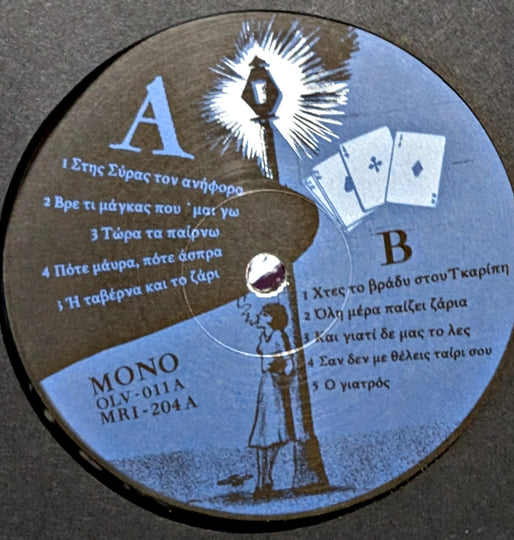
Γιώργος Κατσαρός - New album (2024)

About a month ago, a new record by Katsaros was released by the well-known Mississippi Records and Olvido Records. I’m posting it here because I haven’t seen it mentioned anywhere, and I’m surprised by this lack of even the most basic promotion. I haven’t listened to the record, so I can’t say anything about the release. I happened to see it the other day while passing a record shop in Thessaloniki.

6 Likes


The songs are familiar.
The now well-known clean recordings by these labels.

Well, the song “Στης Σύρας τον ανήφορο” is certainly a particularly characteristic example of the much-discussed—on this forum—possibly deliberate deviation by Katsaros from the song’s rhythm, as I might personally add (though of course I couldn’t prove it). What I realised for the first time today, however, is that the deviations always occur in the guitar accompaniment and never, ever, in the canto itself. When Katsaros sings, he doesn’t stray from the rhythm even once. Could it be, I find myself wondering, that he saw it as a kind of “mannerism for a personal style”?

We’ve said this before: it’s a common trait among people who play on their own. When we’re playing the melody, we can’t correct the rhythm at the same time. The lyrics also help with keeping count. So, when we play a piece without much practice, having only heard it somewhere (like Katsaros), the singing part usually comes out right, while we lose our way somewhere in the intro.
Obviously, it’s not intentional; it’s something that happens all over the world, all the time. Even when I’m playing in a venue, if someone asks me for a piece I’ve heard somewhere but have to work out on the spot, the vocals will come out reasonably well, but the intro will be completely off. If there’s a good guitarist to keep the bouzouki player on track, it will go a bit better—let’s not forget that Katsaros was absolutely spot-on when he played with others.

1 Like

In this particular one, or in others as well?

If, Niko, you mean this particular one, then it would be interesting to see whether it happens in others too.

Someone might say: so where exactly is the interest in that? The fact that Katsaros generally alters the metres but sometimes doesn’t is common knowledge. What would searching for the hidden “algorithm” (or perhaps “algorhythm” :wink: ) that determines which are right and which are wrong offer us?

Personally, I think it might shed light on one aspect of the broader issue of “music before its professional systematisation”. Let me remind you that whenever the subject has been discussed again, videos of Vrachna, Mouflou, Giorgis Papazoglou and various others have also been brought into the conversation—people who, in the modern era (with stages, microphones, records, etc.), still kept elements of the earlier phase alive.

Yes, I meant this particular one. Of course, it would be interesting to see whether the same thing happens elsewhere, all the more so if it happens everywhere, but sorry, I don’t have time to look into it at the moment. If anyone’s interested, there’s a splendid opportunity to distinguish themselves.

Nah, I don’t think so. I’m almost certain there are songs where the gaps between the lyrics have random durations, without a fixed metre.

Meanwhile, though, I’m listening to a few tracks. First on the list: Kakourga Elli (Κακούργα Έλλη): Absolutely!!! And here, too, the arrhythmias outside the singing section. !

As I’ve been listening to songs by Katsaros over the past few hours to look into something, I came across a small error in the transcription of the lyrics: In “And Why Don’t You Tell Us” (1928), the first verse is transcribed as:
Of the sea I bear a grudge, aman, aman,
Of the steamer amati

Katsaros sang:

Of the sea I bear a grudge, ’n aman aman aman,
Of the steamer ’n amachi

Amachi = battle, meaning roughly “I hate the steamer”. The word “amati” doesn’t mean anything in Greek.

It would be good if this could be corrected!

1 Like

Well, I didn’t expect it, but the album is still available, so I bought it.

The clarity of the sound is incredible. I feel as though Katsaros is playing so close to me that our knees are touching.

I only wish it were a little longer. A work of this calibre — both sonically and as an edition: besides the accompanying texts in English and the complete lyrics in Greek with an English translation, it is also exceptionally beautiful; you enjoy holding it in your hands and looking at it while listening to it — featuring only 5+5 songs is a shame.

1 Like

I’m rereading the thread, and it seems to me that Peloponnisios is right:

Indeed, it has been largely overlooked. This is a very important release that deserves more attention, unless, of course, there is another, more detailed reference to it on the forum.

It includes a biography of Katsaros, based—as the authors explain—on information and research that were not available to those who had previously written biographies of Katsaros. The most interesting point is that the myth of his extraordinary longevity is being challenged: according to sources cited consistently and accurately, he did not live for 108 years, nor indeed 120, as is said here and there, but only (!) 96.

This, and all the other information, is based on what has already been written about Katsaros, as well as on published research by Kounadis and Frangos (Steve Frangos) and personal research by @stavros_k (Stavros Kourousis). The opposing views are also presented, together with their supporting evidence, and the reader can make up their own mind.

I no longer have it in front of me: I bought the record in Athens, but I’ve now returned to Heraklion and couldn’t fit it in my luggage, so I’m writing from memory. I don’t know whether the insert is available online; in any case, I can’t find it at the original link in #1 (here). So I’d like to ask something, but I’ll necessarily have to be approximate:

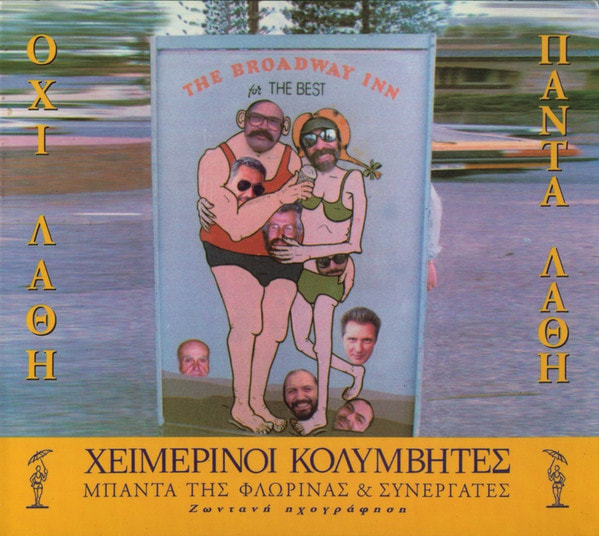
We read somewhere that when Kounadis tracked Katsaros down in Tarpon and brought him to Greece, he performed at two concerts, in Piraeus (or Athens?) and Thessaloniki, with the Winter Swimmers and the Florina Band respectively. Is that certain? Could it be that he performed alone at one of them and with both the Winter Swimmers and the Florina Band at the other? Because, firstly, the Winter Swimmers were collaborating with the band around that time, …

…and secondly, there are videos going around in which Katsaros, I think in Piraeus, is playing completely on his own.

Basically, it doesn’t even mention that the entire edition is Stavros’s work (along with others—I remember Kopanitsanos and Tony Klein).

Oh, come on, guys! It needs a completely new presentation from the outset.

What new presentation?

It’s a collection from Olvido Records, like the ones below at the link.

https://www.discogs.com/master/3639351-Giorgos-Katsaros-Giorgos-Katsaros

(A record label based in the USA, dedicated to the restoration and circulation of obscure music with due diligence to the artists, their kin and their culture.
Run by Gordon Wilson Ashworth.)

They collaborate with Tony Klein, Stavros, etc.

https://www.discogs.com/label/908593-Olvido-Records

I mean here on the forum.

Yesterday or the day before, I wrote in an unrelated thread: “Not that what I’m about to say is of great rebetiko interest, but…” [+hot take]. Well then, the release of this edition is very much a matter of great rebetiko interest. It’s gone completely unnoticed here. Peloponnisios, of all people, wrote it…

…but by now two years have passed, and surely some people will have bought it.

I’m not really in a position to say much because, as I explained, I did buy the record, listen to it and read all the texts, but I left it behind in Athens. Anyone else?

Or perhaps, why doesn’t @stavros_k write a few words himself?

Someone has to, though. We’re talking about a research event! It’s no small thing to have grown up with the myth of the over-century-old Katsaros, only for someone to come along and tell you, “I found these two documents in some American archives, whatever they were, and they overturn the entire picture we had up to now!”

I also learnt something else important from the texts in the booklet. Unreleased recordings by Katsaros have been found, and they have already been released in @stavros_k’s other publication, Greek Guitar. This had, of course, already been announced here as well, but the truth is that I didn’t pay much attention because I had rather assumed that a book with six CDs on a subject that isn’t my primary interest wouldn’t concern me. (Of course, if I see it in person, I may come to the opposite conclusion!)

2 Likes

Look, the truth, Pepe, is that the latest one also contains some pretty extreme findings, but we mainly focused on the spelling mistakes. In any case, I’m glad you’re someone who looks into things and recognises them—I’m saying this sincerely and respectfully.