The ‘old’ horizontal way of holding the bouzouki

Good evening, forum!

Excellent topic — I’ve been waiting for it for ages!

For me, more interesting than whether the bouzouki is held horizontally or not is whether it rests on the right leg or sits in the middle and is supported by the left leg (I’m talking about right-handed players, of course).

As examples from older players, we of course have Tsitsanis and Papaioannou.

Among contemporary players, Skoutas comes to mind, as does Stelios Papadopoulos, whom @icetelli also mentioned, and Tasos Giannousis.

I’ve always wondered why this way of holding it isn’t more popular, even though the shape of the body lends itself to it, and in general, in old photographs, we can see that it was more common.

I don’t think it’s for reasons of virtuosity, as I’ve seen quite a few photographs of Bembis playing this way!

2 Likes

I’ve heard and seen the issue of the supporting leg mentioned before by Giannis Papavassiliou, who often points out that resting the instrument directly between the two legs makes for more comfortable, less tiring playing. Of course, given that both Papavassiliou and Papaioannou are quite tall, perhaps having the neck farther away because of its position between the legs does not hinder them while playing (and we can say with certainty that this grip does not stop Papavassiliou from playing brilliantly!). It is important to point out, of course, that both Papavassiliou and Skoutas hold the neck at an upward angle, unlike players from earlier generations.

“Another issue is the position of the bouzouki—where you place it—which even Themis Papavassiliou didn’t examine, although I have the utmost respect for Themis, how can I put it… (Ed.: Themis Papavassiliou, bouzouki teacher; merely a case of shared surnames.) He has produced some superb players. The position of the bouzouki—that is, how you hold it. I’ve identified five of them: Bembis, Papaioannou, Kalfopoulos, Karapatakis and Chatzichristos. Right here in the middle, exactly like a guitar, in the middle (Ed.: demonstrates the position). Look here (Ed.: demonstrates the sideways position): you strain yourself here, whereas in the middle you don’t. Look at the difference—it’s a less tiring position. You can play with the plectrum for ten hours without getting tired. Watch Bembis’s playing: he has a classical training, and here the instrument rests against the stomach. Your back straightens and you can lean back, whereas in the other posture you can’t lean back, you understand?”

2 Likes

Thank you very much for the article!

I’d noticed that Vlachos plays it in the middle in most of his videos from the last ten years or so, whereas in older ones you can see him using a really high footstool and holding it on the right. But I didn’t know that he promoted this as the correct way to hold it!

I think that, to some extent, the fact that you don’t see many players playing like this is also a matter of style. Just as the guitar isn’t usually played between the legs in jazz and rock music, because that position is associated with classical music. In the same way, for some reason the image of the bouzouki on the right-hand side may have become established. Perhaps it’s because of the image of the Eastern saz player versus that of the Western classical guitarist. Just speculation…

Ultimately, how each person finds it most comfortable depends on their body proportions.

1 Like

I haven’t paid attention to how saz players usually hold the saz, but I do remember how I was taught to hold it when I was having lessons (by a teacher who had himself been taught by another teacher, and so on, eventually tracing back to teachers from Turkey, where the practice is systematic and has been incorporated into conservatoire teaching): at a 45-degree angle, with the soundbox to the right of the right leg, and supported by the forearm of the right hand (the one holding the pick), so that the left hand doesn’t need to support it and can simply move up and down the fretboard.

The general position, particularly the 45-degree angle, is more or less similar to that of a classical guitarist.

I was referring to whether the speaker sits between the legs, not the angle of the hose, as the main difference.

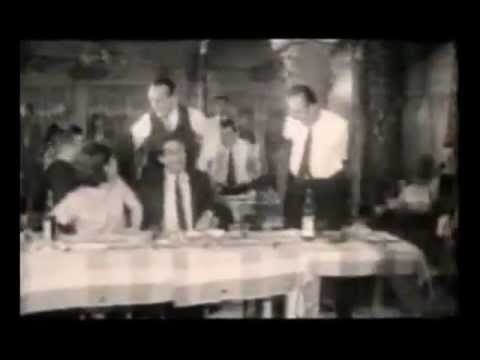
16:28! Here the way of holding it is clearly visible in action. And, in response to the claim “it’s playback”, I wonder: even so, is there any chance that Papaioannou would hold the bouzouki differently from how he would if it were actually a live performance? Furthermore, we can observe the bouzouki player on the right holding it with an upward tilt, more commonly seen in later periods.

My conclusion is as follows: the cases examined in relation to the “horizontal” way of holding it concerned:

- People who were tall. For example, Papaioannou, Tsitsanis and Papavasileiou

- In cases where height is not mentioned, I believe that this is simply more convenient for some players as a matter of habit (e.g. Stouraitis), without this indicating any greater comfort while playing. On the contrary, if one observes other instruments with a (relatively) long neck, such as our traditional laouto, one will notice that it used to be held differently, whereas the modern approach involves a hold similar to that of the great Christos Zotos. Instruments such as the oud, because of their large body and short neck, are better suited to being held at a downward angle.

- It may also have been an earlier trend; in other words, perhaps older players simply held the bouzouki this way through imitation. The older the photographs, the more often this way of holding it appears. Here I would emphasise Markos as a striking counterexample, since he holds the instrument at an upward angle.

In conclusion… one could argue that this informal little “research project” through this thread is nothing more than a belief arising from my imagination and my general love of the bouzouki. Nevertheless, I still do not consider this way of holding it to be a random phenomenon, even though I myself find it more comfortable and believe that it is much easier to support the instrument on the right leg (if the pick is held in the right hand), thereby bringing the fretboard closer to the centre of the body so that the fretting hand has shorter distances to travel.

PS: The discussion takes on another, more conspiratorial dimension if one starts wondering about the angle of the body (in short, how much the soundboard faces “upwards”), followed by the angle of the pick, and so on… I believe that these are issues which have been extensively investigated for other instruments in order to arrive at findings that optimise technique and make playing more comfortable—perhaps the most important consideration of all those mentioned above.

1 Like

Interesting point. I’d venture to say that, because there wasn’t really any established method for learning the bouzouki back then—with a prescribed body position, pick technique and various other things that are somewhat standardised—everyone held it however felt most comfortable for their body and, more or less, developed their own technique. I think the interesting part of your reply lies in what you say about the angle of the bouzouki in relation to the pick, and so on. If I hold the instrument completely vertically, so that I can see only the side markers on the neck, personally I can’t use many different pick techniques. You lose the support of the soundboard, which encourages you to play purely from the wrist. I consider that important for speed, but not for tone. With a slight—or sometimes quite pronounced—angle towards me, I have room to use more finger-driven technique on the bouzouki, always combined with the wrist, to bring out different colours with the pick. It really does matter.

Ooooh!!! 1,000% yes. For any Papaioannou…

1 Like

Specifically regarding Papaioannou, I’ve never seen him play any differently! Whether in videos or photographs. So I think it would be very odd for him to think, „I’ll change the way I play“ every time a camera appeared. Let’s remember the photograph of Papaioannou playing the cymbals — it’s clear that it’s a genuine live moment!

As for the other players… opinions differ. If you look back at live videos, such as the videos I’ve posted above showing Stouraitis not playing along to a backing track but performing normally at a venue.

Very much alive indeed, but I wish I could get this photograph (or photographs, since there’s no way only one was taken…) out of my mind, especially those where he “plays” the baglamas behind his back, “dancing” on top of the little mound of broken plates. I don’t feel particularly proud of our musical culture when I see these displays…

1 Like

That’s what I love about Papaioannou—the ugly charmer. The Belmondo of the bouzouki. Such a legend… and the plates, what can I say, just as you say…

1 Like

good!
and good again! And good once more (did I feed the system..?)

1 Like

I think that playing horizontally is probably what a self-taught musician would do instinctively, and Markos, who was a little intimidated by “serious” music, may have been influenced by maestro Peristeris—they may even have had some discussion about technique.

But Papaioannou was probably not the only example of an idiosyncratic way of holding the bouzouki. Tsitsanis also rested his finger on the soundboard. The point is that, despite their individual quirks, they managed to develop their own personal sound. By this I mean that I agree with what Anestakos says.

“Because at the time there was no established method for learning the bouzouki—with a prescribed body position, pick technique and certain other things that are more or less standardised—each person held it however they wanted, depending on their physique and what felt comfortable, and more or less developed their own technique.”

Things are different today. Technique has advanced so much that we have reached the point where there are chameleon-like bouzouki players. They can imitate the sound of any old bouzouki player-composer. At the same time, they can also demonstrate a sound of their own.

1 Like

I’d missed this topic; I hadn’t seen it last year when it was discussed. Very interesting, and I had exactly the same concern as Jimmy.

The now-famous video from the French television documentary (if I remember correctly), in which Markos and Tsitsanis play live and on their own, in their prime, of course.
https://www.youtube.com/watch?v=KzPP-RDxK2I&list=RDKzPP-RDxK2I&start_radio=1

1 Like

This method is also generally recommended by Yiannis Papavasileiou (with the instrument supported on the left leg and against the abdomen). Tringas recommends it to some extent as well (support on the right leg, but with the arm completely horizontal, parallel to the ground).
Indeed, it may seem somewhat awkward, but there is a very simple reason in favour of this choice: it keeps the shoulders low and relaxed. As you can see, all string-instrument teachers “fight” for relaxed shoulders! They claim that relaxation starts in the shoulders and travels down into the arms, and that if the shoulders are raised and tense, the arms never relax.

1 Like