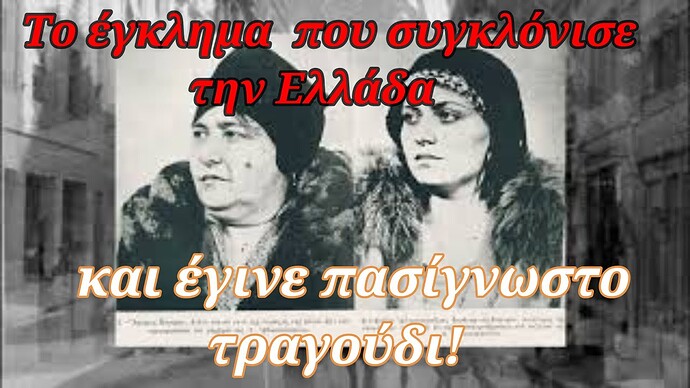
Guys, it’s both a street and a neighbourhood, but the crime took place in the neighbourhood, not on the street. And the book is called Crime in Harokopou.
On more substantive matters:
I see the song more as a document of what the prevailing perception of events was at the time. I haven’t read the book (although I had bought it as a present for a friend who lived precisely there); I’ve read and heard a few things about the actual events, but I can’t claim to know them, and I don’t equate the song with someone coming out and asserting in prose, “This is how things happened”, when they actually happened differently.
Are historical songs and klephtic songs and rhymes (about murders, accidents, etc.) always accurate and, above all, impartial? They are testimonies to how events were perceived. They were not written by people capable of maintaining a historian’s distance, nor necessarily by people who had a complete picture (especially if we’re talking about the era of Athanasopoulos, when mass media existed). We wouldn’t rely on them to form an opinion about the events. They are, however, evidence of their time.
I’m in favour of them being sung, but hearing them carries a certain responsibility.
The contemporary anachronistic reflex of projecting current values onto past societies and cultural formations seems to lead to “censorial” practices and “reconstructions” of the reclaim type.
As we’ve seen before in a discussion here, Athanasopoulos was a tyrant to the women in his household. This became apparent during the trial, even though it was neither fair nor impartial (it was blatantly biased in the man’s favour), and it actually marked the beginning of a shift in public opinion.
All of this is relevant because we see the same thing happening today, with so many femicides. Well, sometimes the women manage to take revenge before they are murdered…
So, a reclaim that puts things into their proper perspective and sends every Athanasopoulos to the dungeon or ditch he deserves would be most welcome.
(For reference, Wikipedia, among other sources, contains quite a bit of information from newspapers of the time.)
Anthime, I get the impression that you have a legal background that I don’t. What could a married woman, for example, do if her husband raped her in the time of Athanasopoulos? It really isn’t such a distant era—we still read the literature of the Generation of the ’30s, still sing the songs, and so on.
Did Greek law at the time recognise rape between spouses? How would the police have dealt with a complaint? We know that, in divorces, the husband used to keep the children. Were there shelters for women? And so on. Given all these circumstances, is the wicked mother-in-law and the heartless wife, etc., really to blame?
As for the heartless woman, I don’t know, but as for the wicked mother-in-law, I don’t think there can be any disagreement. A woman who forces her helpless daughter to marry her lover. Who, even after marrying her daughter off to him, continued having sexual relations with him. Out of guilt at hearing her daughter being raped (what is legally described as “against nature”), she decided to intervene and have her intellectually disabled nephew kill him, promising him that if he did so, he would marry her daughter—and his cousin—as well, etc., etc., etc. Everyone had dirty hands. From the perpetrators right down to the victim, who was a real diamond of a man himself. The maestro and orchestrator of the whole affair was the—Naturally, the lengths of the sentences were ridiculous.