Where does the idea that stigkáro means “gather the sails” come from? I’m asking because, as far as I know, when a fishing caique under sail weighs anchor, the next step is to hoist its sails (= raise them), not gather them. Then it sets off back towards shore, its nets full.
So, could it be that the song describes a process incorrectly (using the right words)? Or did he just throw in that rare word (for most people) at random?
Even I, who am not a sailor, understand that when you raise the anchor, you set sail to leave—you don’t gather the sails in. But I only understood it because Nikos explained it, writing in ordinary rather than specialist nautical language. The way the song puts it, I wouldn’t even have noticed whether I was making sense, or whether that meaning was logical.
Of course it makes no sense to furl and stow the sails once I’ve set out on the voyage; that only happens when I return to port. Conclusion: what Pericles says in his #4 is indeed happening here: an incorrect description of the procedure. It’s neither the first nor the second time this has happened in an interwar song. As if anyone’s going to put Tountas up against a wall — “But how can you drop anchor after weighing anchor? Are you trying to drive us mad?” Quite simply, Tountas wasn’t going to lose any sleep over it: the rhyme “weigh anchor — drop anchor” occurred to him, and that was that — the line was made! And Tountas got away scot-free, despite never having had anything to do with the sea, neither in Smyrna nor in Alexandria.
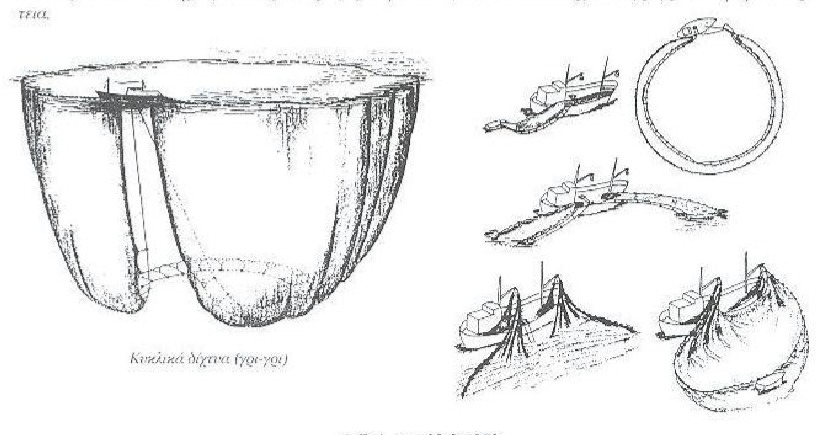
purse seine: an encircling net whose lower part is closed using a wire rope (στίγκος or στίγκα) that runs through a series of rings; pursing = closing the net
Quite right: we haul in the nets! Makes sense, since they’ve filled up (with fish). And now that we’ve also learnt that the stígka / stígko is the wire we pull to haul them in, we stíngar.
(What we do with the sails is a completely different matter…)