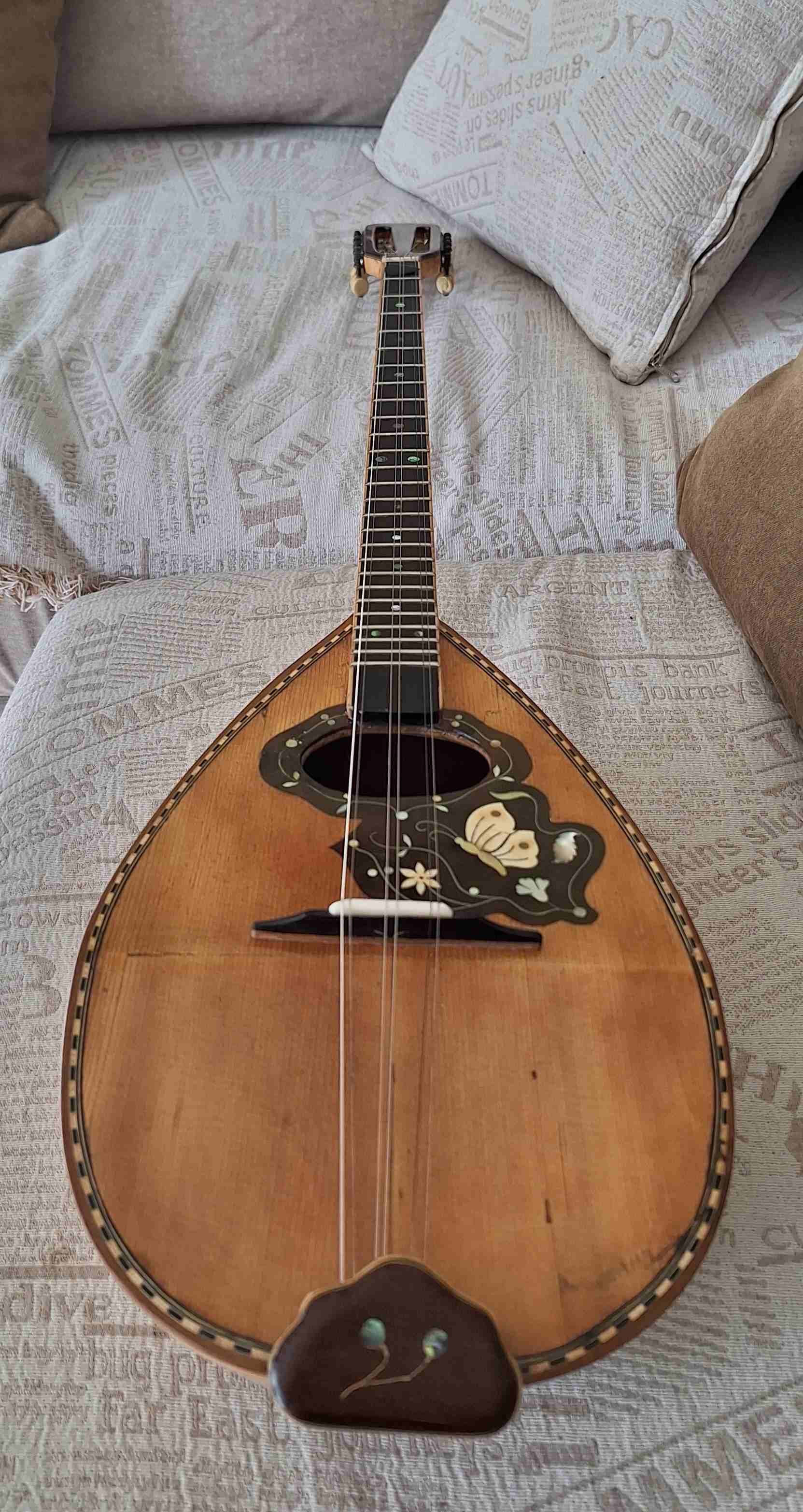
The whole project started with a German-made mandolin from the 1950s (maker unknown). It was bought on eBay in poor condition with the intention of converting it. In order to carry out the conversion, the body had to be opened up and reinforced. I enlarged the neck block, reinforced the body rim with an additional lining, and glued the loose and broken rib back together. The entire body was reinforced with gauze and newly paper-lined.
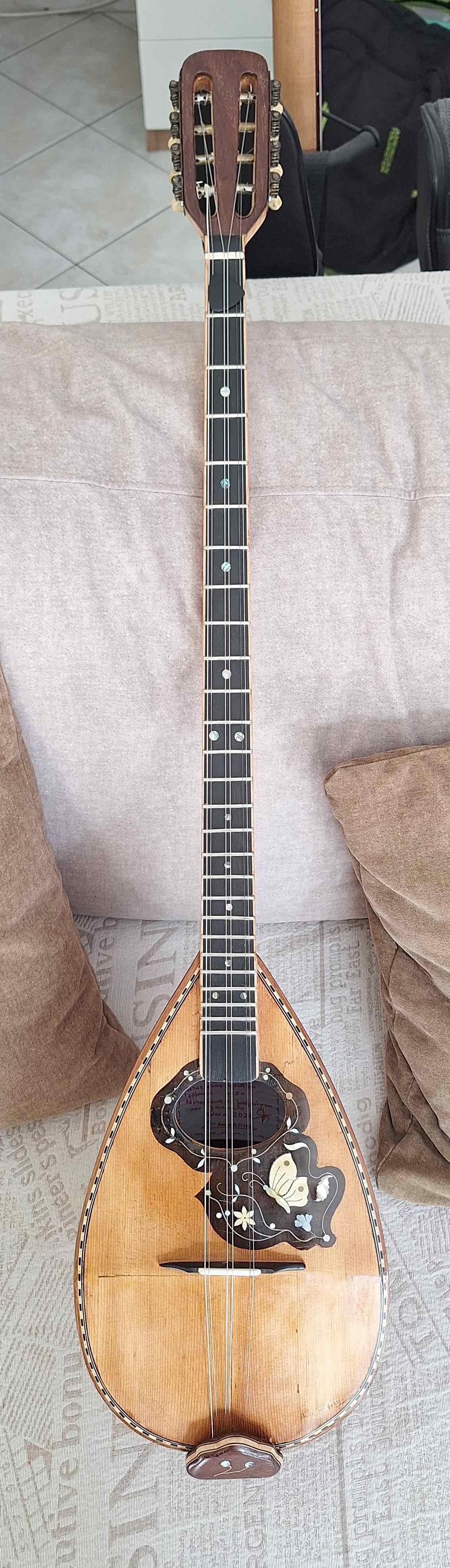
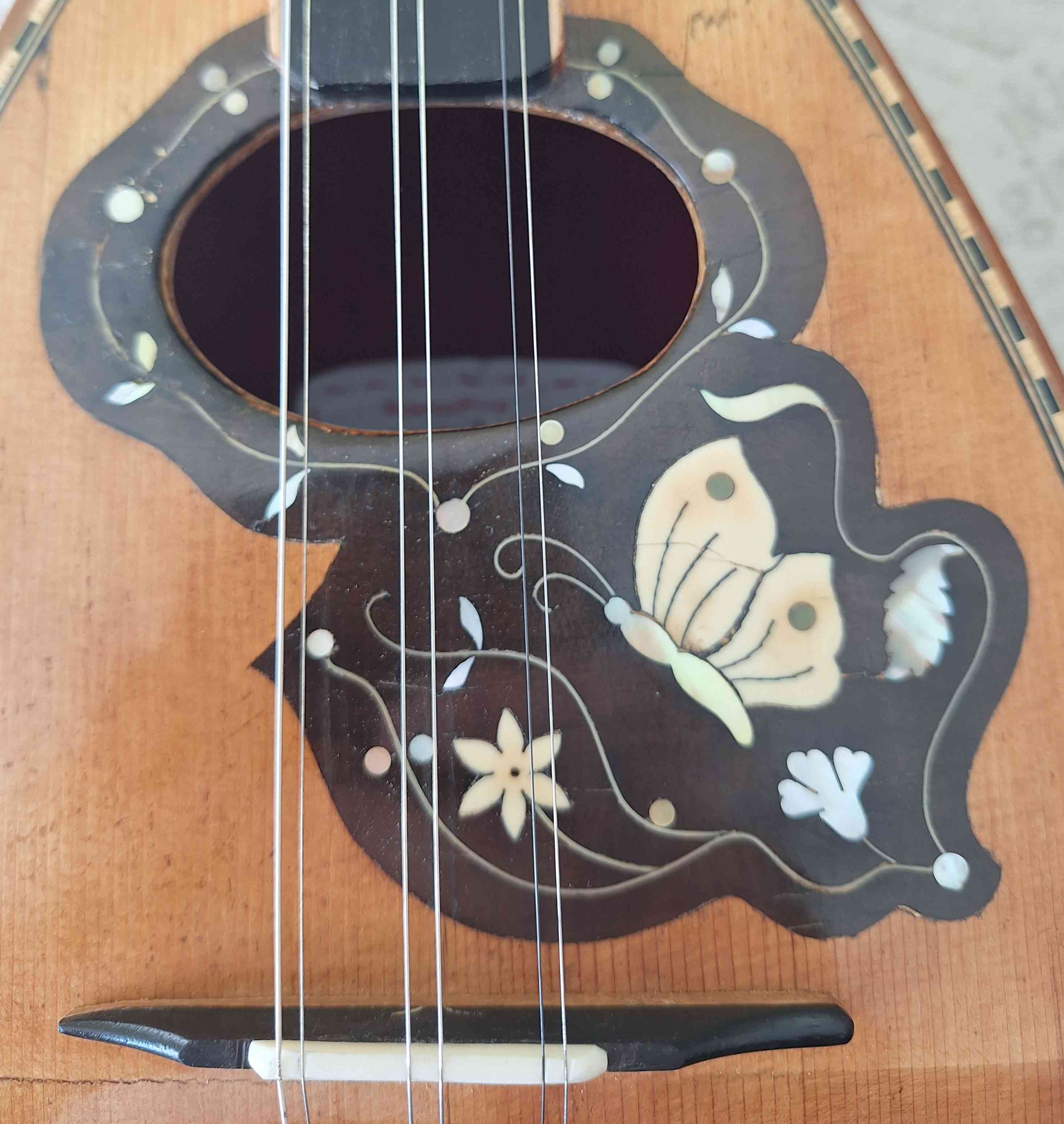
The cracks in the soundboard were glued and reinforced, and the pickguard and rosette were restored by adding the missing shell inlays as well as the background (rosewood dust mixed with glue); the broken bone parts were re-glued. The peripheral purfling was replaced with new material, and the original bridge was modified.
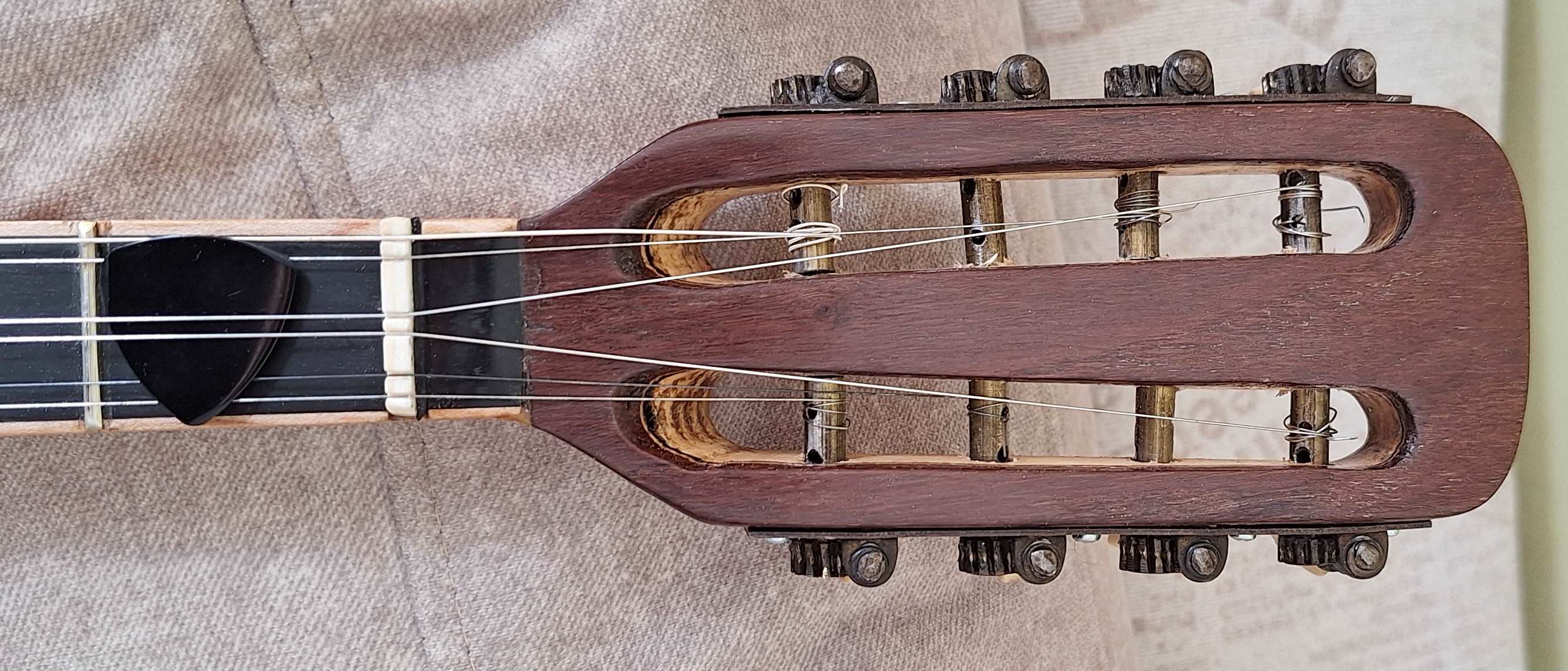
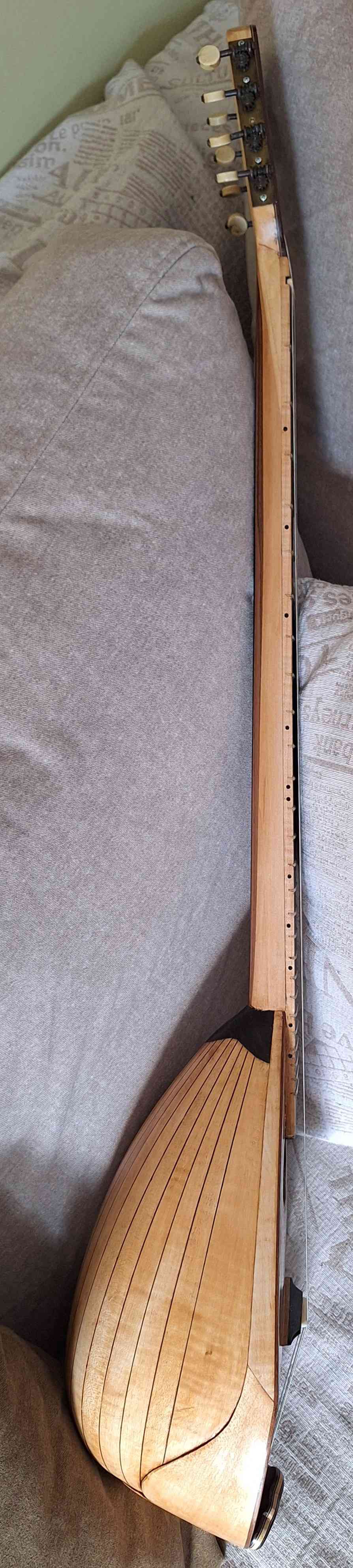
For the conversion, the neck was removed and a new one was made, adapted for a 63 cm scale. The shape of the pegbox was copied and a new one made. New ebony fingerboard with figured maple outer binding.
A new tailpiece was made, based on a typical baglamas tailpiece, with a wooden cover.
Main features:
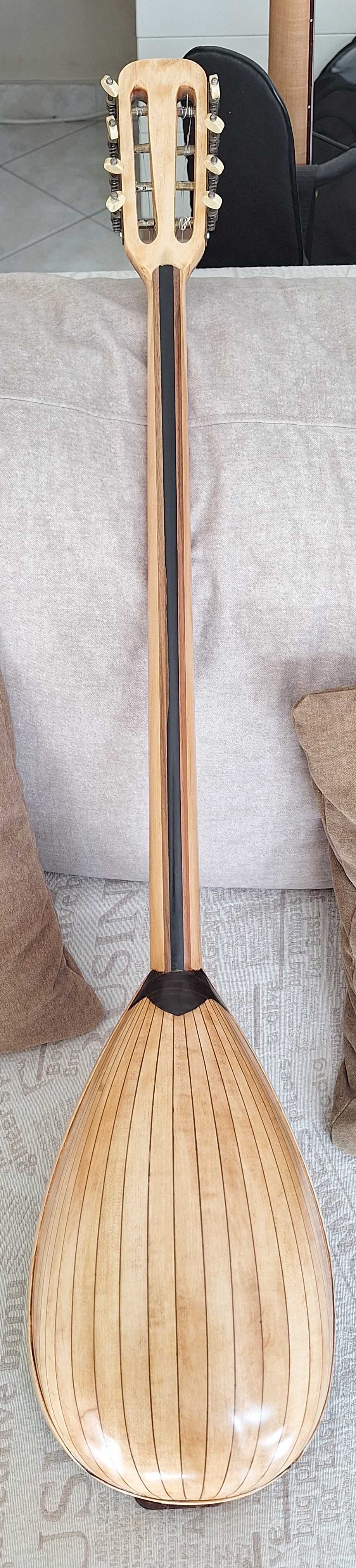
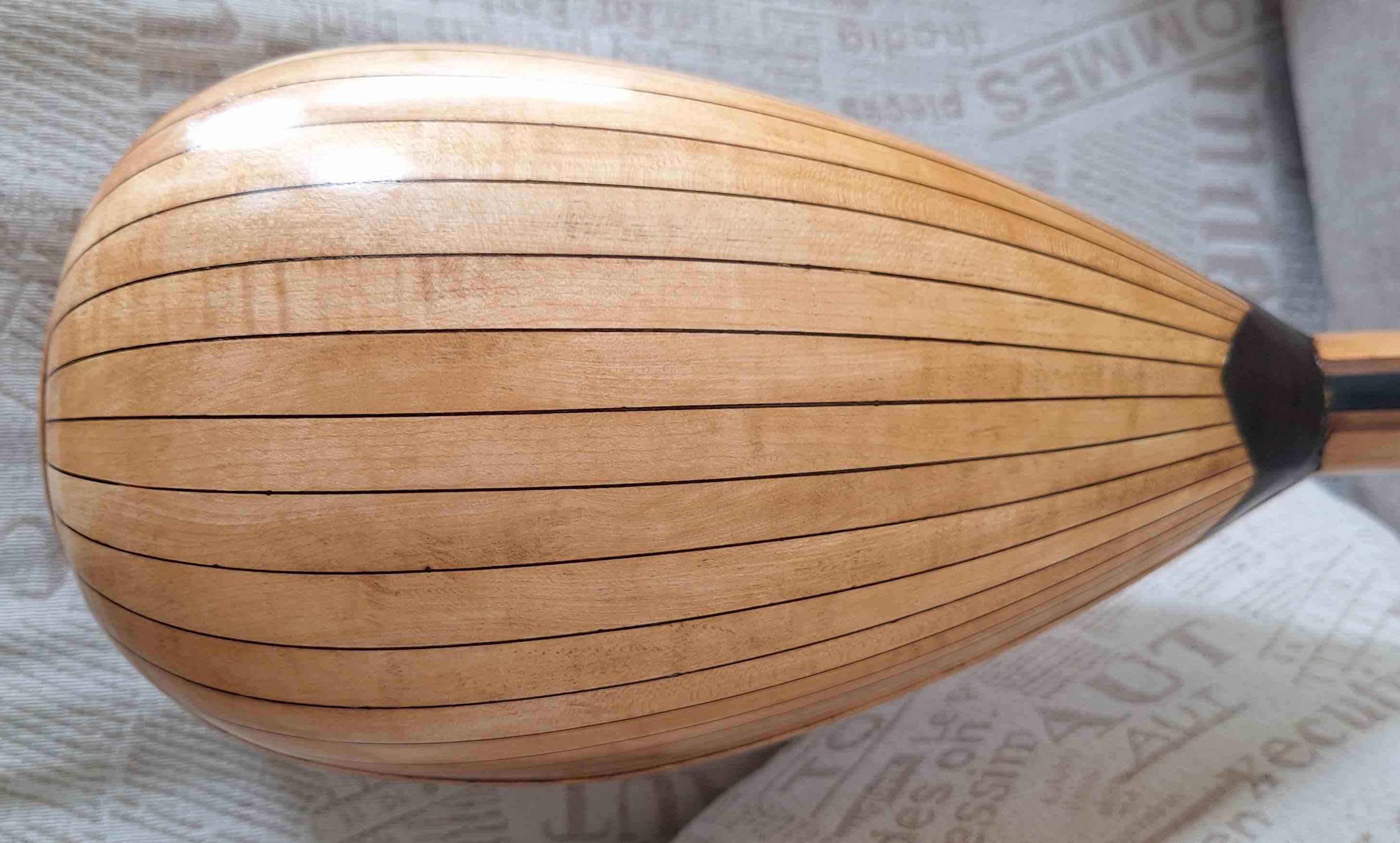
Body: figured maple with black purfling; dimensions: length 32 cm, maximum width 19.5 cm, maximum depth 13.4 cm. Backstrip made of Macassar ebony (not present on the original body).
Soundboard: spruce. Pickguard and rosette in one piece. Beautiful shell and bone design (by the original maker). Thin purfling made of synthetic material (celluloid). Classic soundboard with a crease. Peripheral purfling: black/white/black/black-and-white (pre-made)/mahogany.
Bridge: light-coloured rosewood added to the original, ebony (original), bone — length 9 cm, height 16 mm.
Tailpiece: homemade, with a wooden cover (French mulberry, white/black purfling, figured maple, black/white purfling, French mulberry). Decoration with figured maple purfling and abalone shell.
Neck: limewood/Greek walnut/ebony (two-tone)/Greek walnut/limewood
Fingerboard: ebony with figured maple outer binding — 26 frets, neck joint at the 21st fret. Scale length 63 cm. Abalone fret markers, with celluloid ones along the sides.
Pegbox: limewood, white/black wooden purfling, French walnut.
Tuners: brass mandolin tuners (the original ones, after servicing and repair)
Finish: nitrocellulose sealer/French polish
More details about the conversion at luthier.gr
Μετασκευή μαντολίνου σε μισομπούζουκο
And a first rough mobile-phone video, which does not do the sound justice.
https://www.youtube.com/watch?v=aZ0GmZmgayg
The strings normally need replacing, and a slight rattle can be heard.

Great job, mate.

Thank you, Nikola.
I chose to keep as many of the original parts as I could (basically the much-abused lid with the beautiful figure), as well as the worn keys, bridge and bone.
What was the rationale behind choosing the scale?
At first, I was considering a 67 cm scale length, like on a bouzouki. I’ve even made tzouras with a 65 cm scale, but it occurred to me that some of the earliest bouzoukis had a 63 cm scale, so I decided to try it. I was ultimately satisfied with the result. The sound is very close to that of the pre-war bouzoukis heard in the earliest recordings. It resembles a tzoura, but with more volume.
Well done, Dimitris — I can see you’re progressing both as a player and as an instrument maker! I’d be delighted to see you at the next get-together, along with the brand-new little instrument, of course.
(+2 for the choices from Cheimerinous)
Niko (Liga Riosa), thanks for your kind words, although you’re exaggerating. As for my playing, let’s not go there. I’ve been playing for 30 years, but if you don’t study, you won’t get anywhere. As for instrument making, I’m doing my best and making slow but steady progress. I was working on the half-bouzouki alongside a new build: a three-course instrument with a break and a bowl with carved ribs. I’ve finished it, and I’ll be presenting that one too in a few days.
As for the get-togethers, I haven’t been able to come for many years. The weekday ones they organise are difficult for me, which is why we meet at the luthier’s at weekends. Anyway, if I do come, I’ll definitely sit quietly. I’m miles behind the average level of the players on the rebetiko forum.
P.S.
The Winter Swimmers are much loved! Of course I was there on the rocks in October; after all, Vyronas is my neighbourhood too.
The luthier’s gatherings are great too, lovely company! But why so quiet, mate? We all play to have fun.
We’re looking forward to the three-string one too.
Oh, come on! If you’re miles behind, I’m whole kilometres behind. And I play at the get-togethers too. No one imposes restrictive limits on us…
The parasang was an ancient measure of length which, according to the views most consistent with ancient accounts, was equivalent to a distance of 30 stadia, that is, 30 × 185.15 = 5,554.5 metres in modern units — the distance a pedestrian would normally cover in approximately one hour.
However, it seems that the length of the parasang was not fixed, as it represented different distances in different periods. This accounts for the information given by later Greek writers, according to whom it was equivalent at various times to 60, 40, 30 or 21 stadia. The parasang was most commonly used to calculate the length of royal roads.
Exactly! So this:
we correct to:
If you fall short by parasangs, I fall short by dozens of parasangs.
(which, even if we put hundreds, the meaning remains the same…)
I made another quick little video in my kitchen to compare the sound.
The first instrument you hear is a tzouras (maple and rosewood, with a Sitka spruce soundboard), with a 65 cm scale length.
The second is this half-bouzouki, converted from another instrument, with a 63 cm scale length.
The third is a bouzouki with a bend in the soundboard (maple and walnut, with a spruce soundboard), with a 68 cm scale length.
The instruments can be seen in the video thumbnail.

Hello, Dimitri, with your lovely bouzoukis!
Lovely rebetiko sound!