Μαρίκα Νίνου – Love That Became a Double-Edged Knife | New restoration from the original 1955 gramophone record

We made a new recording and restoration of the beloved song “Love That Became a Double-Edged Knife”, performed by Marika Ninou.

The track was clearly neither one of the “lost” recordings nor one of those without a decent-quality digital version. However, it lacked fullness in the bass, and much of the magic of the voice and the song had been lost through the excessive use or addition of too much depth (a classic mistake) in the early digital versions that had become popular.

So our team wanted to leave behind a new, clean-sounding version that was closer to the original recording.

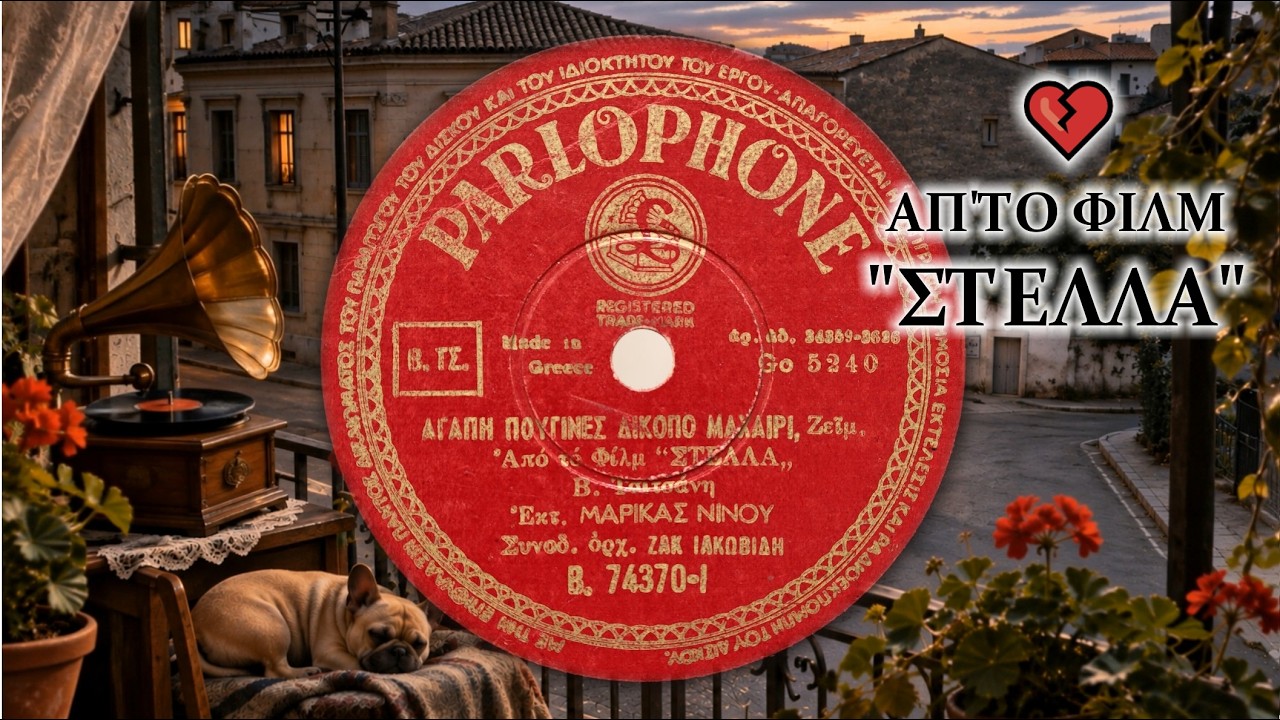
This historic recording is performed by Marika Ninou, accompanied by the orchestra of Zak Iakovidis. It was recorded on 1 December 1955 and is one of Ninou’s final recorded performances. Her passionate and distinctive voice gave the song a deeply personal character. Although Melina Mercouri performed it in the original film, Ninou’s rendition became established as a historic recording.

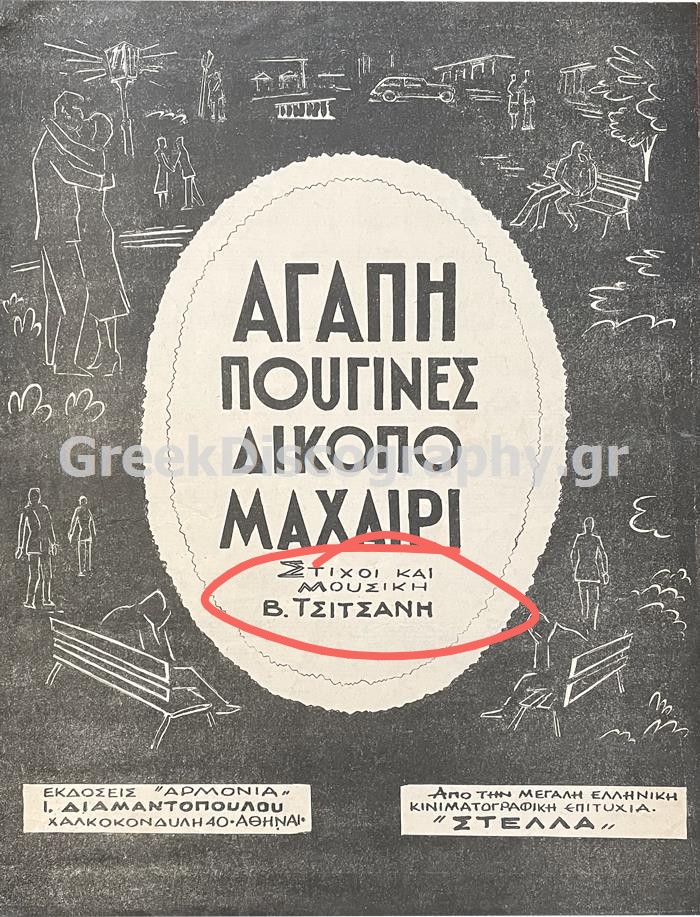
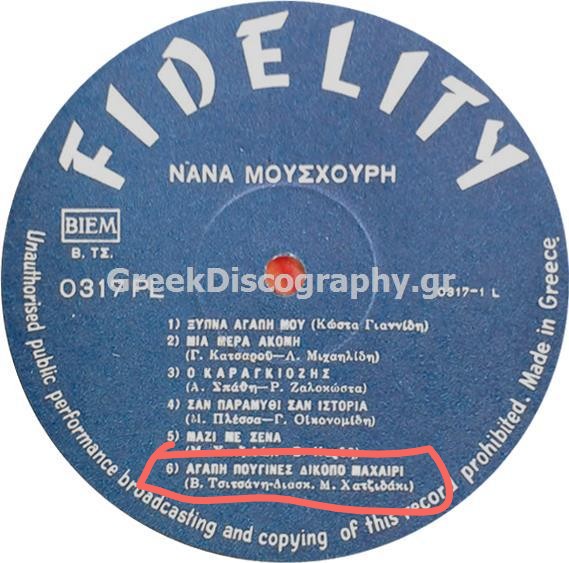
It is yet another song with a “controversial” attribution of composition and music, since the following paradox arises: the record lists Tsitsanis as the creator, while it came to be accepted that the song had been written by Manos Hadjidakis.

Of course, the truth lies somewhere in the “middle”:

The key lies in an earlier song: “The Mad Gypsy”—also known as “Crazy Gypsy, Where Are You Going?” Its melody formed the basis for this song from Stella. It was therefore not an entirely independent composition by Hadjidakis.

What exactly happened?

“The Mad Gypsy” came first. Its basic melody is associated with Tsitsanis, but there had already been an earlier dispute over whether the composition belonged to him or to Ioanna Georgakopoulou. Georgakopoulou claimed that the melody was hers (after it had been given to her by Tsitsanis!).

For “Stella”, Hadjidakis reworked this melodic foundation. Cacoyannis wrote the lyrics. Melina Mercouri performed it in the film in 1955. Tsitsanis had a close musical collaboration with the production and took part in the film’s popular music sections.

In an interview with Lefteris Papadopoulos, published in the magazine Difono in January 1998, Tsitsanis is reported to have said:

“It isn’t mine. Hadjidakis took the basic melody from my ‘The Mad Gypsy’ and wrote it.”

“Obviously, following an agreement between them.”

This is very important testimony, because he himself did not claim to have composed Stella’s song in its entirety. However, he did acknowledge his own melodic contribution.

Enjoy listening :heart::sparkles:

2 Likes

and the sheet music from the period, explaining who, when, where, and how.

1 Like

Wonderful find!.. “Tsitsanis” there too :slight_smile:

I didn’t know any of this. I had grown up believing that the song was credited to Hadjidakis and stolen from The Crazy Gypsy.

It’s strange, too: if it really had been credited to Hadjidakis, anyone could have noticed the similarity to Tsitsanis’s song and said, “But it can’t be — it’s Tsitsanis’s.” It isn’t hidden, and The Crazy Gypsy isn’t exactly an obscure song.

But since the opposite is true — Tsitsanis is credited with a song that resembles another of his own — where does Hadjidakis come into it? Where did they get the idea that he was credited with it? Only (I assume) from the rest of the film’s music, or from his other collaborations with Cacoyannis and Melina.

______________________

Edit: Do the film’s credits say Tsitsanis, as do the record and the sheet music? Or is that where the misinformation started?

Here’s to more of the same!

P.S. Regarding the confusion over the credits, might it have started because Hatzidakis found references to the original composer in arrangements aesthetically distasteful, as when Mitsakis took him to court?

1 Like

Your question is entirely reasonable, but I think we need to distinguish between three separate issues: who created “Crazy Gypsy”, who made use of its melody in “Love That Became a Double-Edged Knife”, and how authorship of the latter song was ultimately credited in the various editions…

Apart from the aforementioned interview with Lefteris Papadopoulos, the story has been illuminated by testimony from Kostas Ferris, who took part in the Rebetiko Forum discussion in 2005. He stated that the song was registered with AEPI as a composition by Manos Hadjidakis and Vassilis Tsitsanis, with lyrics by Michalis Kakogiannis. He even described how Hadjidakis asked to borrow one of Tsitsanis’s melodies, and how the latter suggested “Crazy Gypsy”.

Therefore, the appearance of Tsitsanis’s name on the labels is neither inexplicable nor necessarily contradictory. There are different discographical credits: some editions name Tsitsanis, while others name Hadjidakis.

The article in Ta Nea dated 29 August 2011 records this discrepancy particularly clearly, even among the 1955 records…!!

There is, of course, a second, even more complicated issue: the authorship of “Crazy Gypsy” itself. Ioanna Georgakopoulou claimed that the song was hers (with a kind of “grant” from Tsitsanis) and that she had first performed it with Stellakis Perpiniadis in 1947, to lyrics by Charalampos Vasileiadis! So perhaps we cannot simply take it for granted that Tsitsanis had the exclusive right to grant use of that particular melody…(!)

Consequently, it would not be entirely correct to say that Hadjidakis composed the song from scratch, nor that Tsitsanis alone wrote the whole of “Love That Became a Double-Edged Knife”. The picture that emerges from the available testimonies is one of a collaboration, involving the use of the melodic foundation of “Crazy Gypsy” and further reworking by Hadjidakis.

And that is precisely why the different listing of the creators on the original labels is interesting: we should neither ignore it nor regard it, on its own, as definitive proof of authorship.

Another incredible story surrounding the creation of a beloved song! :smile:

Sorry, who am I speaking to? Was this comment written by a human or by artificial intelligence?

My question was actually the exact opposite. Since Tsitsanis was essentially the one who wrote it, and Tsitsanis is credited on both the record and the sheet music, I was asking where the rumour that Hatzidakis was the author came from.

Of course you’re talking to a human! Artificial intelligence couldn’t possibly be posting and interacting here :sweat_smile:

Back to the subject: These are simply two cases (Ninou’s record and the particular score, which, I admit, we hadn’t found either) where Tsitsanis alone is listed as the creator! As was mentioned earlier in the lengthy text, which you may not have understood on your first reading, it wasn’t all like that!

For example, on the film-related record Parlophone B.74344 – Melina Mercouri (1955), Hatzidakis, rather than Tsitsanis, is listed as the creator.

Manos Hatzidakis is also credited in the film itself.

That is precisely what I pointed out to you in the sentence referring to the article in Ta Nea.

In the meantime, on later records (e.g. performances by Beba Blanche), even Ioanna Georgakopoulou is listed on her own! (And not Tsitsanis or Hatzidakis.) Precisely because of the unclear situation that had arisen through the succession of disputes and statements by the people involved.

**And of course there were also others that credited both of them, or even all three! (Which may ultimately have been closest to the truth).

I can see that in all the recordings, Hatzidakis is credited as the orchestra conductor (he also played the piano).
Sapountzaki
Mary Lou
Ninou
Chrysafi
Mouschouri
And in a collection with Mouschouri, we see Hatzidakis credited as the arranger
(for a composition by Tsitsanis).