Good morning. Today I found this little gem. Made by Ioannis Aerakis in Ampelokipi. Its scale length is 36.3 cm, fret to fret. I’m posting it because it impressed me..
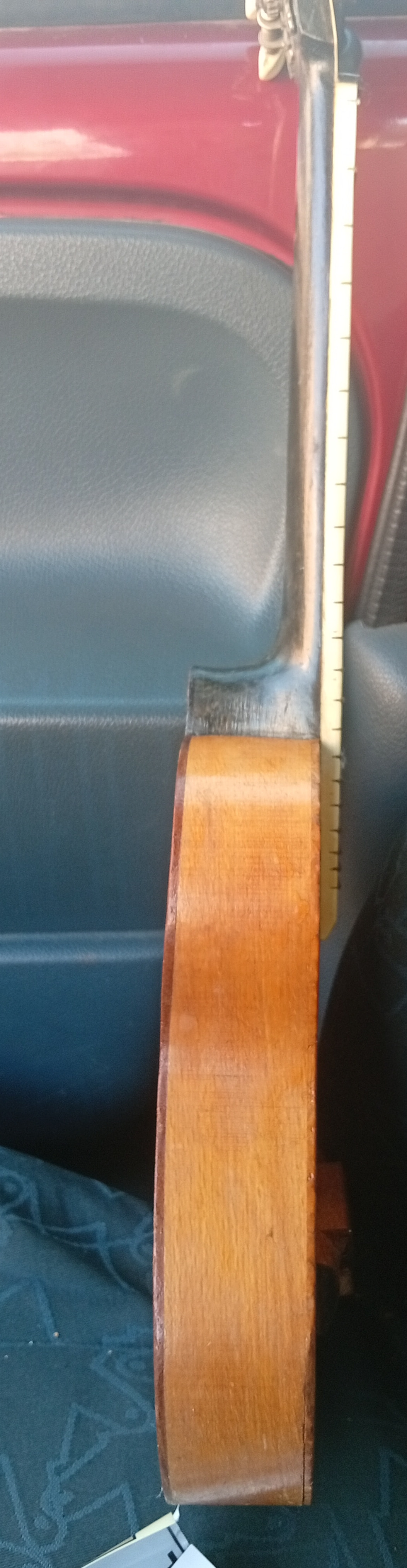
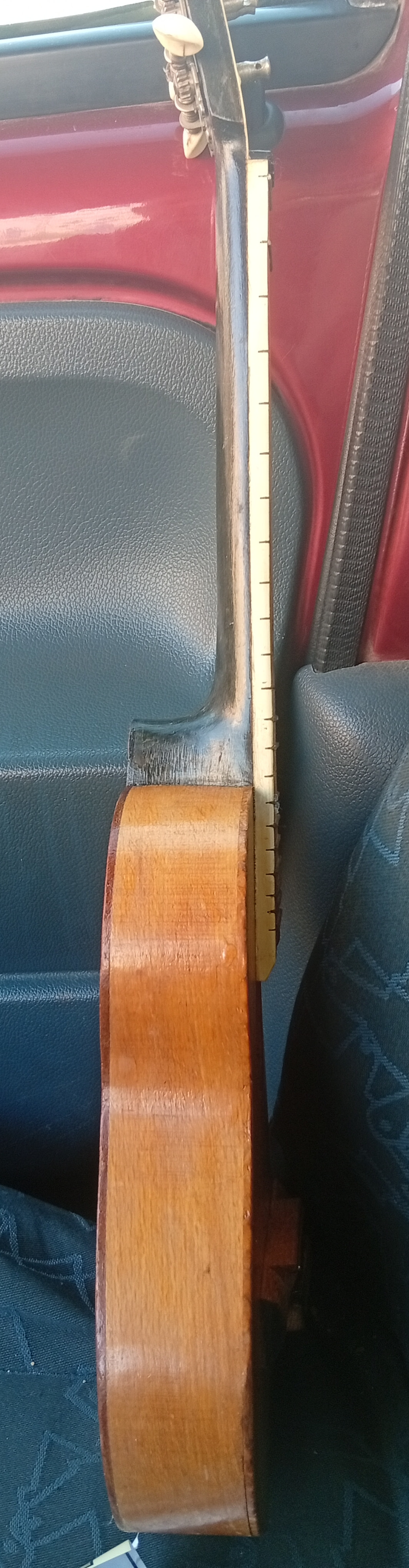
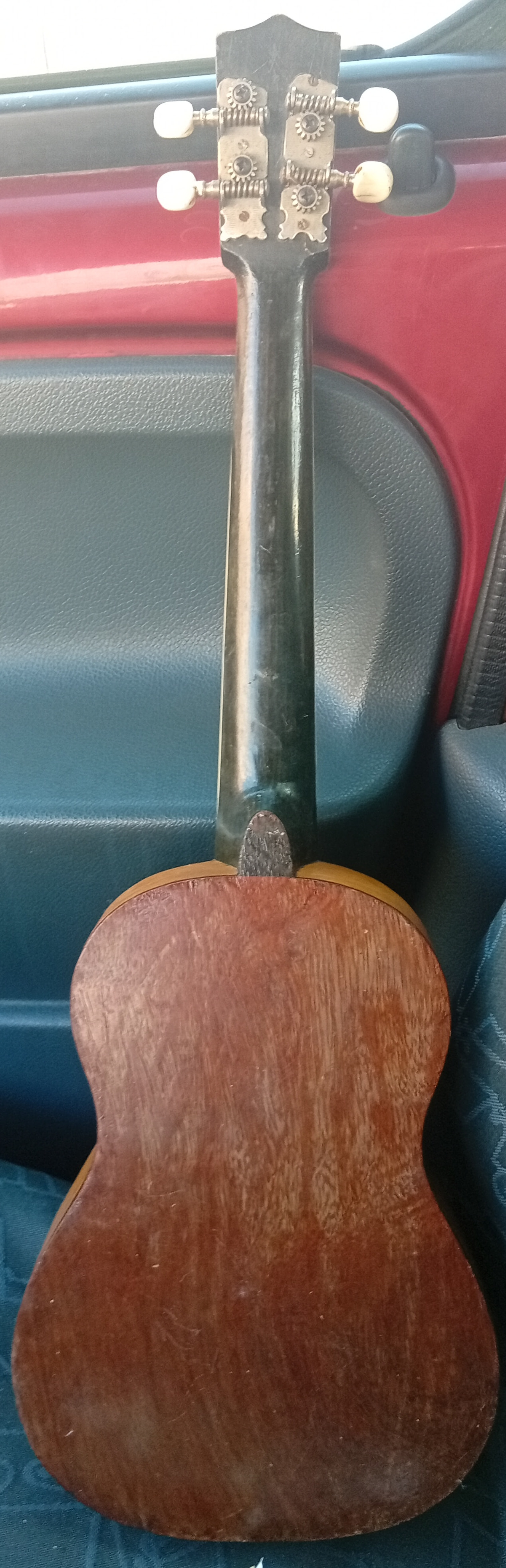
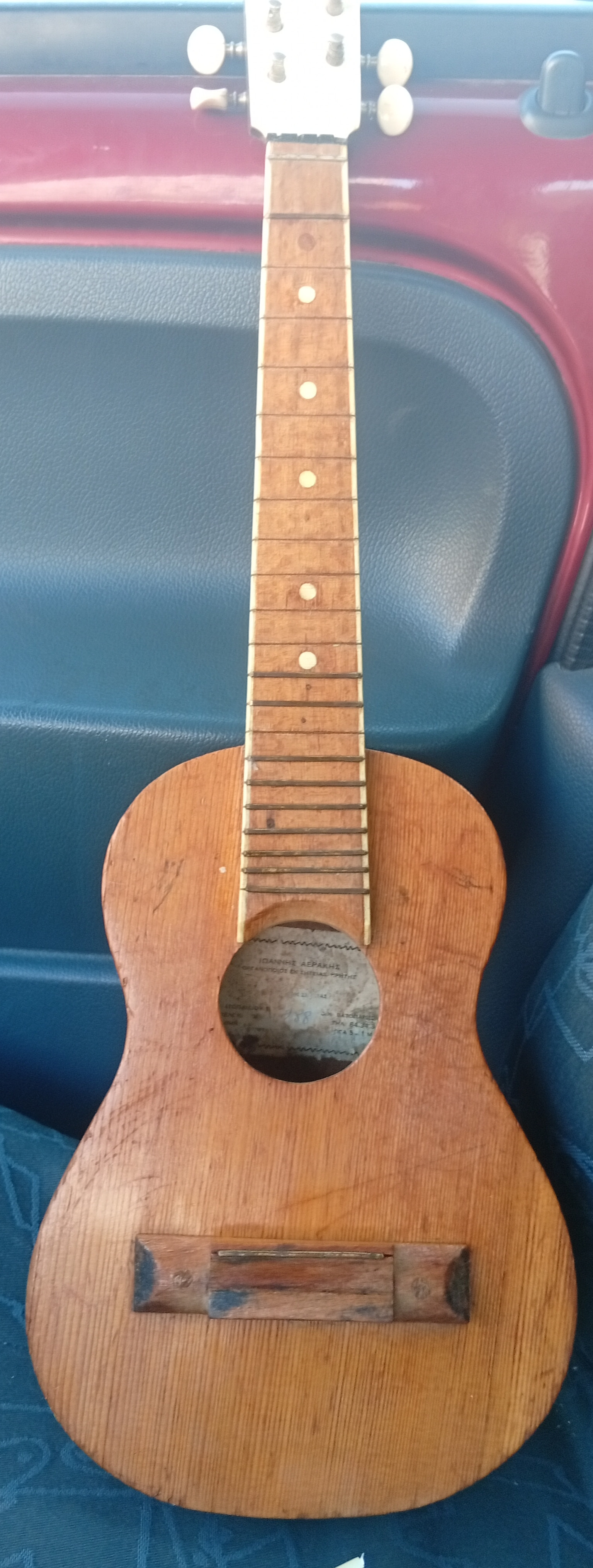
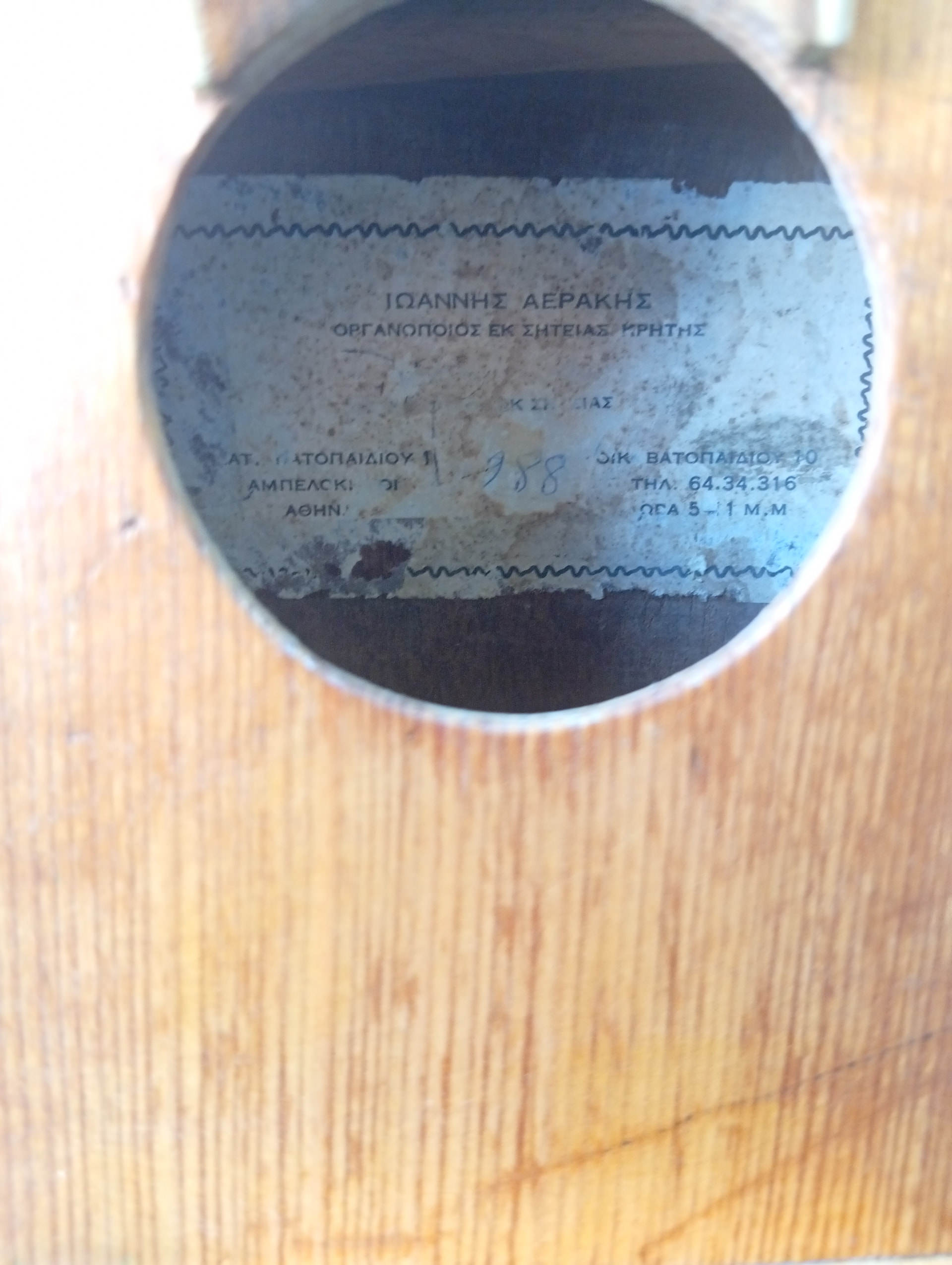
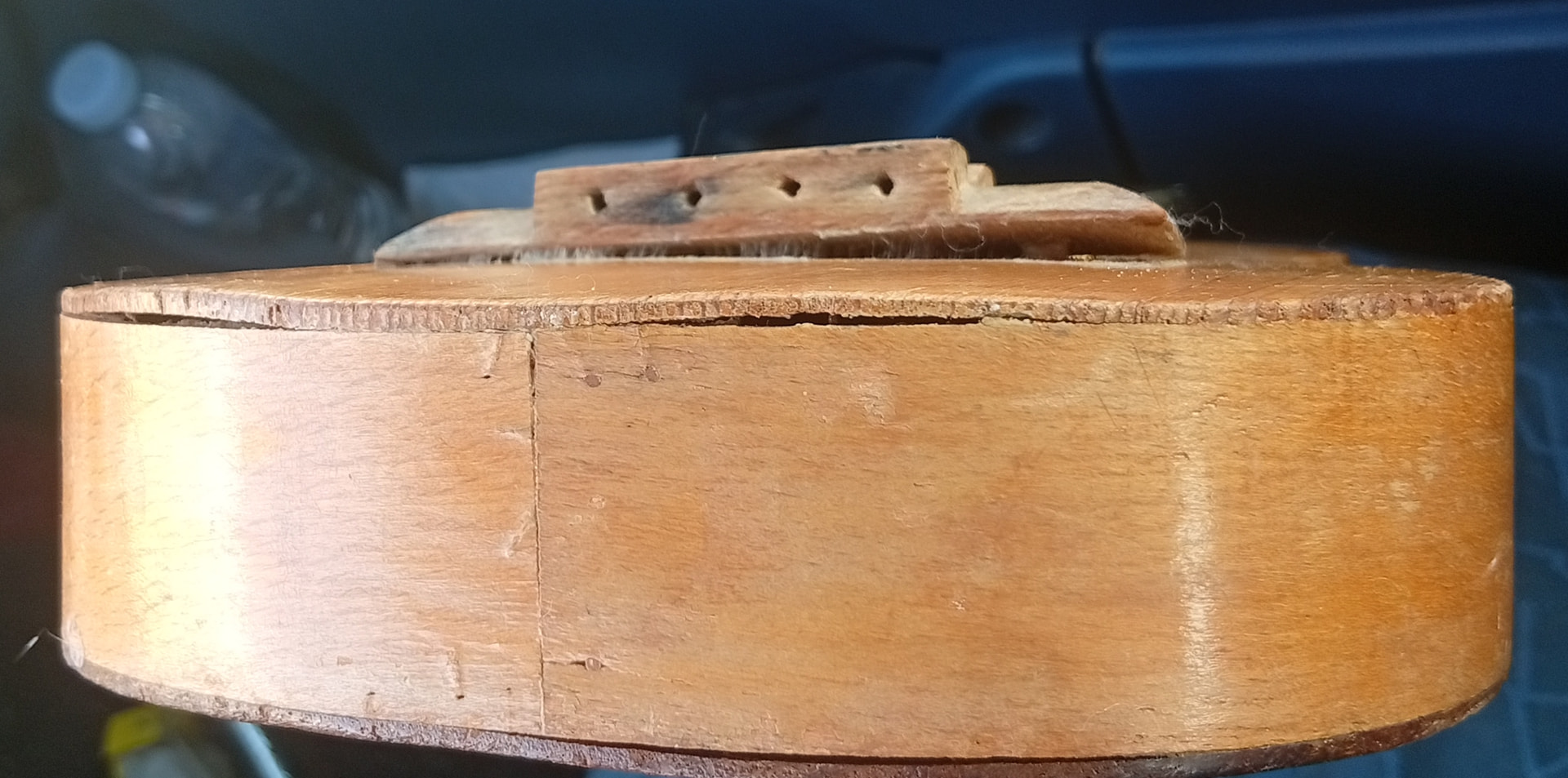
A very distinctive build, a little four-stringed fawn. It brings to mind some Latin American guitar-like instruments. Does the label say 1988?
We measure the scale from bridge to bridge—the length of the free string. What do you mean by fret to fret?
“Isn’t it ‘ukulele’?”
The free string length is between the extra frets on the bridges. If you look closely, you can see it in the photos. Regarding the 988, is it a date or a serial number? I can’t make it out.
1 Like
It doesn’t have a bone; it has a fret.
1 Like
We call these four-stringed instruments tenors.
tenor guitar, tenor banjo, etc.
2 Likes
The scale length is the length of the entire free section of the string when you are not fretting it, so from the nut to the bridge. This measurement is also called the instrument’s scale. How long is it?
This particular instrument also has a zero fret. I don’t know why, but that doesn’t affect the measurement.
The 36.3 you found is some other distance; you didn’t explain which one, but in any case it isn’t significant.
I don’t know what the usual scale length of a ukulele is (that’s what it’s called in Greek). A first search doesn’t turn up figures like that, but from experience I know that it’s more or less the same as a baglamas, or slightly longer. It does indeed have four single strings. Of course, besides the standard ukulele, there are also various lower-pitched (and therefore larger) models: tenor, baritone, etc. By standard I mean the soprano, which is the smallest of all and is usually simply called a “ukulele” (whereas the others are specified: tenor ukulele, etc.).
However, besides the ukulele, there are many other instruments whose general appearance is guitar-like, in a variety of sizes and with different numbers of strings. Mainly Latin American ones: requinto, charango, and various others. But there are also examples outside Latin America: the chitarra battente of southern Italy is a distinct instrument from the ordinary guitar, as is a certain Maltese guitar-like instrument. Many of these also come in ranges of sizes, from the lowest-pitched and largest to the highest-pitched and smallest.
To get an idea of this whole broader family of guitar-like instruments that are not all guitars, let’s think of the acoustic bass guitar, which most of us have probably seen: it looks enough like a guitar that a non-specialist might mistake it for one, but it has four strings, which are thicker; the instrument as a whole is larger than a guitar; I don’t know whether the ratio of the neck length to the body is also greater than it is on a guitar (as it is on an electric bass); I imagine it also has unseen structural differences to withstand the tension of the bass strings, which is greater than that of guitar strings. So, taken as a whole, it isn’t a guitar; it’s a bass. Well, the ukulele, charango, chitarra battente, etc. are similar: they aren’t guitars. But they do look like them.
This instrument is something from that group. Quite possibly, indeed, a ukulele. Or it may be some unfamiliar (to me) type of small four-string guitar.
1 Like
When I say the open-string length on this particular instrument, I mean from fret 0, as you call it, to the part that serves as the saddle on the lower bridge. That’s what I measured.
1 Like
At this scale, it’ll be a ukulele. I do like that he used Cretan keys, though.
So you measured it correctly.
That’s what it seems to say, but it isn’t in a place where it says „year of manufacture“ or anything else equally clear. There’s room for a little doubt. Also, the luthier was from Sitia, but his workshop was in Athens, in Ampelokipi.
1 Like
Am I to assume that the instrument is designed so that the “open” strings always line up with fret 0? It seems to be higher than the others? (*) I can’t imagine what purpose it serves. Is there a type of stringed instrument where this is customary? And if so, what purpose does it serve?
(I know that it existed on some old tambour-like instruments, but there it served an entirely different system for attaching the strings to the tuning pegs. This is something else.)
________________________________________________
(*) You can try using a large ruler or a similar object to see whether, when placed from the upper to the lower bridge, it lines up with fret 0.
Thank you all for your replies. I’ll see if I can sell it to someone who would be interested in repairing it and keeping it. It does seem to be well made, though; it isn’t a mass-produced children’s guitar, which is why I bought it. Thanks again. If I manage to find out anything more, I’ll post it on the forum. Just for the record…
1 Like
Before I forget, what you said about the ruler won’t work because the bridge has come loose to a large extent and needs to be glued back in place first so that it can be seen.
1 Like
There’s a guide nut behind the zero fret. It used to be found on cheap guitars. I imagine it lowered the action.
This used to be common; the English Wikipedia explains it here: Zero fret - Wikipedia
Any relation to Stelios and Michalis Aerakis?
The zero fret is a common technique. To find the exact scale length, measure from the zero fret to the 12th fret and double it to find the open-string length.
The Aerakis family are Anogeians (Rethymno). The lyra player Nikiforos and others are from the same family.
The instrument maker is from Sitia.
1 Like