If you hadn’t said so, it would never have crossed my mind!
I’ve thought about something similar, converting a classical guitar into a tres cubano. The problem with the laoutokitharo (λαουτοκίθαρο) is that you need to support eight steel strings, which creates two issues:
α) Greater tension, which the neck may not be able to withstand. There’s more tension both because of the steel strings and because there are more strings.
β) Eight holes, equally spaced, in the lower bridge.
Bridges don’t come off the soundboard easily. It’s not impossible, but you could damage the soundboard, or even crack it. Afterwards, you’d have to design a new bridge with eight holes, or fit a movable one and anchor the strings to a metal mechanism on the body.
The upper bridge is fairly easy to make; it would necessarily have to be a new one, of course, so that each string is evenly spaced from the next.
Now, the sound is a whole different matter. Classical guitars have extensive bracing, while I’ve no idea what kind of bracing lutes have. Acoustic guitars, at any rate, have completely different bracing from classical guitars. It’s obviously a risk, and given that you’d have to remove the bridge, it isn’t easy to return the instrument to its previous state.
One modification you could try would be to use doubled strings only for the two treble courses and leave the bass strings single. That way, the total number of strings remains six. With the lower saddle, you can guide the strings wherever you want by cutting grooves, and you can do the same with the upper saddle.
At some point I’m planning to experiment by making a classical tres cubano, which has six strings in three pairs, like the three-string guitar.
Not equally spaced. In pairs.
Nah, I don’t think so. Apart from the fact that you won’t get a lute-like sound, the geometry will be odd as well. Six strings arranged not in groups of three but as 2-2-1-1—where will they pull from?
The observations are spot on.
All of this carries a risk.
Of course, it won’t have a lute-like sound; it will sound completely different. But it could turn out well. If you take a look at the Latin American tradition, they have created guitar-like instruments in every conceivable size and with every possible combination of strings. From the enormous Mexican ones to the ukulele, and from the tres to the twelve-string guitar.
Finally, I forgot to point out that classical guitars have quite a wide fingerboard. This will also be a problem, since spacing the strings evenly in pairs would leave huge gaps between them. If you narrow the neck, on the other hand, there is an even greater risk that it won’t withstand the extra tension. Perhaps an acoustic guitar would be a safer starting point for this conversion than a classical one.
As for the risk with the sound, you’re right: it’s an experiment, and we don’t know what it might produce—possibly something good. You’re also right about the Latin American guitar-like instruments, some of which are even called “such-and-such guitar”, while others have completely different names, showing that they don’t even consider them guitars (requinto, charango…)
But what about the strings? As you sit and play, you have a pair of treble strings at the bottom, attached to the lower row of tuning machines. Further up, there’s a pair consisting of one treble and one bass string: the lower one (the treble string) is attached to the lower row of tuning machines as well, but the upper one (the bass string) to the opposite row. This is the part that seems to me as though it would cause a problem: imagine the angle it would make between the tuning peg and the nut. Further up, there is one bass string and then another, in the normal positions on the upper row of tuning machines.
I think you would want either a 2+4 arrangement rather than 3+3, or an entirely different construction with an oud-style headstock and friction pegs. (Some of the Latin American guitar-like instruments mentioned above use friction pegs, but not the oud’s complicated headstock, because they don’t need it.)
A very good point—I hadn’t thought of that.
I went back through that old, massive discussion from the beginning. Not 100% of it—I skipped over some bits too.
We had started with Anogeianakis’s text, which argues that at some point folk musicians had almost come to feel ashamed of their art, and that the lute-guitar came along to meet their “need” to appear more modern without having to learn the guitar proper, a new instrument.
I wonder whether it came to meet completely different needs:
Is building a guitar soundbox—with a two-piece back and two sides—not simpler than building the lute’s bowl, with its staves and all the trouble they involve? That’s where the whole comparison lies: in the soundbox. The soundboard and the rest of the instrument are more or less the same in the lute and the lute-guitar.
So if it really is simpler to build, could the lute-guitar simply have been the instrument makers’ solution for being able to sell cheaper lutes (and therefore more of them), and, correspondingly, the instrument players’ solution for buying cheaper lutes?
But why make one at all? There has never been an instrument called a “lute-guitar”. The “term” arose from the need some lute players had, in earlier times, to be able to play in the absence of a lute, but with plenty of guitars available: they would take a guitar and change its strings so that it could be played like a lute.
In ’#126 above (which until recently was in another thread), I wrote about another possible cause that I’ve just thought of, which may have led to the development of this type of instrument.
In any case, it used to be played quite a lot, so it was made as well. It isn’t played very much nowadays, so it takes some digging.
Yes, it was played, but it was always a guitar—the well-known six-string instrument—which some laouto players and non-guitarists would restring to turn it into a “laoutoguitar”, even though it was already a guitar.
Do we know this for certain? That is, that they were converted guitars rather than instruments made in Greece from the outset to be tuned like a laouto?
Well, yes. Instruments made from the outset to be tuned as laouta are called laouta. They also have a distinctive, unique shape—that of the laouto.
I think we’re getting confused:
the first possibility is that someone took a ready-made guitar and put laouto strings on it.
the other possibility is that someone built a laouto from scratch (with the bracing, scale length, etc.) and made it flat, with the appearance of a guitar.
Do we know which of the two is happening?
Yes, but I’m not aware of any such cases, at least. If anyone made such a lute-guitar and an example has survived, let’s see it!
I haven’t actually handled such an instrument myself. My objection is this: when we say that the louto-guitar doesn’t exist because it is a modified guitar,
that requires evidence, in my opinion. So, have you come across the other case—a guitar modified to have lute tuning?
We had a similar discussion about Penanen when he decided that the bouzouki was made from mandolas.
Here’s one from the interwar period.
And here’s another one
The laoutokithara, like the laouto but unlike the guitar, has its fingerboard at the same level as the soundboard. The guitar’s is higher. And, of course, the laoutokithara has no frets; it has tied frets.
We have seen all this in countless photographs, of course.
If these features have been achieved by modifying guitars, that is already far more than simply changing the strings. I do not know whether there are also differences in the unseen parts of the instrument, such as the braces and so on.
I do not think we can simply call it “a guitar with laouto strings”, even if in some cases that is all that has been done, without any further modifications.
Quite apart from the fact that even a “simple” change of strings may require modification to the headstock to accommodate four banks of tuning pegs in place of the guitar’s three.
If that’s really how things are, then here’s a golden opportunity for anyone who’s keen to look into it. Go on, whoever’s interested…
From a construction standpoint, a lute-guitar should have significant differences from a guitar.
A fingerboard level with the soundboard (as mentioned above) and wooden struts.
A lute scale length (72–75 cm), considerably longer than that of any acoustic guitar.
Eight strings instead of six, so a different pegbox, and certainly more robust bracing, as well as a larger neck with stronger reinforcements.
A joint at the 11th fret.
Although I have no evidence to substantiate this, I estimate that the lute-guitar is more likely to have emerged as a kind of modernisation of the “lowly” traditional instrument.
As for converting a guitar, if you take an acoustic guitar with a large body (say, a jumbo), you remove the soundboard and neck, install new reinforcements, and end up with a hybrid instrument. With a small guitar body, you will not have the necessary volume needed for the lute’s tone. Such conversions are not unusual—for example, converting a mandolin into a bouzouki or tzoura. Personally, I have made a half-bouzouki from a mandolin. I have also seen a guitar (a 3/4-size classical guitar) converted into a guitar-bouzouki by following the method I mentioned above, essentially keeping only the body. With this in mind, if you find a guitar with a broken soundboard, you can convert it, avoiding the construction of a new body—and you’ll be more modern as well.
3 Likes
The laouto-guitars came about because of fashion and embarrassment, at the same time! They had nothing whatsoever to do with patents or conversions. Besides, laoutos have eight strings, while guitars have six… Generally speaking, laouto-guitars are more laoutos than guitars!..
When guitars (acoustic and electric) became firmly established in folk music, laouto players began, in a way, to feel embarrassed by their laoutos… they were losing ground… So they began ordering guitars with laouto necks from instrument makers!..
Here are three genuine laouto-guitars with no modifications whatsoever: one made by Apartian in ’55, one by the Panagis brothers in the 1950s, and one by Theodorou in the 1970s.
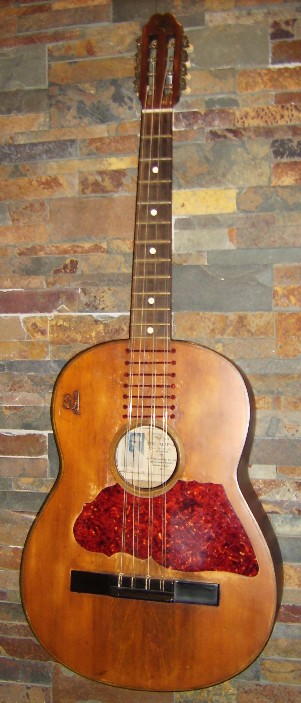
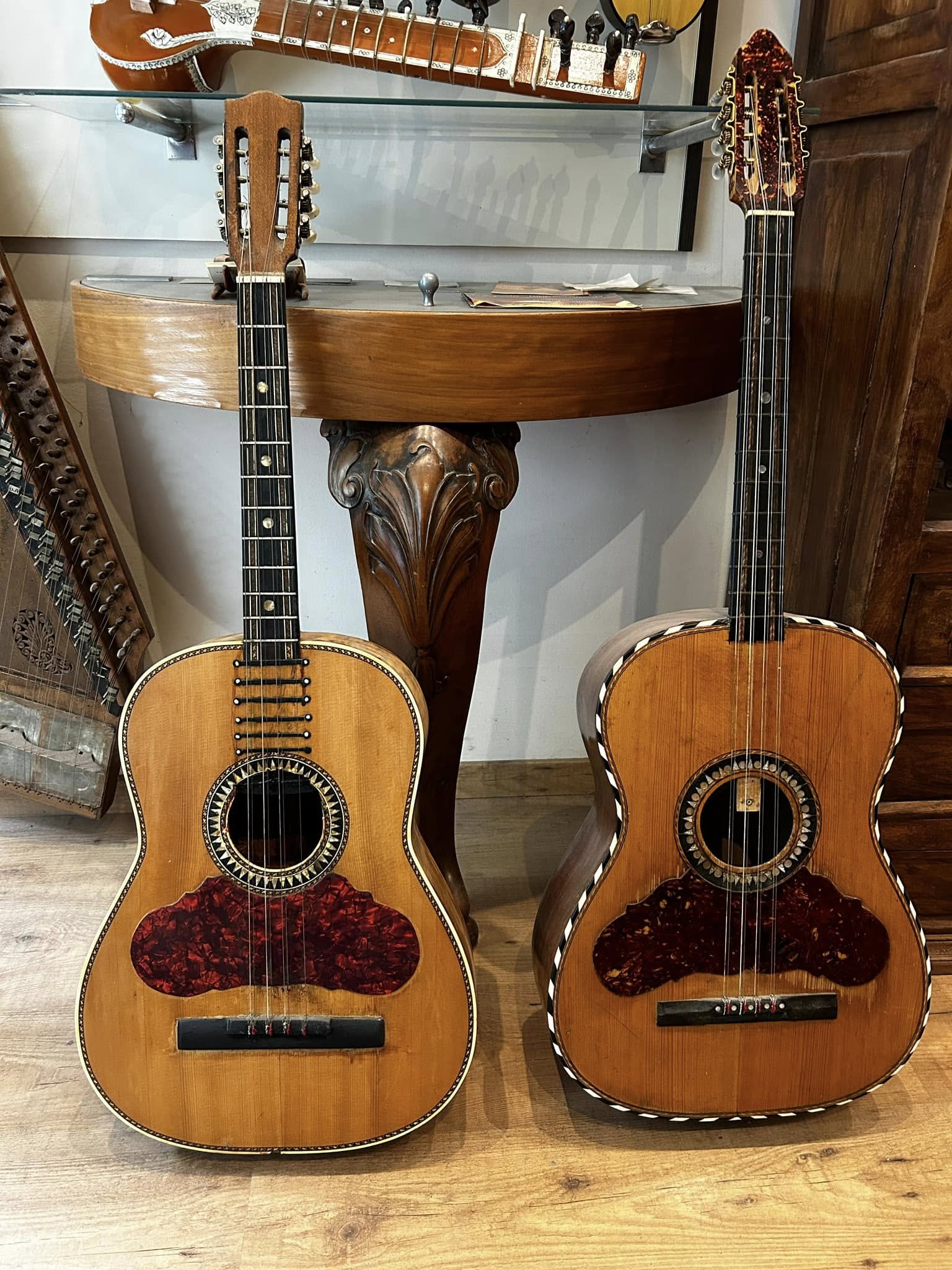
4 Likes
So, Tasos, does what Anogeianakis says about shame check out? Or do you know it only from Anogeianakis too?
Because at first, in 2011, when the thread began, I accepted it without a second thought and took it as a given for further reasoning and speculation. Since then, however, I’ve got to know Anogeianakis better too, by reading things I didn’t know back then (both by him and by others about him), and in general all my thinking is now based on knowledge and information I’ve acquired since then. The result is that I’ve come to question what I used to argue for.
Does the other theory—that it’s more cheaply made—hold water?