αν βρεις κατι πες μου φιλε

Guitar-lute, late 19th to early 20th century. Museum of Modern Greek Culture (donated by the Society for Folklore Studies).
A guitar in the shape of a lute. Six single strings, fixed metal frets, but a fingerboard level with the soundboard and little braces. I’m not sure how reliable the dating is, as I saw other instruments that didn’t seem to belong to the period to which they had been attributed.
I notice that the neck is slightly shorter than that of a standard lute, reaching as far as the ninth fret.
1 Like
Is it Greek-made? The lute shape with guitar strings was very fashionable in Germany at that time.
1 Like

It’s almost the same as this one here
1 Like
Indeed, identical. The nine frets, the tsamboukades (τσαμπουκάδες), and, apparently, the angled headstock, as well as the shape of the body, which isn’t 100% like that of a classical Greek laouto!
A large part of the discussion here might perhaps be better continued in a separate thread about instrumental versus singing accompaniment, and more serious dances versus less serious ones, and perhaps also in a thread about Anogeianakis. As for the lute-guitar, another reason for its creation, besides the desire for elegance, was economic: a guitar is easier to make than a lute (quite apart from the possibility that cheap imports may have been available), and many lute-guitars were converted guitars. For example, Anogeianakis’s lute-guitar was certainly originally a guitar.
I wonder whether the Northern Epirote tuning that was mentioned (la–re–la–sol) is related to an a la turca arrangement, such as I have seen on Albanian lutes (similar to ours in design and rosette, but without the lion and with untempered fretting). Also, regarding what was said about courses without wound strings, do we have any additional information, or perhaps an example?
I’ve seen it with my own eyes repeatedly. Two plain strings on all the old ones in Karpathos, and a single plain string on Papaïoannou’s from Kythnos.
1 Like
I’ve seen it on the G string in Cyprus.
1 Like
Yes, that’s what I mean too. The G in Kythnos island music, which is D in Karpathos Cretan music (but with Karpathians usually tuning quite a bit higher and the Thermians lower, it ends up being practically the same!).
There is also a set with a low C, which some people will use for repairs.
1 Like
I’ve seen someone come up with it independently, to extend the range down into the bass. It’s not exactly a difficult idea; I’m sure many people have arrived at it independently.
Wanting to restrict the range (G without a bourganá (μπουργάνα)) seems rather paradoxical. In my view, the explanation is that in the old self-accompanied style of playing, on the one hand, the range very rarely descends below the fifth fret of the second string from the top; in other words, what we essentially have is tamboura-style horizontal playing almost exclusively on the highest string. On the other hand, the third string is played open almost constantly in the accompaniment, creating an ison-drone effect that is somewhat difficult to imagine—but I can assure you, after an entire evening of Kikilis–Papaioannou here some fifteen years ago, that it is captivating, ecstatic.
However, since my main experience is not that one Thermian evening but the countless Karpathian ones, with lyra, laouto and sometimes tsampouna as well, I keep thinking that there is a very close analogy between the tuning of the lyra (A–D–G reentrant, i.e. with the A and G a tone apart), and the way it is used, and their counterparts on the laouto. As for the relationship between the tsampouna and the lyra, that is a given.
Let me also recall a related story that happened to me:
But not everyone liked the Bulgarians equally. Others, still in Karpathos, had told me, “Your laouto (Rapakousios) sounds very nice, but that string is buzzing and ruining the whole thing—change it!”
2 Likes
With a low C, the instrument becomes a mandocello.
3 Likes
3 messages were merged into an existing topic: Bourgana, Mourgkana, Vourgara
And somewhere above it’s mentioned that the laoutokithara (λαουτοκιθάρα) favours a more upright playing position than the laouto (λαούτο). One question: is the shorter scale length standard on the laoutokithara, even for instruments originally built as laoutokitharas?
1 Like
No, you play the laouto the same way you play the laouto-guitar. A laouto has a guitar soundbox, whereas the German one is a guitar with a laouto soundbox. And there are plenty of them in Germany, old and cheap. The laouto exists in various forms all over Europe. Barba-Antonis in Larissa made them with a 71 cm scale length. The same goes for laouta: they don’t have a standard length; it depends on the maker. The laouto itself ranges from 68 cm to 75 cm. The Cretan ones do too, and likewise the laouto-guitar comes in different scale lengths. Certainly not 74 or 75 cm for Cretan ones, though—unless someone there made one as well.
2 Likes
Band with two fantastic laouto guitars, 2011:

The first person we see on our right is Giorgos Peltekis (a close associate of Sakis Dokos the Elder).
See more here.
I once made a recording with the Elder (I don’t remember when); it’s on YouTube.

Sakis Dokos, Giorgos Peltekis (laouto, guitar) and Alekos Dokos, accordion.

1 Like
I met Peltekis at the hospital in the summer of ’22; we were in the same ward. I asked him about laoutos; he told me they used to have some, but they gave them away and kept the laouto-guitars. He ‘left’ a few months later. His condition was very serious. As we can see, it is a laouto, simply with a guitar soundbox, and one decorated in the laouto style, no less. The tuning is classically lowered for an A clarinet, so that they have open chords in E, F-sharp, A and B. That is how the old players tuned, to match the clarinet, because these are the male keys in certain songs, from which sequences of songs then follow.
4 Likes
I didn’t expect to see this: a laouto-guitar in Naxos, 2007.
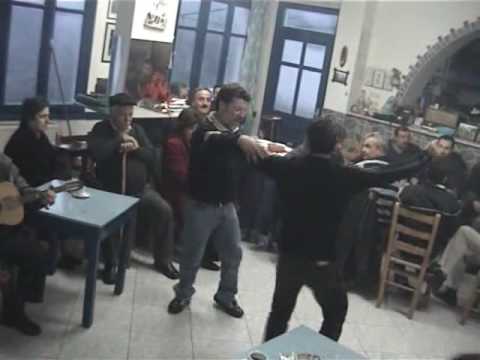
By the way, the song is a local adaptation of “Katifé” (“Tsachpín”).