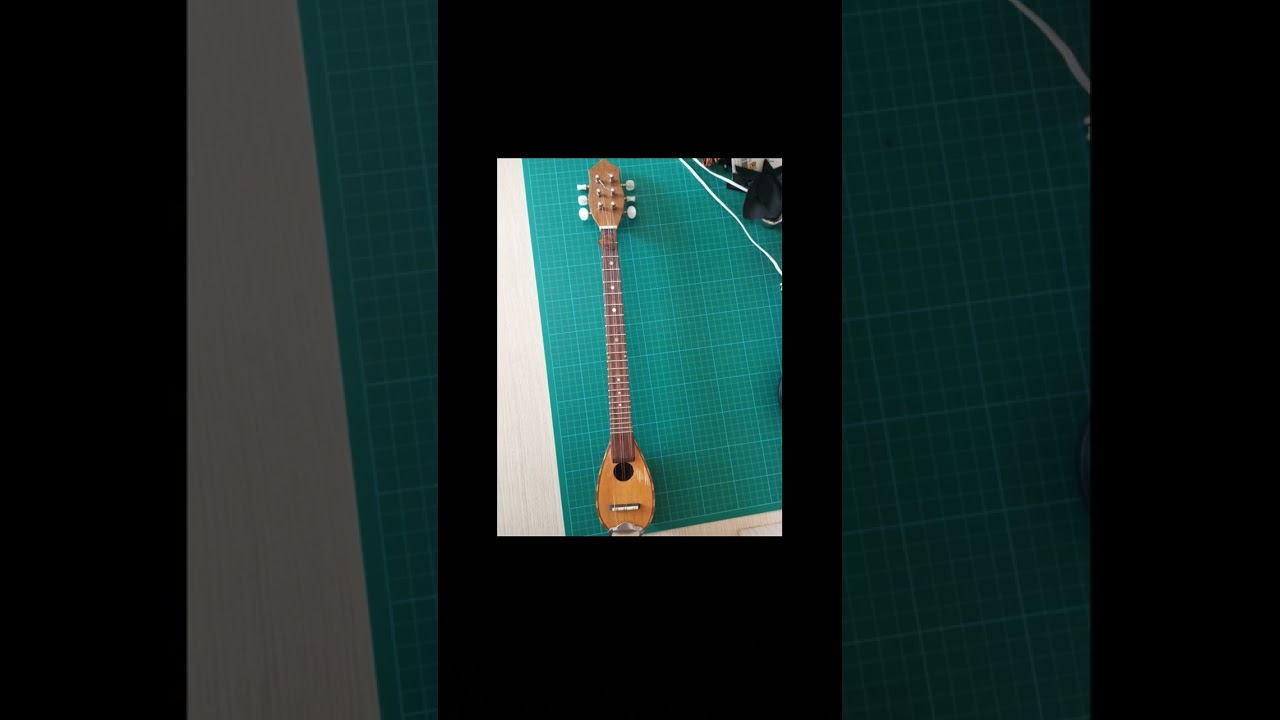
I decided to make a short recording of Diamanto by Giovan Tsaous (with a little improvisation towards the end), played on the baglamas in D–G–C tuning. I think the result is quite satisfactory. I bought the baglamas I’m playing three years ago from Antonios Verikakis’s instrument workshop in Chania.
Good effort! There was also some freedom in the melodic interpretation, but the rhythm was steady, and that matters.
You could also try it in re–sol–si so that you have the 3rd on the bourdon string (1st sol, 3rd si—the basis of segâh).
Generally, when it comes to douzénia, I like there to be a sense of, let’s call it, “absent-mindedness”. To my ear, I like it a little more that way. When I first started working with douzénia, I did it somewhat deliberately, but by now it has become second nature to me. I’ll try it in D–G–B as well—thank you very much!
Nice! I sat down and listened to it with my attention focused on the open strings: they strike exactly where they should, without adding or leaving out a single pick stroke, as if you had a separate guitarist. At the same time, the high string moves up and down, embroidering short and long note values, and one part doesn’t get in the way of the other. I think I’d burn myself out trying to do that!
But something doesn’t seem quite right with the cadences down on the tonic. The ear expects to hear a full, rich C, but hears something else instead: one time, a C major chord with the third voiced as though it were a melodic note (whereas the melody note here is C); another time, a second that weakens the sense of tonality…
(In the saz with this tuning, the corresponding fingering is the first and second strings fretted at the fourth degree, the third string open, with the pick striking all three strings.)
I find the deviations from the standard melody acceptable, provided they are made consciously as ornaments, rather than because one thinks that this is the standard version.
And I too, on a second listen, find the addition of the C major unnecessary—I was consciously noticing it. I feel that, in a dozen, a freer interpretation works well in some pieces.
It’s perfectly fine.
I just don’t understand the reasoning. I mean, you end up doing something that is (very well, objectively) more difficult than standard tuning, and along the way you also lose your tonic on the same string — meaning you have to change the melodic string for just one note. Might some other method/makam, instead of Mahur, reward you more in this process?
(The sound is also crystal clear.)
If we’re talking about adding the chord, the easy solution is simply not to play it at all, since we conclude that it’s unnecessary for this kind of playing. But if we’re talking about the melody itself, the only note I don’t play on the kantíni is the low C, which I play on the bourghána or on the G string. For me, that isn’t a particularly huge compromise. Another option would be to lower the D to C as well, but to my ear—because I’ve tried it—it sounds like a lowered D–A–D, that is, the monotonous tuning I’m trying to avoid. Now, if we’re talking about changing to a douzeni, if I understand what you’re saying correctly, then of course that’s a good solution.
I was mainly talking about changing the repertoire..
Anyway, I was thinking the following: normally, we use such fingering combinations only when we can’t avoid them, so..what better way to practise than to step a little outside our comfort zone through such a process?
That’s exactly what I think too! This change in fingering for each dozen is really lovely. For me, it also gives each scale a better timbre. As for the repertoire, fair enough—you do have to step outside your comfort zone at some point, I’m not saying you shouldn’t, but I’ve also got the chops for this job.
I don’t have any experience with douzenia tunings, but I’ve tried this particular one on the baglamas, especially since I already knew it from the saz. It works perfectly for rast-like modes in C. And it’s probably the most tried-and-tested type of tuning for any kind of stringed instrument: consecutive fifths. It produces the dromoi with their corresponding bases exactly as theory predicts!
The only difficult point is when, in dromoi in D, you emphasise the fifth while you have an open fourth underneath…