I suddenly got this crazy urge to have an oud and, since I don’t have the money to buy one, I thought I’d try making one completely amateurishly, mostly just for fun, using simple materials (not cardboard  ) and keeping the cost down. Of course, I’d still like it to be at least somewhat decent. Something like a canjo, for those who know what I mean. Sorry if I’ve bored you, and thanks in advance.
2 Likes
Great idea. I imagine you’ve built an instrument before and have the right tools and knowledge, and that you’re good with your hands. Is that right?
It’s a good incentive to build an instrument to your own specifications, so that you can also develop an emotional attachment to it — although I hope that won’t get in the way of your objectivity 
Good luck with the whole project!
1 Like
I’ve got the tools, but I’ve never built an instrument before (unless that thing with the kitchen rubber bands when I was five counts).
3 Likes
Good evening! Building the first instrument you make will usually cost more than buying a ready-made one. That’s because the only cost you save is the labour — the time spent building it. In fact, at this stage, the time spent studying how to build it is much greater than the time spent on the actual construction.
However, wood and instrument-making materials in general are not cheap, and some materials cannot be bought in quantities as small as those required for a single instrument (e.g. glue). On top of that, you need certain materials you would not think of at first, such as moulds, various jigs and workarounds, as well as some specialised tools that you discover along the way.
One solution is a kit containing all the necessary materials for a particular instrument. However, I don’t know whether there is a kit for an oud.
Even so, if you’re interested in instrument making and the construction process in general, you can start with what you have and then move forward at whatever pace your budget allows! After all, instrument making is a journey that never ends! Best of luck!
4 Likes
Ooooh, things like that!.. (but yes, they didn’t count for me either; I chucked them out, even though I did manage to play a familiar little tune with one of them)
2 Likes
Might this be of interest to you? https://athensmusicinstrumentshow.gr/
I read about it in a thread on the Forum. It’s happening this weekend. I guess you were lucky to find it, so you can learn more sooner and manage to fix your oud! Best of luck — perhaps you’ll even be an exhibitor at the festival in the future!
2 Likes
I searched for this canjo and found this which we’d call a zvantzo in Greece. Is that the sort of thing you mean?
Buy some two-part epoxy glue (which bonds pretty much anything together fairly strongly). Determine a scale. Get a sturdy piece of wood for a neck and pray that it can withstand the tension of six strings! (The first time you tune it, take plenty of safety precautions, because something might go flying.) You could also screw the neck onto the tin can/oil tin or something like that. In any case, don’t expect much from it in terms of sound. Metal is high-pitched, so it probably isn’t really suitable for an oud… Someone made a tzouras out of a tin on YouTube which, surprisingly, sounds like one! It’s unlikely to hold up for long, though. If you’re lucky, it’ll make it through the summer.
The first problem you’ll have to deal with is how to get your hand inside the tin to screw on the neck. Personally, I have no idea. You’re venturing into uncharted waters… Unless you detach the lid from the tin to open up one whole side and then glue it back on.
2 Likes
Also, I thought that if you screw directly into the tin, it would rattle because of the screw touching the metal. So you need a wooden block inside the tin. The block will also distribute the force over a larger area. After all, stringed instruments have blocks inside the body too. At the bottom, the strings need to be attached to a metal mechanism, because I don’t think anything glued onto the tin with the strings fixed to it would hold. Now, how you’ll attach the mechanism to the tin without it rattling… That will probably be difficult. Perhaps by soldering it? With a block on the outside and another on the inside? I do understand you when it comes to being skint, though. We have countless brilliant instrument makers who build excellent instruments. We just can’t afford to buy the instruments they make…
2 Likes
Honestly, a baglamas, say, can cost €500 or €600 from certain sellers.
All right, although even the labour that goes into a single baglamas doesn’t come to €500 or €600 if you’re to be properly paid, unless you set up a production line and make them by the dozen. The reality is that labour in Greece isn’t paid properly. Certain gentlemen are sucking up the money through a stove pipe, leaving nothing for everyone else.
2 Likes
I also found a way you can name it so it doesn’t sound American.
“Konservo-outi”
4 Likes
You can make whatever instrument you like and have it play using cheap materials. If you’re considering going through the whole process purely to save money, in my opinion it isn’t worth the effort. There are what you might call “tourist” ouds from Turkey available very cheaply, either new or second-hand. They’ll certainly be better than an oud made from a tin can. If you’re doing it because you fancy getting involved in instrument making, go for it. As Panagiotis said, the total cost of making your first instrument, if you try to build it as well as possible using decent materials (not the most expensive ones), plus the cost of buying the tools, is considerably greater than the instrument’s value. If you’re good with your hands and fancy instrument making, give it a try—we can help you here too.
Anyway, for the record, besides regular instruments, I’ve also experimented with some unusual constructions myself. For example, years ago I made a baglamas from a wooden box of Turkish delight from Istanbul, also known as a loukoum box (after a
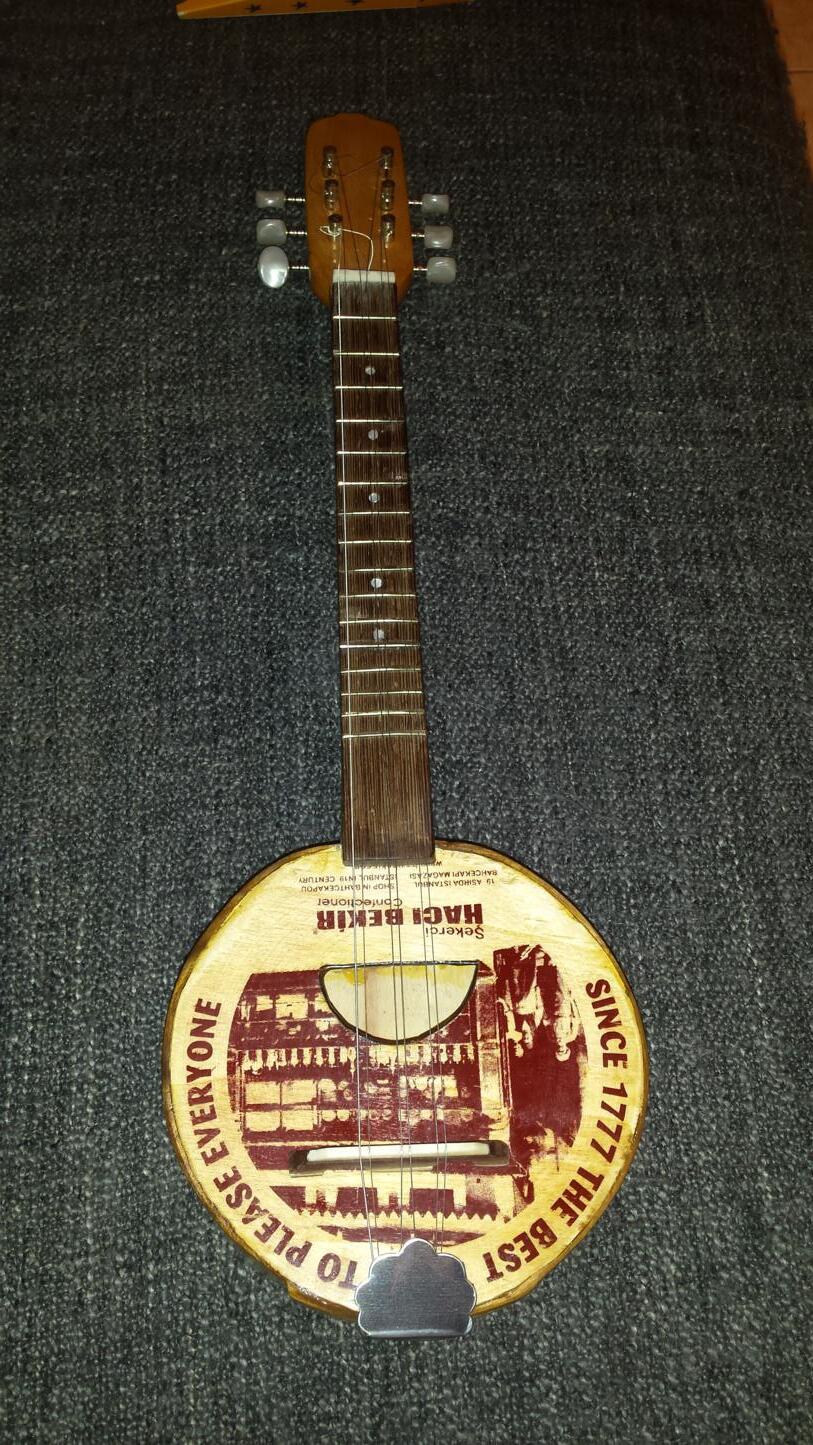
cigar box), or a sherbet baglamas. The little instrument didn’t turn out badly, but I admit it sits neglected at the holiday house and I don’t play it. In the link below, you can also find information about the construction that may help you.
Note 1: The whole box is plywood, obviously.
And for the record, in a simple search on Skroutz, the cheapest one costs €185.
https://www.skroutz.gr/c/469/oyti.html
You can find a cheaper instrument second-hand.
3 Likes
That’s why instrument makers are professionals: after making a certain number of instruments, they recoup their initial investment in tools and other permanent equipment and start making a profit, whereas they lost money on the first one and perhaps the first few.
Traditionally, there was another way too: making an instrument because you wanted to own it. Instruments made not by instrument makers but by musicians. Baglamas made from gourds, turtle shells, coconuts, etc., or from a single piece of wood that you can carve with one or two rudimentary tools. They can be made without spending money, with patience, enthusiasm and skill (and a little luck, I suppose). And many folk instruments have developed as such homemade constructions; some are still made that way even today.
However, you wouldn’t fit a pegbox on such an instrument; you’d use handmade twisted tuning pegs. You wouldn’t fit a fingerboard with mathematically calculated frets, but tied frets made from some makeshift material (they would process the gut themselves from animals slaughtered for food), attached directly to the neck, and position them by trial and error. In general, this kind of homemade construction isn’t a rough amateur imitation of professional construction; it’s something different, based on a different overall philosophy.
And then there’s a hybrid method too: instruments made partly according to the philosophy of empirical homemade construction (a soundbox made from ready-made boxes) and partly according to that of professional, systematic instrument making (a neck with a proper pegbox, tuning pegs, frets, possibly a fingerboard as well, etc.).
2 Likes
In the end, guys, I went for a cheap student oud. It has a good sound, but it’s given me a lot of trouble with the tuning—it needs tuning every 10 minutes.
Make sure the strings are wound properly, because if the winding of one gets in the way of another, you’ll tune one and the other will slip.
When tuning, push the key inwards as well. The keys are tapered, so pushing them in also fills the hole.
There’s also a paste for keys called Pegpaste. It might help.
1 Like
Thanks, I’ll look into it.
What does it do?
I’m thinking I might gradually try to turn that little children’s violin into a proper instrument. It already made a difference with the right strings.
In general, it has a paste-like texture that smooths out any imperfections in the keys while also adding a little thickness to them, so it may help the tuning hold. It doesn’t work miracles and isn’t meant for frequent use, but it might help.
1 Like
If you could upload a little clip for us to listen to, that would be really interesting!

The first thing you hear is the loukoum box, and the second is the baglamas made by the same maker. Although they’re tuned to different keys, you can hear the difference!