Good morning everyone,
Could someone identify what instrument is playing from 0:57 onwards in the video below?
It plays from the beginning, but it sounds more clearly like a bouzouki to me there. Am I wrong?
Yeah, I thought so too? At the beginning of the song, I also thought it was a saz, but from the point I mentioned onwards, it sounded more like a bouzouki to me, although I don’t have a trained ear, of course. So, saz it is.
Thank you for your time.
No, it’s the same instrument playing the taksim from the beginning. It must be some smaller type of saz, or a tambouras, without mourgana on the first string.
Naturally, while respecting all the opinions above, I’ll share my own view as well.
When I first heard the song and paid particular attention to the seconds our friend @anon22110369 points out, I thought: it’s a saz.
Reading the posts by @Spyros_Tsianakas & @anon62325095 as well, and noting in particular that it’s an electric saz… that’s what you’d call “confirmation”.
However, on a second listen, I hear a “flutter” in the picking, a “distinctive scratch” instead of a plectrum—a feather…a feather on an “electric oud”
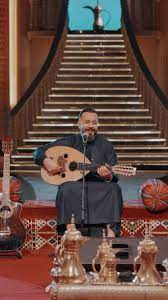
Anyway, in a search I did for Ibrahim Hassan, the musician, I found that, besides the guitar, he has a photo on Instagram with a type of oud. It’s in low resolution.
If my ear isn’t deceiving me, every note, one by one, is pinned to a specific pitch. In other words, there are frets. And they aren’t very closely spaced—not like those on a lafta, for example, I mean. Even in a few passages where something very fast and indeterminate is being played, which sounds as though it temporarily does away with the scale (0’48", 1’20"), listening at half speed reveals neither a free glissando on a bare fingerboard nor even notes that have fallen slightly to one side of the normal pitches used in the rest of the piece.
So, in my opinion, we can rule out the oud and conclude that it’s something saz-like.
Well, on Discogs it appears that the musician in question is from Qatar and plays percussion. So I suggest we don’t stop there.
Based on what I hear, I can make out metal strings, which to me suggests that it is something saz-like.
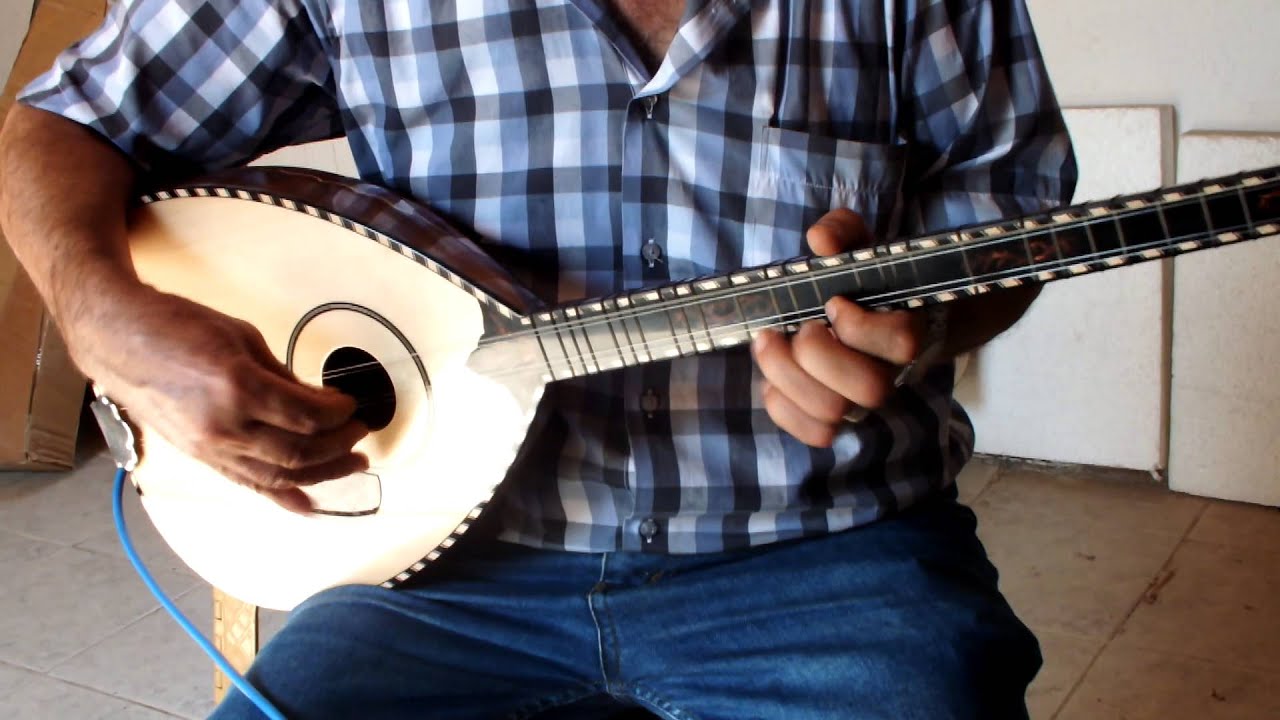
Is there an unambiguous designation, “Arabic bouzouki”, that refers exclusively to instruments like the one pictured? Also, what exactly does bozuk mean in organological terms? When I put it into Google, it only gives me the well-known “broken” and nothing else.
Yes, it’s quite a distinctive instrument, with two pairs of strings and the shape we can see in the video. And it’s mainly an instrument from a particular country, not a pan-Arab one, but I can’t remember which.
Exactly that. Well done. It gave me something of a bouzouki feel and brought to mind the bozuk I had once seen online, but had never heard. I was persuaded by the more experienced people that it was a saz, but the way you put it framed exactly what I felt.
Yes, that’s how I hear it too. It’s definitely not fretless.
Now that we’re talking about it, I’ve been looking into the bozuk a bit and I see that it has three pairs of strings. It’s not particularly widespread, but it does have at least some presence in Syria.
From what I’ve seen made by Arab makers, as well as from searching Google (arabic bozuk), they have 3 strings. I don’t know anything more, but this one by Mr Voulgari seems perhaps to be an exception—a variation.
Without knowing much about it, I’m fairly familiar with the two-course bouzouki, although I hadn’t realised that its courses are triple-strung. I’m not sure where I know it from—probably discussions and things like that—and I remember seeing one at a luthier’s for repairs once. Perhaps, for some reason, it’s the version that’s best known in Greece…
ZARAZ
(Κουνάβης Ευώδιος, ποιητής (εκ του προχείρου και εν πλήρει φορμαλισμώ))
17
It is supposedly the case, though, that two triples is the norm, while three doubles are a recent fad.