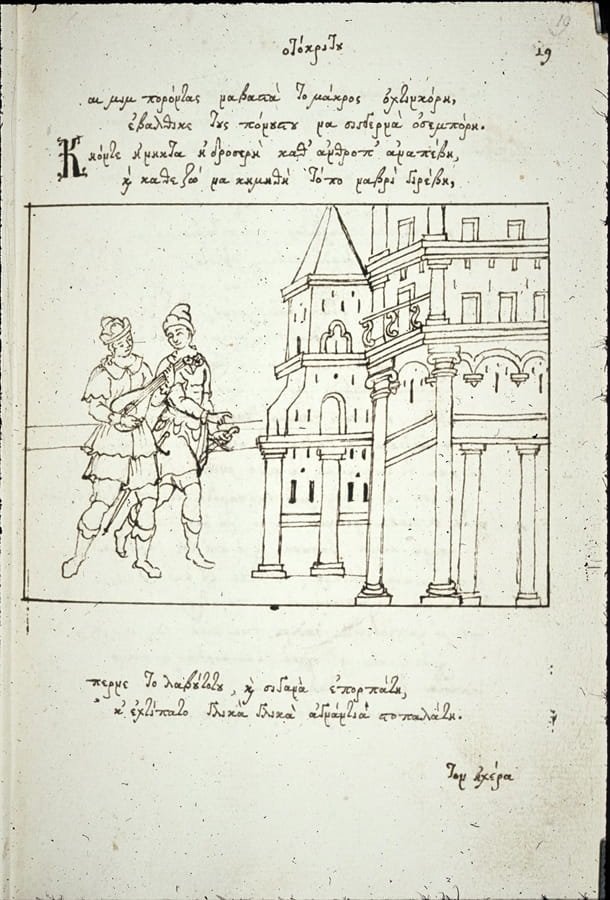
I don’t know what it’s like in the editions of the text (I assume as emc says), but more generally it’s an interesting question:
More generally, the current popular form, not only in Crete but throughout Greece, was «άθρωπος», for as long as there was a relatively clear distinction between popular and learned language. And similarly αθόνερο, νύφη, πεθερά (instead of νύμφη–πενθερά), etc. And some, such as the last two examples, eventually prevailed throughout the entirety of the Modern Greek language, in every style and shade of meaning. Others, however, did not.
Now, the point is that the distinction between popular and learned language has always placed all dialects on the popular side. In the past, learned language meant Atticising Greek; later, the more or less heavy forms of Katharevousa; and today, Standard Modern Greek, insofar as it makes certain choices that would not suit popular speech.
The Erotokritos, however, is one of the few exceptions in which a dialect was used for a learned purpose. It may have had popular appeal (enormous appeal), but it is nevertheless a learned work.
Here, then, there is no specific, clear rule on which to base the choice. Certainly, in Kornaros’s time, ordinary Cretans would have said «άθρωπος», while learned people, Cretans or otherwise, would have written—and probably said—«άνθρωπος». Of course, learned people did not write in Cretan. And yet Kornaros did!