In June 1946, after five (5) silent years, the Columbia factory in Rizoupoli welcomed new and old artists, who took their turn recording their new songs.
Among them was Vassilis Tsitsanis, who had dozens of songs with him that he had written during the years of the German occupation. They were the so-called “Songs of Thessaloniki”, as the Trikala-born composer had lived through the harsh years of the occupation in the capital of Macedonia.
Some of the old artists did not make it through the occupation and were not present at the “appointment” with the others. On the other hand, new and fresh faces recorded for the first time in Columbia’s repaired studios.
Before settling permanently in Athens, Tsitsanis was notified to come down to the capital to record his first post-war songs.
Thus, on 15 June 1946, Tsitsanis crossed the threshold of Columbia for the first time since the war.
Let us read what he said about Columbia’s reopening in a conversation with Kostas Hatzidoulis on 10 August 1982:
Ragosyllektis (Hatzidoulis): Were you the first to record, Tsilas?
Tsilas (Tsitsanis): Yes, in mid-’46. Then, I remember, Papaioannou, Mitsakis, Manolis and Markos recorded. Look, I hadn’t entered the studio for almost five years, since the eve of the war, with “Whatever I May Say”. At first I felt a little… frightened…
Ragosyllektis (Hatzidoulis): Why, Tsilas?
Tsilas (Tsitsanis): I don’t know exactly why. Perhaps because I was moved, perhaps something else. You see, it was the first time in the studio after so many years—wars, occupation. I felt something; I can’t explain it to you now…
Ragosyllektis (Hatzidoulis): It was probably anxiety…
Tsilas (Tsitsanis): It’s possible. And I remember Aretaios, the sound engineer, who realised something because he was extremely perceptive, saying to me, “Vasilaki, calm down; it’s easier now than before the war.” Aretaios had admired me ever since I started…
Tsitsanis did not remember correctly. The first to record, on 12 June 1946, were Giorgos Mitsakis and Manolis Hiotis.
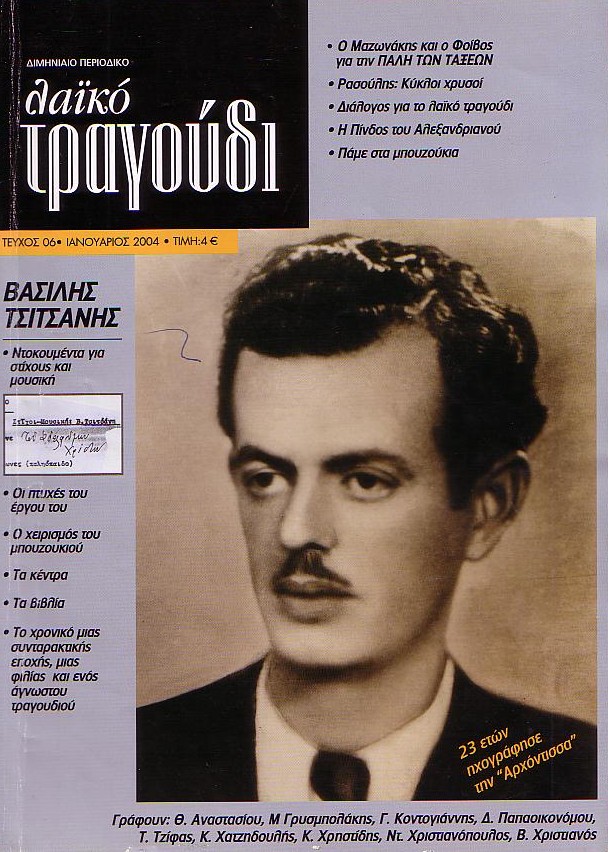
Vassilis Tsitsanis’s interview with Kostas Hatzidoulis was published in 2004 in the magazine “Laïko Tragoudi”, issue 6.
Overcome by fear, anxiety and emotion, Tsitsanis entered Columbia’s studios to record his new compositions.
He had four (4) songs with him, which he recorded for the first time that day.
They were:
The Hashish Addict’s Tune
Won’t You Marry Me
In the Morning with the Dew
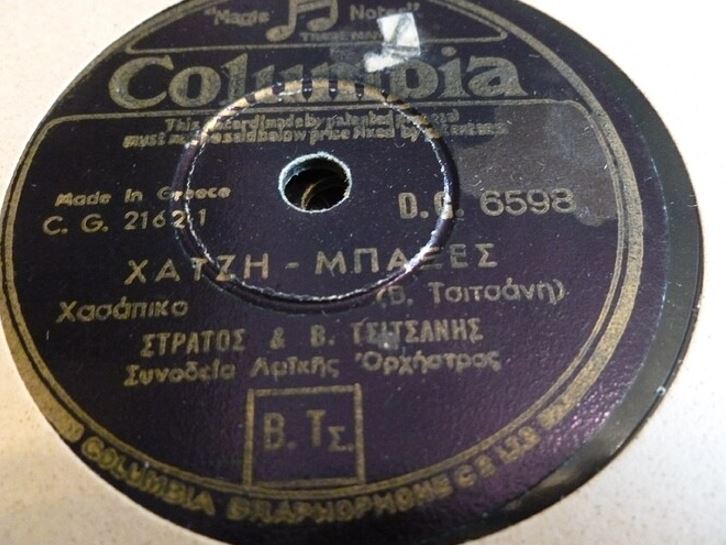
Hadji Baxes
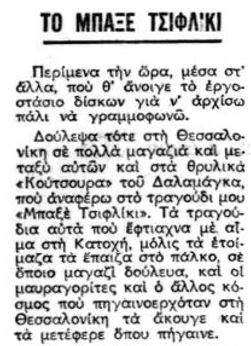
Most of the songs he had with him had been tried out on the “stage” during the occupation. One of them was “Hadji Baxes”, a song that made the rounds of various areas of Thessaloniki.
According to Zoi Tsitsani, the Trikala-born composer’s wife, the song’s original title was “A Stroll around Salonica”. Although most people know it as “Baxes Estate”, on the label of the 78 rpm record it appeared as “Hadji Baxes”.
The composer sings with Stratos Payioumtzis.
The “godfather” of the title was the well-known Dimitris Semsis, or Salonikios, the most famous violinist in Europe, as the newspaper “Akropolis” noted on 14/10/1933.
Vassilis Tsitsanis revealed the story behind the title on the record label to Kostas Hatzidoulis.
In the same conversation (10 August 1982), the song’s composer revealed that the person who had a hand in printing “Hadji Baxes” on the record was the great Greek violinist Dimitris Semsis.
What follows is the exchange between Vassilis and Zoi Tsitsani and Kostas Hatzidoulis.
Ragosyllektis: I’ve been wanting to ask you about “Baxes Estate” for years, but I keep forgetting. Why did you give it the title “HADJI BAXES”? It’s lucky you didn’t call it “HADJI DOULIS”.
Tsilas: (laughing) Were you even born in ’46, when the recording was made?
Ragosyllektis: I was a three-month-old baby…
Zoi: Let’s get you married, Kostaki; I’ll find you a good bride! Shall I tell you something? The title was “A Stroll in Salonica”; that’s how we had it written down there in the notebook, in the notepad.
Tsilas: (puzzled) How did you remember that? Sometimes she’s incredible, absolutely amazing! As for “Hadji Baxes”, the Salonikios put that in after the recording. In ’46. He said to me, “Vassilis, let’s put it like this.” And I didn’t want to upset that man, because I respected him. I didn’t want to refuse him…
“Hadji Baxes” was one of the first songs V. Tsitsanis wrote, according to Tsitsanis himself, after the country was occupied by the Germans.
In it, Tsitsanis “strolls” through various parts of Thessaloniki.
Let’s go for a stroll over to Baxes Estate,
my sweet doll from Thessaloniki,
in Nikakis’s little boat, my sweet Marigoula,
I’ll play you a fine baglamas,
in Nikakis’s little boat, my sweet Marigoula,
I’ll play you a fine baglamas.
Let’s go for a stroll over to Karabournaki,
and drink the night away in Kalamaki,
and from there to Bechtsinari, on a fine shore,
I’ll play you a fine baglamas.
and from there to Bechtsinari, on a fine shore,
I’ll play you a fine baglamas.
Let’s go for a stroll to the Acropolis in Varna,
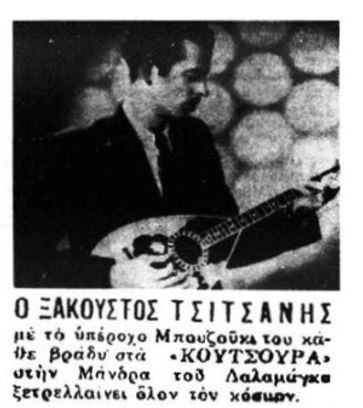
and from there to Koutsoura at Dalamangas’s,
Marigo, you’ll go mad hearing Tsitsanis,
play you a fine baglamas,
Marigo, you’ll go mad hearing Tsitsanis,
play you a fine baglamas.
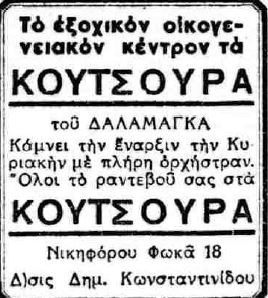
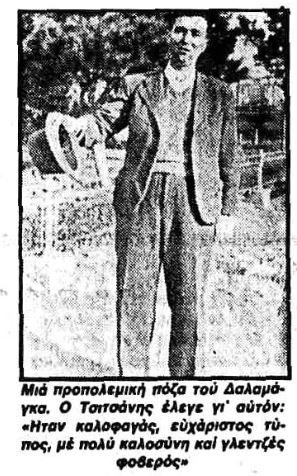
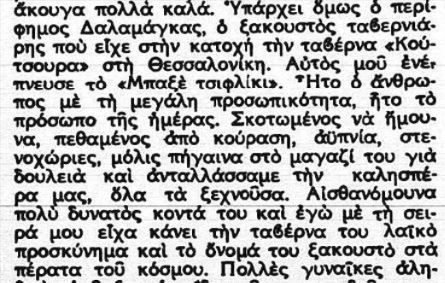
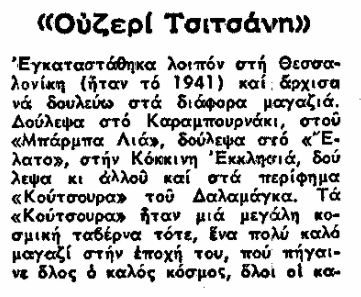
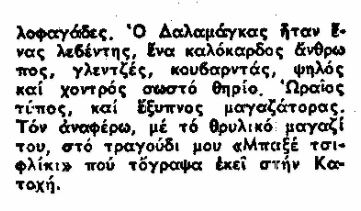
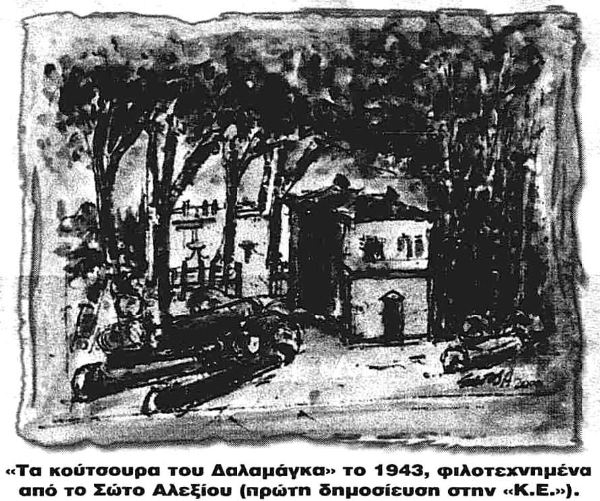
As we can see in the final verse, Tsitsanis refers to the famous “Koutsoura at Dalamangas’s”. “Koutsoura” was one of the establishments run by Giorgos Dalamangas in Thessaloniki.
In an article published on 18/02/1939 in Thessaloniki’s newspaper “Nea Alitheia”, G. Dalamangas owned the taverns “Xyrafi” at Syntrivani, “Labyrinthos” at the White Tower, “Klimataria” on 4th August Street, “Attiki” in Vardari Square and “Koutsoura” on Nikiforou Foka Street.
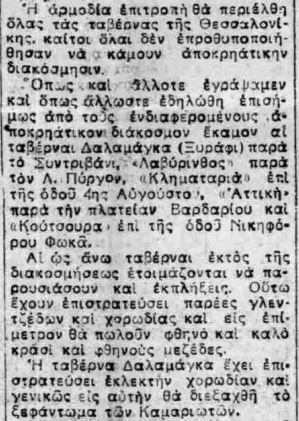
Giorgos Dalamangas managed five taverns at the same time, including “Koutsoura”.
This is the first reference we found to Dalamangas’s “Koutsoura”.
On 21 February 1939, we found another reference to the “Koutsoura” tavern, this time in the newspaper “Makedonia”.
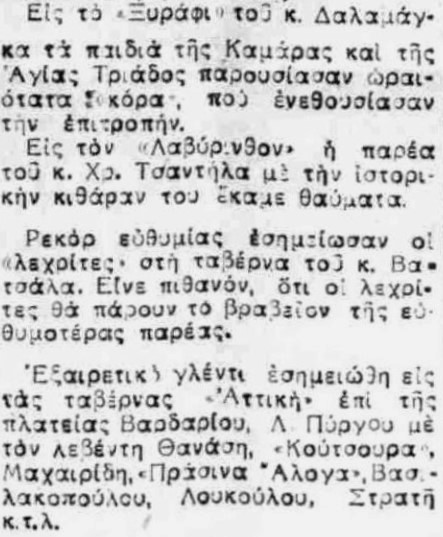
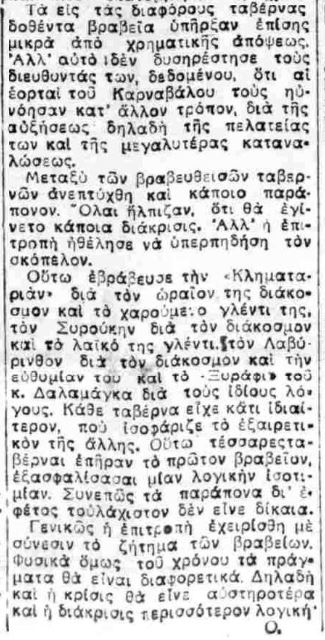
Dalamangas’s taverns entered the competition for the best carnival decorations in Thessaloniki in 1939, and actually won three (3) of the four (4) prizes, as the newspaper “Nea Alitheia” reported to its readers on 2 March 1939.
A few days later, specifically on 6 March, again in “Nea Alitheia”, we found the following photograph of one of Giorgos Dalamangas’s establishments.
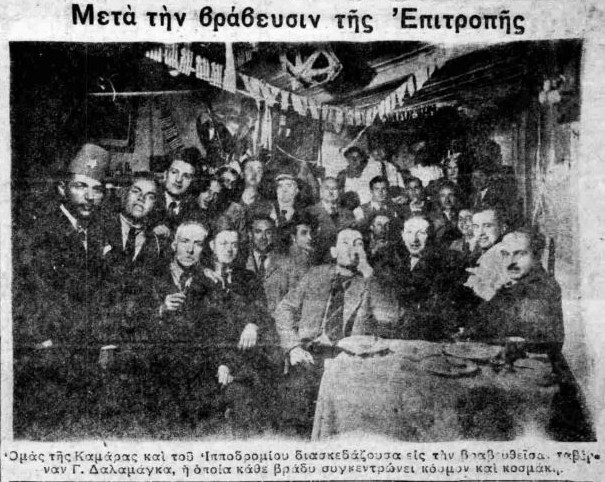
According to the article published on 21 February 1939, this particular tavern belonging to Giorgos Dalamangas was “Xyrafi”.
We also found a reference to “Koutsoura” in 1940.
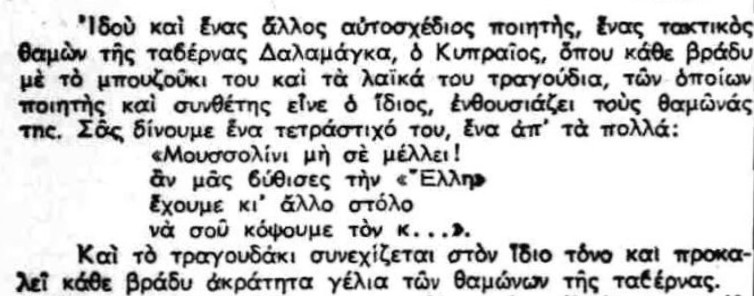
On 24/11/1940, while the Greco-Italian War was raging, “Koutsoura” inspired a tavern patron named Kypr[e]aios, who with his bouzouki and his folk songs delighted the other customers at Dalamangas’s establishment with the following quatrain:
Mussolini, don’t you worry!
Though you sank the “Elli”,
we have another fleet
to cut off your arse…
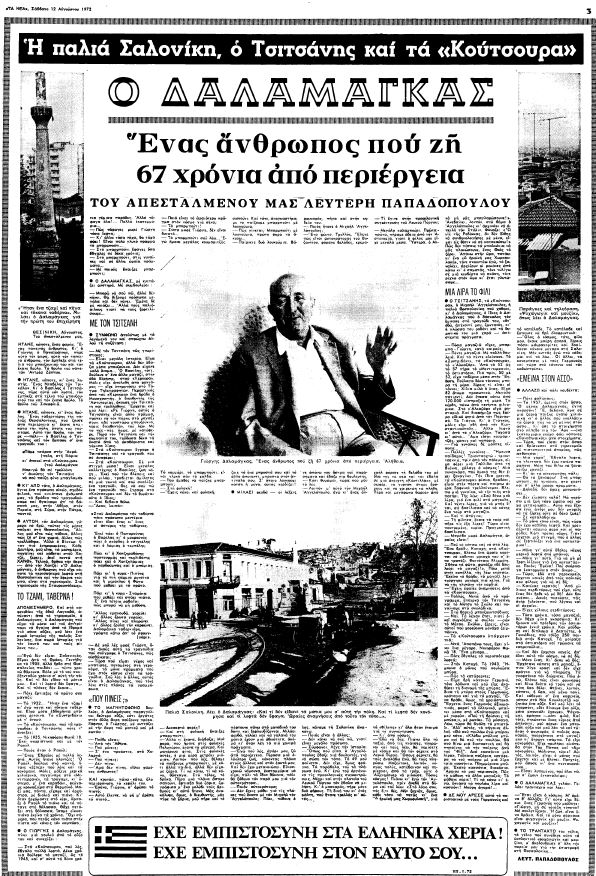
Years later, Giorgos Dalamangas himself remembered that he opened “Koutsoura” in 1935 and kept it until 1945.
The famous tavern had a ten-year existence, according to its owner.