This interpretation does not hold, for the reasons given in a previous message.
I do believe, however, that it is beyond dispute that κοχλιάριον / κοχλιάρι means “spoon”.
From the Greek Lexicon by Anthimos Gazis to our more recent dictionaries, the numerous references in the press, mentions in literary texts, archaeological finds, etc., etc.—all these are incontrovertible sources regarding the interpretation of the word.
The fact that, in colloquial usage, κοχλιάρι is also called κοχλάρι [hence κοχλαράκιας] does not alter the fact that it is the same word, with exactly the same meaning.
The “correct” pronunciation of the word is “kochliári” (κοχλιάρι), so the username “kochilariákias” (κοχλιαράκιας) is “normally” pronounced that way too.
For the sake of euphony, however, it becomes “kochlariákias” (κοχλαράκιας), just as we find in the press, for example, “kochliári (κοχλάρι) for sushi”, “kochliári (κοχλάρι) for cake”, “kochliári (κοχλάρι) in the wrong hands”, and so on — charming…
In any case, we are adding an [-i] to the word in the Glossary.
The positive outcome of the discussion is that we have moved away from linking “kochlas” (κόχλας) with “kochlarákia” (κοχλαράκια), leaving the latter with its spoon in hand.
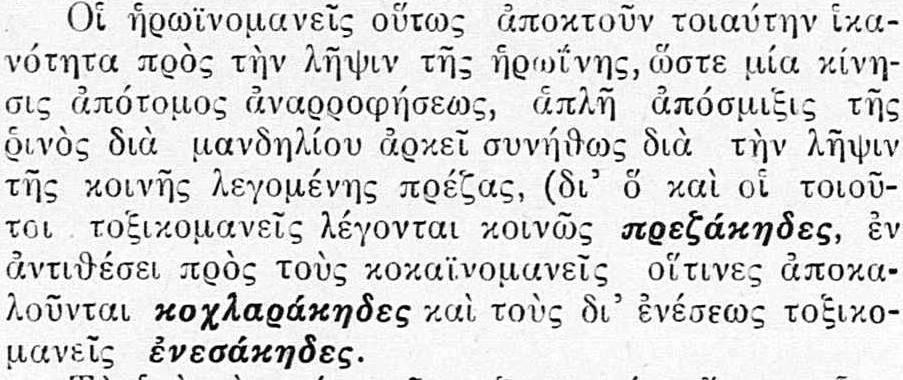
I’m not sure that we leave him like that, because I see in reports from the period 1925–1935 that it wasn’t a spoon that was dropping, but a nose and some snorting…
The point isn’t to support one view until the other has been proven. The point is what Anthimos said earlier: do I know the etymology? Then I write it down. Don’t I know it? Then I don’t write it down.
So far, we don’t know anything for certain. We’re making hypotheses. The hypothesis connecting it with kochliarion can be made by anyone who knows this word and the fact that injection users use spoons. The other hypothesis can be made by anyone who knows kochla (certainly fewer people).
No one opens a dictionary to read hypotheses they could have come up with on their own. All the more so since we don’t have a dictionary here but a glossary. For hypotheses, checking them, searching for sources, exchanging opinions or questions, etc., this is exactly the place where we are now.
Are we at least sure about the meaning of “kochlarakias” itself?
Let me remind you, so that we don’t have to change pages, that the full entry currently reads as follows:
The word also appears in Nikoklakias, which I think is a better-known song.
I opened the link Anthimos posted above, leading to a contemporary paper. Searching with Ctrl+F+koch found all the information, hypotheses and discussion there concerning the words kochla and kochlarakias. The discussion is very similar to the present one, except that there the glossary is not at stake; it is simply an open discussion.
Twice, actually: in Apogevmatini and Empros.
Does kochlarakias appear anywhere apart from the two songs?
I’d also like to put another thought on the table:
What does “the junkie who takes his dose by injection” mean? Obviously, it means a heroin addict. It’s already been generations since people started calling heroin “priza”, and that hasn’t changed even today.
And yet, “priza” refers to another way of taking powder, not to injecting it. It means snorting, and it can be done with cocaine as well as tobacco; it isn’t something specifically associated with heroin.
So slang isn’t particularly concerned with precision. For that matter, ordinary language isn’t either—but slang even less so.
Which means that, whatever the etymology of “kochlarákia” (κοχλαράκια) may be, it won’t necessarily provide precise information about what “kochlarákias” (κοχλαράκιας) means.
Drug addicts dying in the street. Junkies and kochlarakides (κοχλαράκηδες) (ELEFTHEROS ANTHROPOS, 23/6/1932)
«Arrests junkies and kochlarakides in the holding cell […]» (CHRONOGRAPHOS, 11/8/1932)
«[…] the spacious police office was flooded with the ragged faces of a group of kochlarakides» (THARROS, 6/2/1934)
«The drug addicts sit around the loula, and one by one they begin to take a puff, eating figs and walnuts so that it tastes better! They have now become chochlarakides!» (ATHINA, July 1935)
Getting better and better. But I’m increasingly confused about what a „kochlarakias“ (κοχλαράκιας) is:
From what we know today, the drug addicts who die in the street are mainly heroin addicts. That doesn’t happen with cocaine, which is the drug of the rich. Did it happen in the past?
Because from this quotation I understand it to mean heroin addicts, and perhaps „junkies and kochlarakides“ means heroin addicts who snort it and others who inject it. But I’m just speculating.
From the third quotation I understand it to mean hashish users, and there’s no need to infer anything from the photocopy—it explicitly says „cocaine addicts“.
Finally, the two dictionaries seem to be referring explicitly to heroin.
But it is precisely here that another objection arises.
When our Glossary gives us this definition (“The junkie who takes their dose by injection using a spoon”), it unjustifiably narrows what it means to be a “spoonie” by defining one as someone who takes the substance only in this way…
Conversely, under the spoon/powder reading, we bypass the spoonified “particularity” and arrive at the “universality” of taking powder by any means.
If the word’s origin is indeed related to a spoon, that does not necessarily mean that the word itself refers to something related to spoons—that’s the point.
In any kind of dictionary, each entry is necessarily dealt with literally, so etymology is taken into account as well. Something similar is done in the Glossary.
“Κοχλαράκιας” specifically refers to a spoon, so its definition necessarily narrows the scope, including only those substances that can be taken in this way and not by some other means. A mental-health professional asked about it would give roughly the definition provided here.
For someone who takes substances in a different way, the corresponding definition is sought.
We can exchange views as much as we like, but once an entry is recorded, it must be specific and informative for the reader, leaving no questions or doubts, always insofar as is feasible.
Otherwise, we leave the matter open for further investigation in the future.
Yes, but since here we’re not dealing with dictionary entries but with an exchange of views, one question still remains: what proves that this is indeed the etymology? It merely seems plausible, while also running into certain problems. Exactly the same goes for the other one.
And of course we’re not going to ask mental health professionals about etymological matters. At most, we could ask them about the vocabulary of drug users, with which they would probably have some familiarity (has anyone actually looked at sources of that kind?).
However, from the entry’s inception to the present day, this etymology has been presented not as a hypothesis but as a certainty, leading to its dissemination across the internet, etc., etc.
The quotations, however, both in the two songs in question and in the corpora, do not seem to indicate that the kokhlarakias (κοχλαράκιας) was characterised by taking the substance using a spoon…
That is precisely why I suggested that, given the evidence before us, we should remove the etymological section and copy the definition from the street dictionaries: heroin addict/cocaine addict/junkie
In that case, though, it would probably be “κοχλάκιας”, not “κοχλαράκιας”.
(I wanted to post this comment as a reply to “Rebetiko phraseology and unknown words”, but for some reason I can’t. If they wish, the moderators can put it in the right place.)
Kochlarakias (κοχλαράκιας) is a slang term (mainly from the linguistic idiom of rebetiko music) referring to a drug addict (junkie) who uses drugs by injection, using a spoon to prepare the dose (heating/boiling the substance).
More specifically:
The word comes from «kochliarion» or «chouchlari» (spoon).
The spoon is one of the drug addict’s basic pieces of paraphernalia (“sea”), which they use to dissolve and heat (to “boil”, that is, simmer) the substance before injecting it.
The term is often found in rebetiko songs, where it describes a user of heroin or other substances. “