Look at this coincidence: what did the automatic resurfacing of old threads randomly dredge up!
I find that a little harsh. I think that when a musician experiments with musical genres they haven’t specialised in (obviously on the instrument they know, which may not necessarily be associated with that repertoire), it can only do them good.
Now, if they’re putting on a “performance” and presenting their experimentation as “traditional” playing, then there may be an issue.
Other than that, rhythm and notes are everything, and if your instrument can reproduce them in some fashion, you can give it a try. If you can use some trick with the instrument to get closer to the authentic style, even better.
And experimenting is only a good thing, and in general I enthusiastically support arrangements. But you need to be conscious of what you’re doing!
What isn’t good is flattening everything out. Coming up with five or ten rules in our heads about orchestration, how each instrument should be played, how different rhythms and scales should be rendered, and so on, and then applying them everywhere indiscriminately.
The variety of our traditional music isn’t merely vast; it is what defines it above all else. Even today, in countless villages, people play so differently from the neighbouring village that the other style seems to them anything from strange and difficult to downright awful. The attitude of „Whichever village it comes from, I’ll play it for you“ amounts to taking on a very great responsibility.
1 Like
Then why is the kanonaki referred to as one of the traditional Greek instruments?
If we say that the kanun only arrived in Chios in recent years, then I can’t find a single difference between Chian and Mytilenean songs. Zeibekiko dances, syrtos dances, santouri-and-violin music, wind instruments, etc.
Now that we’ve mentioned it, I have no idea whether the clarinet existed in Chian music, since, as far as I understand, the clarinet came to Greece in 1830 and is almost identical to the clarinetto. It was imported under Otto, but I’m not sure.
The clarinet isn’t merely almost the same; it is the very same European-conceived and European-made instrument that people called the klarino, and it entered Greek folk music long after Otto, not directly from Europe. If you’re interested, look up Despina Mazaraki’s book The Folk Clarinet in Greece; you’ll find plenty of information, but you’ll also be left with some unanswered questions…
It’s a question of how we define “Greek traditional”.
There is a characteristic difference when it comes to wind instruments. In Mytilene, “fyssera” — entire wind bands with trombones and so on — played a very important role for at least a century and a half, whereas Chios simply adopted the clarinet, on its own, as did almost all of Greece, including the Cyclades and other areas where it ultimately failed to take root.
Another very characteristic Mytilenean instrument is the guitar. Of course it was imported, but in Mytilene it developed a very distinctive local style of accompaniment that is not found elsewhere.
Chian tsambounotoumbaka (bagpipe-and-drum ensembles) have no equivalent in Mytilene. There, among the “old” instruments, there was the zourna-daouli pairing, which is admittedly more or less pan-Greek and almost universal, but in this particular context brings us closer to Asia Minor, both Greek and Turkish.
In general, ethnomusicologically Chios is divided into the southern mountainous part (more “primitive”: tsambounas, many songs without instruments, sung antiphonally by the dancers themselves, etc.) and the northern lowland part (more “modern”, with clarinets and so on), while Mytilene is divided into many more subregions with distinct characteristics. Talking about Chian or Mytilenean music as though each were one thing is a bit of an oversimplification. They’re both huge islands, let’s not forget. Each includes villages that historically had no means of communicating with certain other villages, while they did have links with areas outside the island.
Edit: If you’re in the mood, have a dig around this website:
They’ve carried out extensive fieldwork and archival research, and so far they’ve produced an impressive and highly revealing publication on Mytilene (5 CDs plus a hefty book — you can really lose yourself in it!) and one on Lemnos (again, a hefty book plus three CDs, although things are somewhat more neatly organised there). That said, even they haven’t avoided a few bits of slapdash work on the website (which we don’t find in their publications).
In general, every source needs to be evaluated.
2 Likes
Sorry for the barrage, but this is a big subject and the various aspects keep occurring to me bit by bit.
Right, one more comment on the points above:
They also play zeibekika in Chios, but in Mytilene the zeibekiko, along with the aptaliko and the karsilamas (terms that do not necessarily mean exactly the same thing to those of us looking in from the outside), is a whole world in itself.
And this just occurred to me, for the first time in my life! Whatever we know as traditional zeibekiko (and as aptaliko or karsilamas, though much more so zeibekiko), in the local repertoires of regions that cultivated these forms extensively, is overwhelmingly instrumental. The zeibekiko song seems to be of a different origin, probably urban folk in character—in other words, essentially a rebetiko innovation…
I’m putting this out here for everyone to think about and exchange views on…
So, isn’t the oud also part of the tradition in Lesbos and Chios?

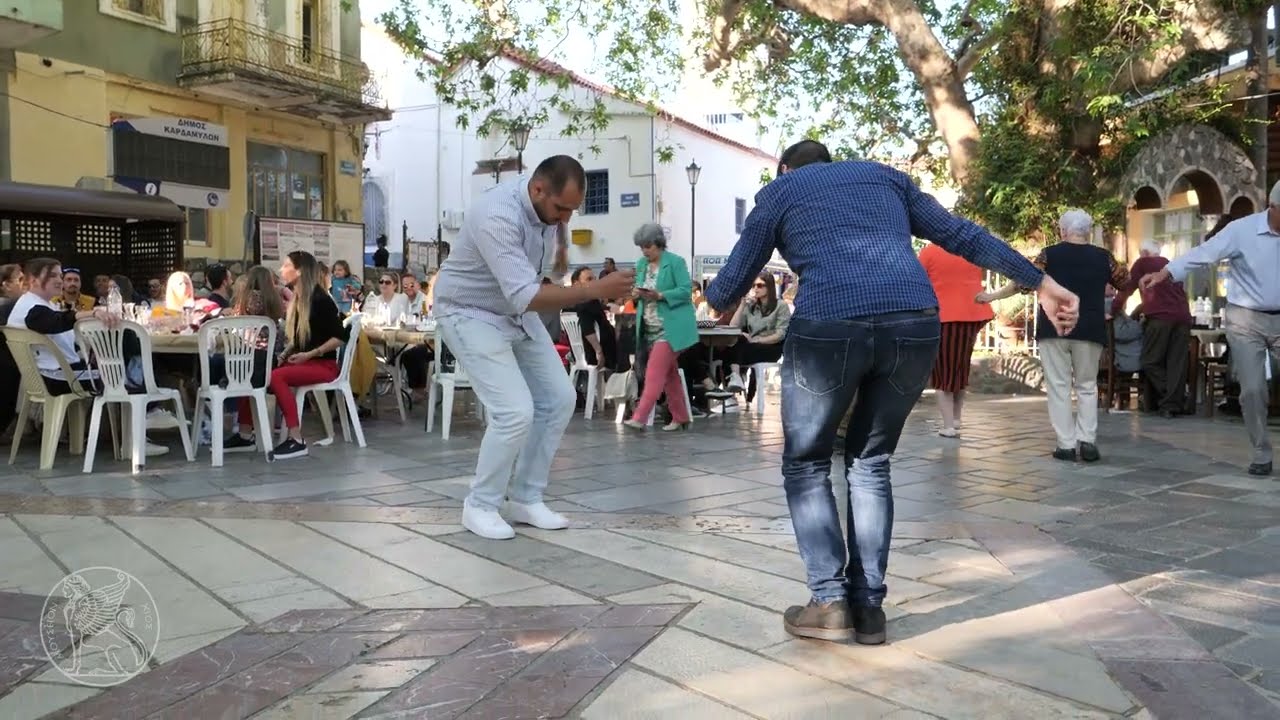
I can’t help wondering when tsifteteli started being danced like zeibekiko 
There is also Angeliki Papazoglou’s testimony about Smyrna:
“‘All of them [editor’s note: she means those she described earlier as mangas and koutsavakia] danced a little. They mostly liked watching others dance. We didn’t have female dancers. They wouldn’t come to us. When a man danced, none of the customers spoke… they just watched. They wanted zeibekikos so that not even the singer would interrupt their rhythm. The zeibekikos had no lyrics.’”
3 Likes
Think about the reasons why one might expect the oud to be a tradition in Lesbos and Chios, and let’s set them out and analyse them one by one. Personally, I don’t have any particular connection with either island, but I wouldn’t start from the assumption that “It can’t be — the oud is hugely popular in Lesbos and Chios!”
What exactly do you mean by “that is”? How did you reach that conclusion?
Anyway, no. As far as I understand, ouds have been played on both islands since long ago.
@video of a rehearsal at a table:
Right, three years ago a young man from Chios is playing the qanun. What do we infer? I infer that he attends the Music School. Based on the school’s website (which I mentioned again, but without a link: here it is), it would be unsurprising if other young people from Chios also played:
- guitar
- lute
- tambura
- piano
- clarinet
- saxophone
- violin
- oud
- bouzouki
- santouri
and also knew Music History, Critical Music Listening, Organology, Harmony, Counterpoint, Form [I assume of classical music], Byzantine Music, played in ensembles, and sang in a choir.
An astonishing contribution to the island’s cultural life as a whole. It is not, however, a map of the local folk tradition.
Shall we look at the island’s conservatoires and private tutors too? We might find electric guitar, bass, drums, other percussion instruments, Cretan lyra, jazz piano, all sorts. Shall we look at the dance schools too? See whether there is classical ballet, Zumba and hip hop? We can, but keeping in mind that, particularly at younger ages, the same child might go to Zumba one year, Greco-Roman wrestling the next (or even alongside it), and the swimming pool the year after…
In any case, I read that the group with the qanun are rehearsing for Salt of the Earth. Was the programme broadcast? What did they say about it?
@video of people dancing zeibekiko while listening to tsifteteli:
I know nothing. This is where we say that you should evaluate your sources, but I didn’t because the question doesn’t concern me. If it concerns you, try to find out where we might be able to determine whether the people shown are simply clueless, or whether this is some dance tradition we didn’t know about that uses the same words (tsifteteli) with a different meaning from the one we knew. I’ll bet the answer is out there somewhere.
Here is the aforementioned programme:
