Minore of the Dawn: the first performance

Good evening to all the members and friends of the rebetiko forum!

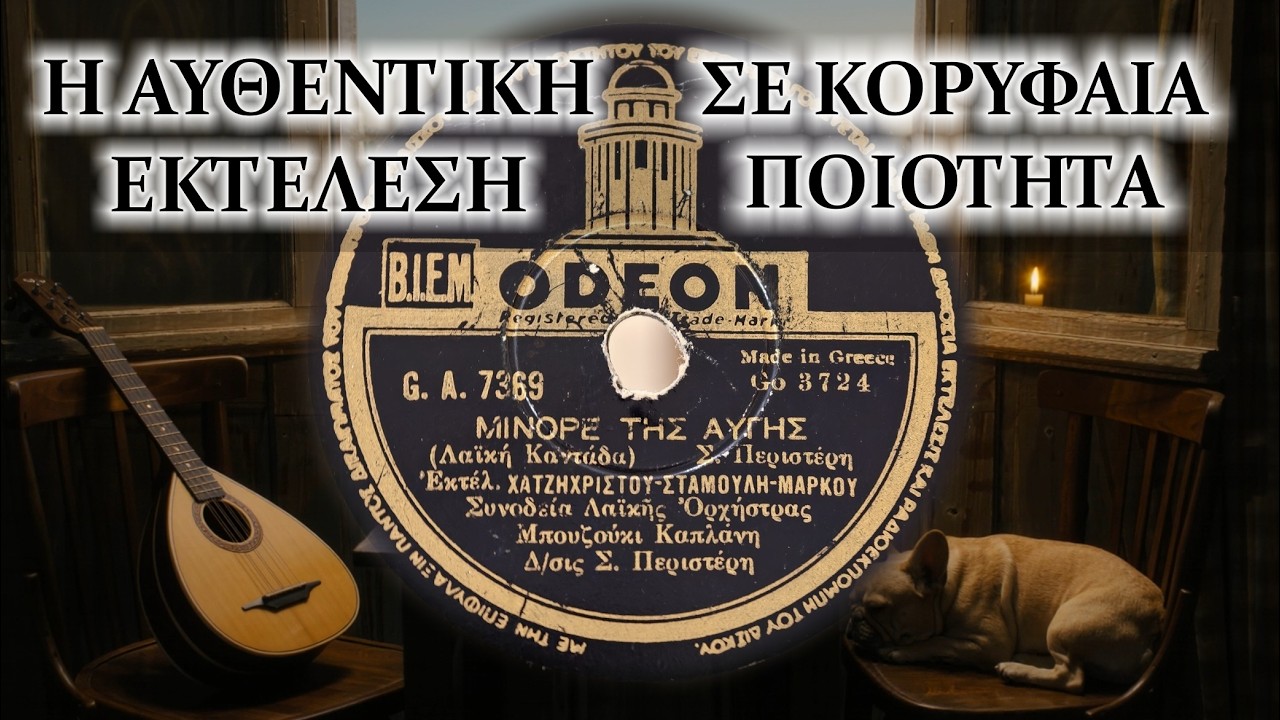
With this post, I would like to share with you a new recording/master taken directly from an original record in our collection, featuring the first performance of “Minore of the Dawn” by the legendary Apostolos Chatzichristos, Yiannis Stamoulis (Bir Allah) and Markos Vamvakaris, with Kostas Kaplanis on bouzouki, of course.

For those who may be wondering, on the Gramophone Gems channel we try to bring rare gramophone records back to life, with tracks that either were not available to the public at all (ghost records :ghost: in the digital world), or were available on platforms such as YouTube but in less-than-ideal sound quality (e.g. with surface noise or poor recording/processing). We always try to document each record historically, even including the label from our record in the loops accompanying the audio file, initially with its details, as well as providing information in the description.

Enjoy, and we would be delighted if any missing information about each track could be added through some lovely interaction and conversation here.

I would also like to ask whether members here would be interested in presentations of tracks from other Greek genres too, such as light music or theatre music.

Many thanks for hosting us.

The Gramophone Gems team :gem_stone::heart:

10 Likes

Well done!
Excellent restoration!
Also enjoy the guitar playing of the “great” Giannis Stamoulis

3 Likes

Indeed, very clear sound. At least as far as the awful little speakers on my laptop allow me to judge.

I read in the description:

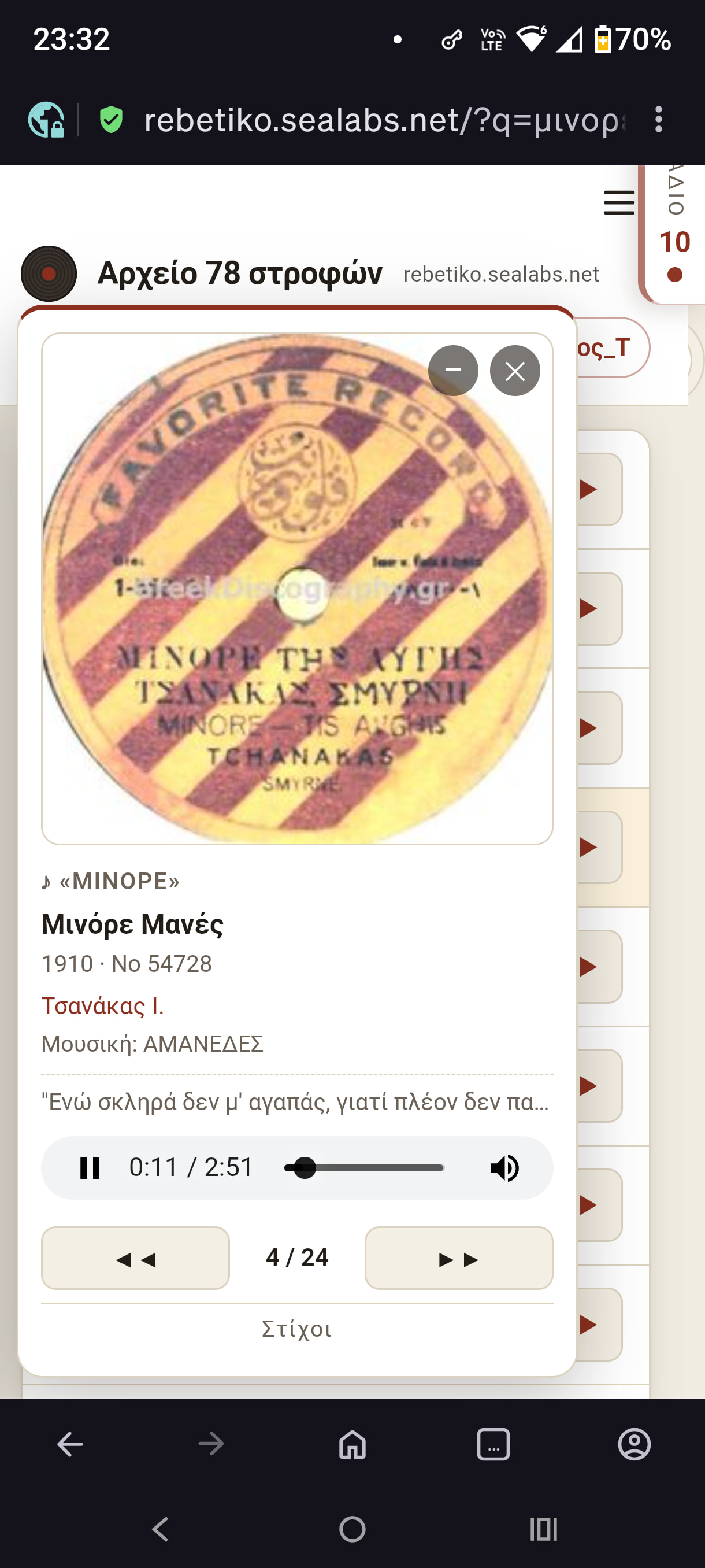
Savvopoulos points out one additional, earlier piece of evidence: a manes entitled «Minore of the Dawn», recorded in Smyrna in 1912 by Giannis Tsanakas, on the Favorite 1-55042 record.

Has this recording been located? Is it available somewhere on the internet? I ask because, judging by the title, the first thing anyone would imagine is that it must be the Smyrna Minoré, a manes that was recorded many dozens of times by a great many 78-rpm singers, with different couplets each time and under a variety of titles such as «Minoré Manes», «Manes of the Dawn», «Goodnight Manes» and so on. Very often—in fact, systematically, although not always—the subject matter of the lyrics and titles revolves around the night, nocturnes, the starry sky, dawn, etc.

As far as Tsanakas is concerned, I know of at least two recordings of the Smyrna Minoré, entitled «Minoré Manes» and «Goodnight». Their discographic details do not match those given by Savvopoulos; however, for Minoré Manes we read:

Under the title “MINORE OF THE DAWN”, there are the recordings Favorite 1-55042 / 7057T and Favorite 1-55050 / 7066T by Giannis Tsanakas, but we do not know whether either of them is the same recording as the present one.

So, if the recording has not been located, it is probably the same one that was also released as «Minoré Manes», and may have been issued again on another record under a different title and number, etc.; alternatively, it may be a third recording of the same manes by Tsanakas. If, of course, the recording does exist, then we can listen to it and all the questions will be resolved.

In any case, this was an extremely popular and widespread manes during the first decades of the twentieth century. The fact that only one of Tsanakas’s recordings is entitled «Minore of the Dawn» (if it is indeed this manes) does not mean that there is any exclusive connection between it and the classic Minore of the Dawn of the same name—the one in question here.

I should point out here that we very often see someone familiar with different recordings of the Smyrna Minoré without realising that it is the same melody each time, especially when the titles are different. Many listeners are led astray by the different lyrics and by the somewhat vague melody (as it seems at first glance—in reality, it is extremely distinctive), with the result that they fail to recognise the identification.

So it is conceivable that the same thing happened with Savvopoulos.

What I mean is: perhaps, in the end, we are not associating this Minore of the Dawn with the particular Tsanakas recording that bears the same title, but with the Smyrna Minoré as a whole, as a melody, regardless of specific recordings or performances.

(Personally, though, I do not see much similarity. The same mode, nocturnal subject matter, both slow—but that is about it.)

2 Likes

(But how could the recordings on two records be identical when they have different matrix numbers? Nah, we can probably rule out the possibility that the Minore tis Avgis on one of Tsanakas’s records is the same recording as the Minore Manes on another of his records. The commenter on the link I provided probably means “the same manes”, that is, the same melody, and possibly even with the same lyrics.)

I think this is it.
But it doesn’t give me a URL, so I’m adding a photo…

But the label says „Minore tis avgis“ (μινόρε της αυγής)

2 Likes

Aha! Indeed! It’s the same one I linked earlier as “Minore Manes”, but I hadn’t noticed that the label gives a different title.

Its individual link:

However, it has a different matrix number. And everything else is different too—the record number, year, etc.

Savvopoulos means something else (unless he’s got them mixed up).

1 Like

First of all, the whole team would like to thank you for your kind words!

As for the reference to Manés and Panos Savvopoulos, we apologise. The YouTube description has a character limit, so it was not expanded as much as we would have liked either.

On the other hand, this is a good thing, because it gives us the opportunity to be more active on the forum and communicate more dynamically :slight_smile:

Based on what we have studied, the entire melody or all the lyrics of the beloved song “Minore of Dawn” certainly did not originate from a Smyrnaic manés. However, according to the researcher, part of the melody—and, most importantly, the song’s opening “key” phrase or theme—does have a Smyrnaic origin.

Specifically, the esteemed Mr Panos Savvopoulos states the following:

  1. The title “Minore of Dawn” already existed in Smyrna in 1912 as the title of a manés performed by Giannis Tsanakas, on a Favorite record.
  2. The melody of the later song is partly based on the earlier “Smyrnaic Minore”, a melody to which dozens of manés had been recorded.
  3. According to him, the first verse of the later song is connected with an old Smyrnaic patináda that went: “Wake up, my little love, listen to the minore at dawn.” (He was unable to find a recording of it.)

In any case, it is wonderful to uncover important historical aspects of music and to shed light on different versions and narratives :rose:

The relevant source:

2 Likes

There is often debate over the titles of certain tunes, songs and so on. This is understandable in light of the way we think about and perceive pieces today. “Minore” in Smyrna was something pioneering for its time, perhaps also a way for the Greeks and Europeans who, although living at the far end of Asia, regarded themselves as belonging to a different musical culture to distinguish themselves. Of course, how different was it when there was also the title amanés… But what kind of amanés? One using Western tonality, yet subject to the rules of the musical modes of the East. The same applies to Balkan music: although it uses tones and semitones, Hijaz is still Hijaz! In Smyrna—and, to return to the subject, in Constantinople and essentially throughout the musical world of our wider geographical region—the titles given to pieces were flexible and fluid, not definitive. When people said, “Sing us the Smyrnaic Manes,” they did not mean one specific piece. Nor did they mean specific couplets. This was later misunderstood with the advent of the recording industry, when a song was placed within fixed boundaries. Besides, most traditional songs are not limited to two or three verses or to a specific refrain. They develop over dozens of verses, which have unfortunately been forgotten nowadays. So, since you have heard the recording by Tsanakas in support of Panos Savvopoulos’s position, it confirms that the melody of the Manes was general rather than specific. A Manes with an established manner of expression, but without specific lyrics. Simply in MINORE. Like the dozens of others that each singer improvises as they see fit AT THAT MOMENT. Then, at some point, the recording industry arrived and imposed boundaries. It is not the creation of one person alone, but of a multitude of people, with continuous adaptation and change. I will also mention two or three other examples. Most of you surely know the song “Mesopelaga Armenizō” (“I Sail the Open Sea”), which is naturally a transformation and adaptation of an older Smyrnaic Manes—and one that had ALREADY been recorded. The same applies to “S’ agapō giati eisai oraia” (“I Love You Because You’re Beautiful”) and “Dari dari”, which is a patinada from a wedding in Erythraea, Ionia, and so on. We have been having this discussion continuously and without interruption for years with anyone who is interested. Things are simpler. The older one gets, the more one understands the relativity, malleability and dynamism of titles, rather than their fixed nature. Music has endless roots, while human life is unfortunately too short to grasp its multifaceted nature. The moulds were created only very recently and cannot constrain concepts, practices, ideas and methods that go back centuries. It is nevertheless a delight to see such a perfect restoration of a record by Gramophone Gems—something that, unfortunately, none of its creators had the good fortune to experience or to take pride in, seeing their recorded efforts. Let us once again partake in the magic of Melody and journey together along the paths of Music, the greatest of the arts. Enjoy!

3 Likes

Very, very clear, and I dare say I can hear the bouzouki perfectly. It’s amazing how poor recordings from damaged records have influenced the way people play… I remember that before I heard Bembis’s solo clearly, I used to think, “What is this man doing? What power and speed!” And when I heard it clearly, I realised that Bembis was caressing the strings… And generally, all the old players played gently. You can hear it in the clear recordings. You hear someone play old rebetika by Markos and you can see that the thumping and forceful playing have remained, whereas when you hear clear recordings of Markos, he barely touches the strings, with a very rounded style and gentle open notes. So this work is important as a source of knowledge about the sound as well. Especially here, I think, where we have one of the finest examples of playing in the history of the bouzouki—the only thing that comes close to the breathtaking masterpiece that is “Minore tou Teke”. Kaplanis renders the embellishments, legato passages and appoggiaturas of the three-course bouzouki with absolute artistry and delicacy. The picking…

2 Likes

And yet it wasn’t. The Smyrneiko minore, regardless of the title under which it is recorded each time and the couplet used, is a very specific melody that is repeated across dozens of recordings, from the beginning of the 20th century right up to some relatively recent ones by Giorgis Papazoglou.

Of course, not everyone performs it in exactly the same way, just as not everyone performs any song in exactly the same way. But they perform the same melody. They interpret the same composition.

The same applies to many other manés, and my suspicion is that this was actually the rule for all manés (contrary to the prevailing view that they were improvisations).

I would be interested in the light music, especially the tangos, and operetta, but I understand that it is somewhat outside the forum’s subject matter, so I’ll look for the channel on YouTube. Are the texts generated by artificial intelligence? For instance, in Kallinikos’s Bálos I’m reading this rather odd text, which seems more like an AI summary of online sources than notes by a “human” editor. And, of course, there is the strange screensaver showing a young man and woman dressed in traditional costumes sitting on a bench, with the HMV dog between them so as not to offend the viewers.

Behind the second side of this rare gramophone recording lies immense cultural value:
The Roots of the Dance: The Bálos is one of the most beloved traditional island dances, deeply rooted in Cyprus’s cultural identity, capturing the festive rhythm and vitality of the region.
The Legacy of Theodoulos Kallinikos: Theodoulos Kallinikos was a leading figure in Cypriot folklore and music, devoting his life to preserving and promoting his homeland’s invaluable musical heritage.

Well done! Crystal-clear sound! Bravo!

1 Like

If only this masterpiece by Markos, from his own first performance, could be cleaned up as well—it would be a blessing! (To Gramophone Gems)

1 Like

I don’t know anything about sound recording, but I’m not sure this can be salvaged. The recording hasn’t deteriorated; that’s how it was recorded in the first place. Gramophone records are a hundred years old and have suffered wear, but when they were recorded, they were crystal clear. The master discs are crystal clear too, and on a few rare occasions, modern CD reissues have been made from them.

2 Likes

Here is the audio recording Stelios Vamvakaris had from that night.
It’s also been uploaded by others, with different noises audible in between.
Sodom and Gomorrah on YouTube :wink:

6 Likes

Well, alright, it isn’t hi-fi, but it’s bearable. The meaning of the song comes through clearly.

2 Likes

Thanks! It’s bearable. Yes!

1 Like

The loops that follow the first few seconds in which each label is displayed always feature the little dog from the channel logo sitting in a setting related to the song. In the case of “Balou”, yes, it’s a couple in traditional Cypriot dress sitting by the seaside. They were created with the help of artificial intelligence, but that is the only thing AI has contributed to on the channel.

The audio, which is the essential part of the whole process, involves many hours of work using different combinations of techniques in audio-editing suites, following careful cleaning of the physical records and the use of professional preamps and specialised needles with different diamond shapes, weights and thicknesses.

The texts are written by our team after researching the subject (we also make use of Dionysis Maniatis’s historical book covering all recorded catalogue and matrix numbers), but we necessarily organise them in a somewhat more condensed form because the platform limits descriptions to 5,000 characters and the translations also have to be included (as there is an international audience too, since records from all over the world are featured). So, inevitably, we often use headings, symbols (“emojis”), and so on, as well as brief references to the content, and we try to maintain a consistent “format” for quicker and easier reading.

2 Likes

Thank you so much! Indeed, that audio recording the lads left afterwards as an extra is actually decent quality :heart:

**Needless to say, we’ll do our best to find and restore many more beloved masterpieces!

2 Likes

If only! We await! We await! For the system!

1 Like