After conducting some research into Lemnos’s rich musical and dance tradition, I decided to share it with the community and hear your opinions. Six main dances are found on Lemnos: the Kehagiadikos or Kehagias, the Patima or Patma, the Katsivelikos (men’s karsilamas), the Elenaki (women’s karsilamas), the Panagia dance, and the Brostopisinos or Tsimandriana Koritsia (the name of the dance song). It seems that most of the dances originate from the village of Tsimandria, except for the Panagia dance, which refers to the village of Panagia in the east of the island. These dances are still performed and preserved throughout the island today. Lemnos’s traditional instrument was the Lemnian lyre. According to local residents, in the old days every village had at least one lyra player, and sometimes more. The last great lyra player whose music was recorded and preserved on the Lemnian lyre was Thanasis Kotsinadellis, who died in 2022. At present, there are two lyra players on Lemnos. One is Marinos Kefalas, who appears to use a Cretan lyre, or a Cretan lyre with a modified tuning. The second is Achilleas Kaltsounis, who teaches the Lemnian lyre at the Lyceum Club of Greek Women of Lemnos. Recently, there have been efforts by instrument makers to revive the lyre. During my research, I noticed that some school projects about Lemnos’s tradition, as well as Google’s AI feature, mention the tsampouna as another traditional instrument of Lemnos. The truth is that I have not found any other information about this, nor any recordings. Looking at the distribution of tsampounas throughout Greece, I can see that this instrument is absent from the northern Aegean. If you have any further information about this aspect of the tsampouna, I would be delighted to hear it. Local residents and musicians will obviously know something about this. Thank you very much; I look forward to hearing your opinions and sharing your knowledge!
A misunderstanding caused by a synonym. In Lemnos, “tsambouna” is what elsewhere is called a mantoura or monotsambouno: a single tsambouna pipe. It is one of the most rudimentary musical instruments there is: a reed with one end closed, a notch that makes the “whistling” sound, and usually five holes. It can be made in a few minutes.
On the islands where (proper) tsambounes are played, the monotsambouno is used as the first stage of learning. In the past it was also used as a rudimentary children’s musical toy, made by the children themselves. They treated it more like a whistle, not really for making music, but those who happened to have a musical inclination managed to play a few tunes, which may eventually have led them on to the full tsambouna (which also has five holes, and therefore practically the same musical capabilities: limited, certainly, and yet sufficient for a very large repertoire).
So they also had monotsambounes in Lemnos, but only as toys. At most, there may exceptionally have been an adult who could play complete tunes. Proper tsambounes, however, are not attested.
In places where there are no tsambounes, we sometimes find the word “tsambouna” used with a different meaning. In Lemnos it means the monotsambouno. In some villages in Macedonia it means the reed of the gaida.
D. Mazaraki also fell into the misunderstanding between the tsambouna and the monotsambouno. In her book The Folk Clarinet, she has some sections in which she talks about the tsambouna, but the picture shows a monotsambouno.
Samos–Fournoi–Icaria have them. And Chios as well. Lesbos does not, but there are some unconfirmed indications that they existed there in the past (although one village had gaidas!). Thasos–Samothrace do not, although in Thasos—which, of course, is practically Macedonia—they had gaidas.
A few more lyra players were recorded in the past by Simon Karas (LP Songs of Thasos, Lemnos and Samothrace ~= CD Songs of the North and East Aegean), and more recently by the Archive of the Musical Culture of the North Aegean, from which the following publication also comes (book + 5 CDs):
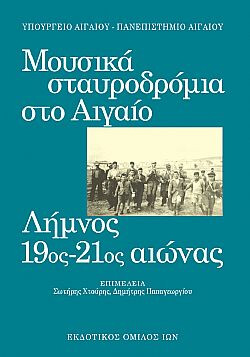
Or, more precisely, her informants—exclusively professional clarinet players with little specialist knowledge (but certainly plenty of disparagement) of tsampounas, monotsampounas, etc.
No, the same one. The informants knew perfectly well what they were saying, but conveying their information accurately isn’t something that happens automatically. If the researcher doesn’t know what it’s about themselves, they can distort it even when quoting it verbatim.
And in the book mentioned above about Lemnos, they’ve made a bit of a mess of the monotsambouna (μονοτσάμπουνο). Not the informants.
Yes, exactly — say that again, and again, and again!
Well, let’s go over it again with greater precision.
Here is what Mazaraki says (Το λαϊκό κλαρίνο [The Folk Clarinet], Kedros 1984, 1st ed. 1959):
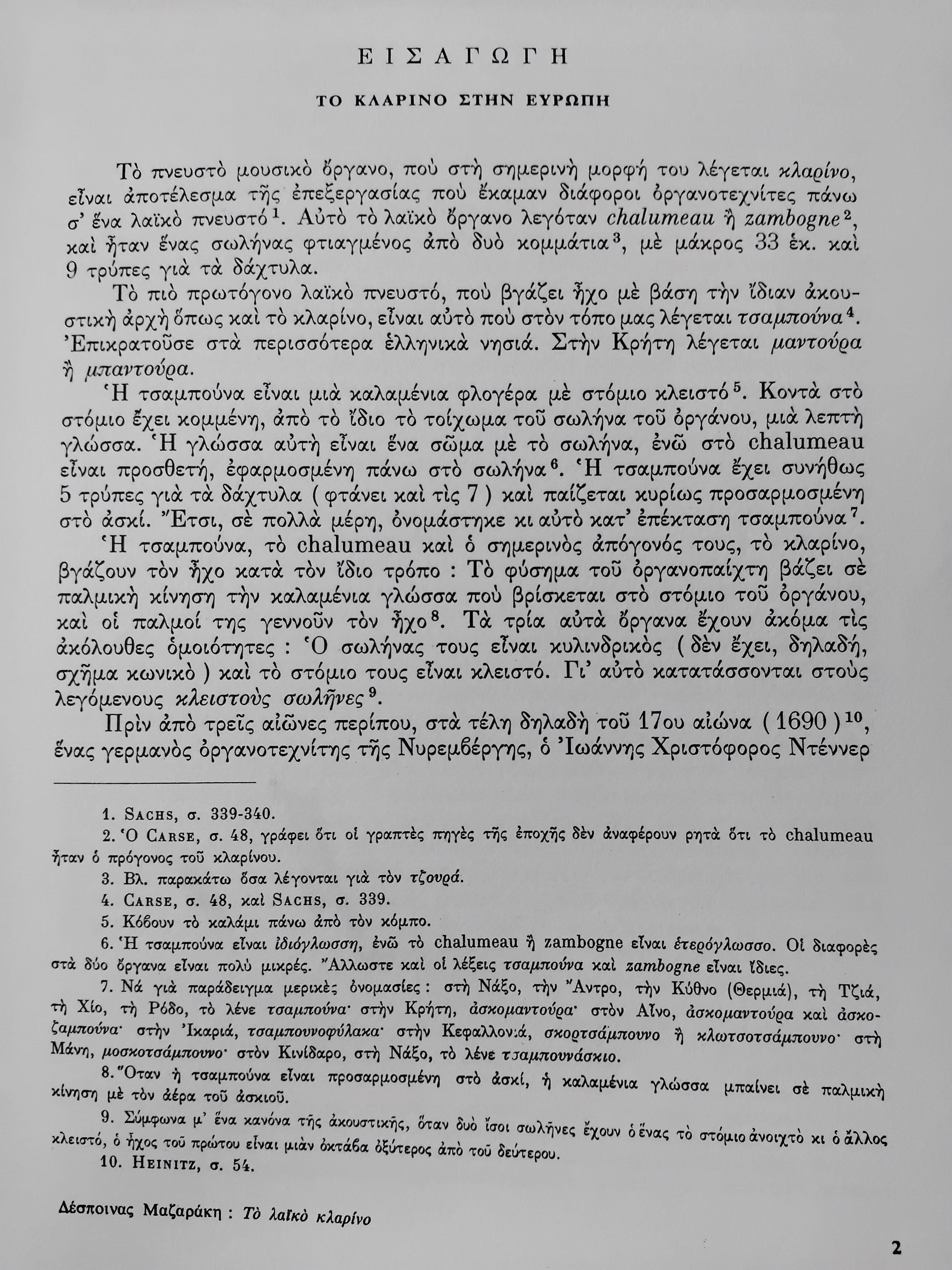
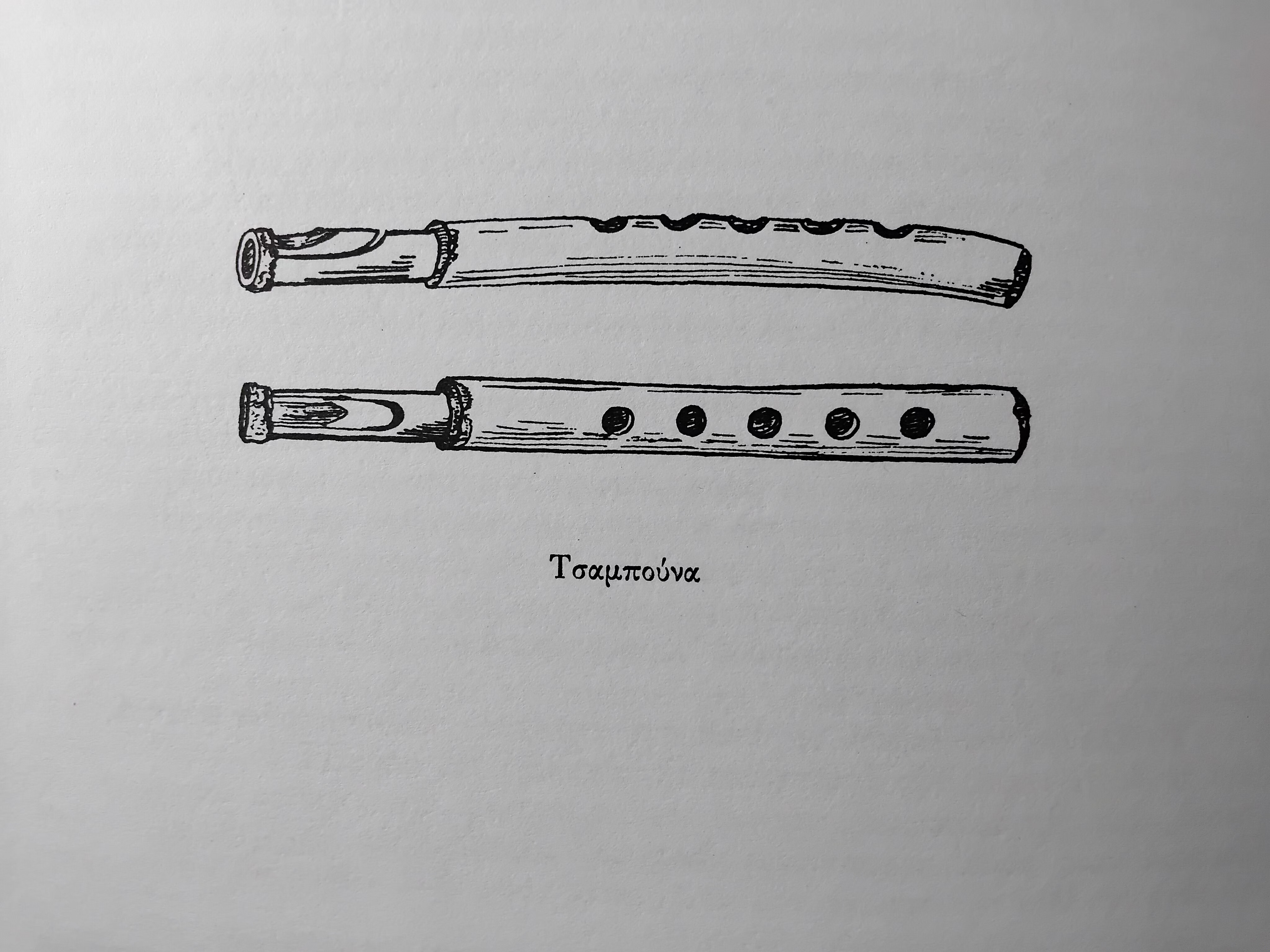
I reproduce p. 17*, which is the first page of the main body of the book, and the image of p. 20. On pp. 18–20, all the references to the tsambouna (τσαμπούνα) are identical to those on p. 17.
Mazaraki herself is in no confusion. She calls the mandoura (μαντούρα) a tsambouna, and talks about the mandoura. As far as I know, what she says about the historical organology of the clarinet—that is, its origins—is broadly correct, and is still accepted today (some details may have changed).
The tsambouna as a bagpipe is not of interest to her (quite rightly) here. She merely mentions, in passing, that because the “tsambouna = mandoura” is also called a bagpipe, the bagpipe is also called a “tsambouna”.
But where did she get the idea that the mandoura is called a tsambouna? Nikos says it came from informants. I say she got the terms mixed up herself. It seems that Nikos is closer to the truth:
They were not, strictly speaking, informants. Where would she have found them? Tsambounas and mandouras are found on the islands, while clarinets are found mainly on the mainland. She had no reason to carry out field research on the tsambouna on the islands. There was only the bibliography. It appears (and she states as much) that she found it in the two sources she cites in the footnote. I do not know who Carse is. Sachs was a leading organologist. However, both of the works cited date from the 1930s. Who had carried out field research on the Greek islands in 1930 that could have given them more accurate information? They gathered whatever they could.
It should be added that besides “mandoura”, a word used exclusively in Crete, on other islands this particular pipe is also called “monotsambouno (μονοτσάμπουνο)”, apart from “tsambounaki (τσαμπουνάκι)”. Elsewhere, “tsambounaki” refers only to the reed (the upper part, with the tongue). And there are certainly places, such as Lemnos, where it is called simply “tsambouna”.
I therefore consider the confusion surrounding the nomenclature understandable, at least to some extent. I repeat that there is no factual confusion: she means the mandoura, talks about the mandoura, and gives correct information about it.
Of course, Mazaraki’s bibliography does not include Sp. Peristeris’s specialised article on the tsambouna from 1960 or thereabouts, nor Anogeianakis, who attempted to bring some order to the chaotic nomenclature of folk instruments, nor Karakasis, who, shortly before Anogeianakis, made his own corresponding attempt (which was not successful, particularly when it came to distinguishing between the mandoura and other reed pipes), nor Baines’s Bagpipes, which is the bible of bagpipes around the world. None of these may have been published in 1959, but they had all been published by 1985.
But the second edition of 1985 is an exact reprint of the first edition of 1959, except that a new preface has been added.
In 1959, for the first edition, I do not know whether it was possible to access more authoritative and up-to-date information than that contained in the books cited in the footnote.
There is also factual confusion in some other passages further on in the body of the book, where the tsambouna is mentioned in passing (for example, that on Tzia they continued to favour it long after violins had been introduced to the island); there it is now clear to us that she means the bagpipe. I do not know whether it is clear to her as well.
~~~~~~~~~~~~~~~~~~~~~~
I will return to the book on Lemnos, where there is genuine confusion.
_____________________________________
*: Let’s not be confused by the “2” at the bottom of the page. It is the numbering of the printed sheet. The page is 17.
As for the book on Limnos.
I’m posting the title page with the full publication details, followed by the reference to the tsambouna, which appears on pages 243 and 244 of the section “Musical Practices”:
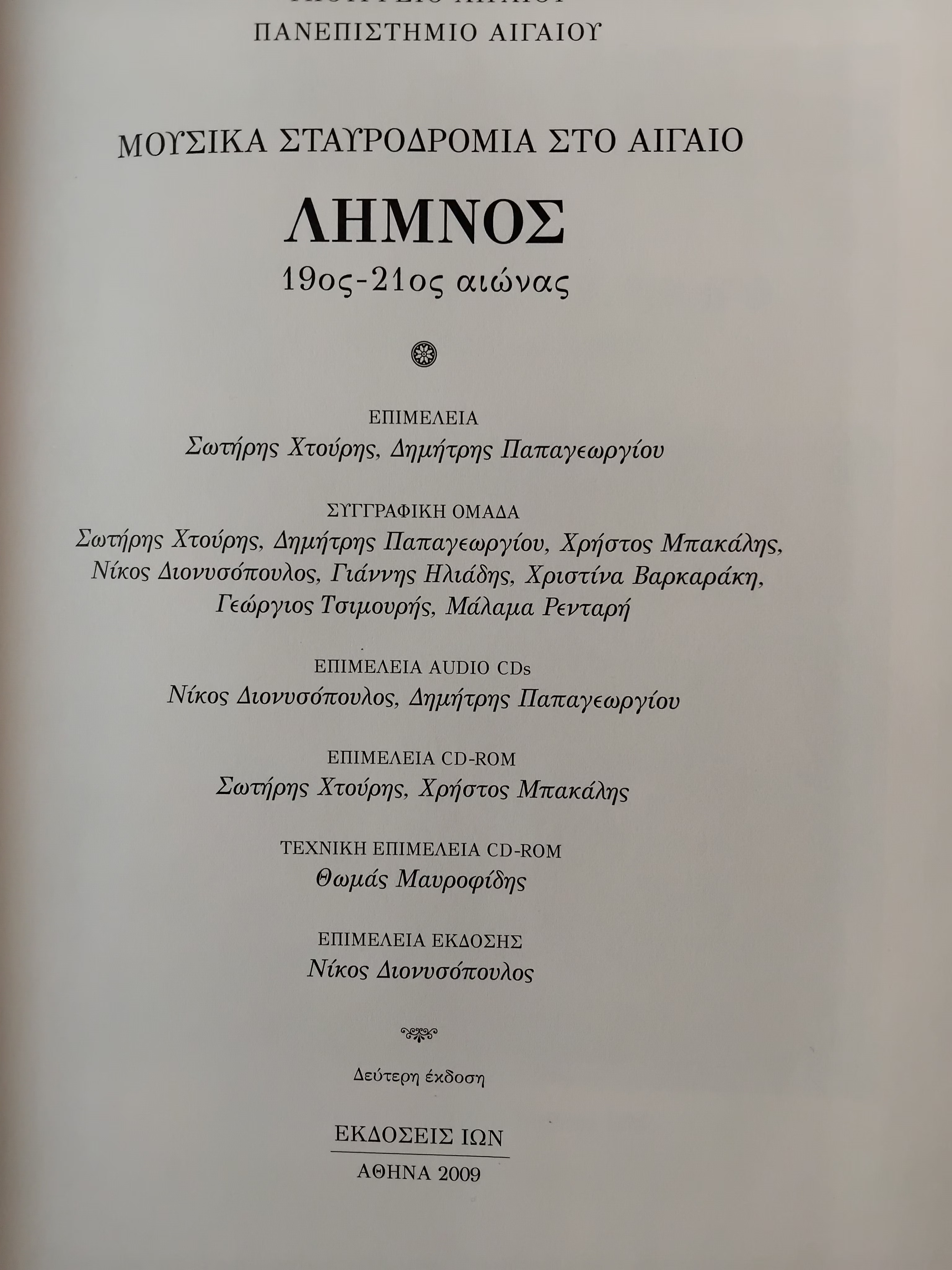
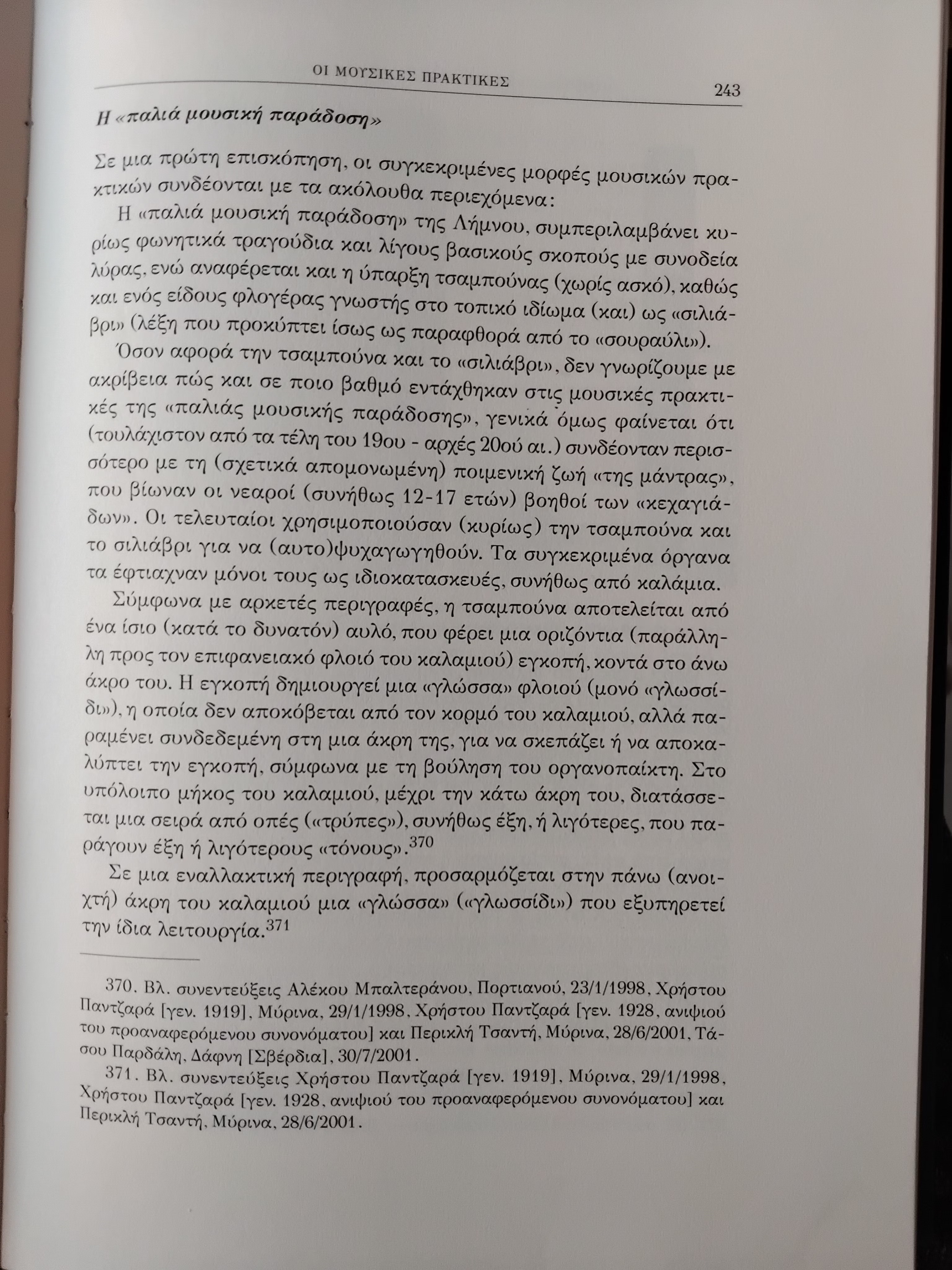
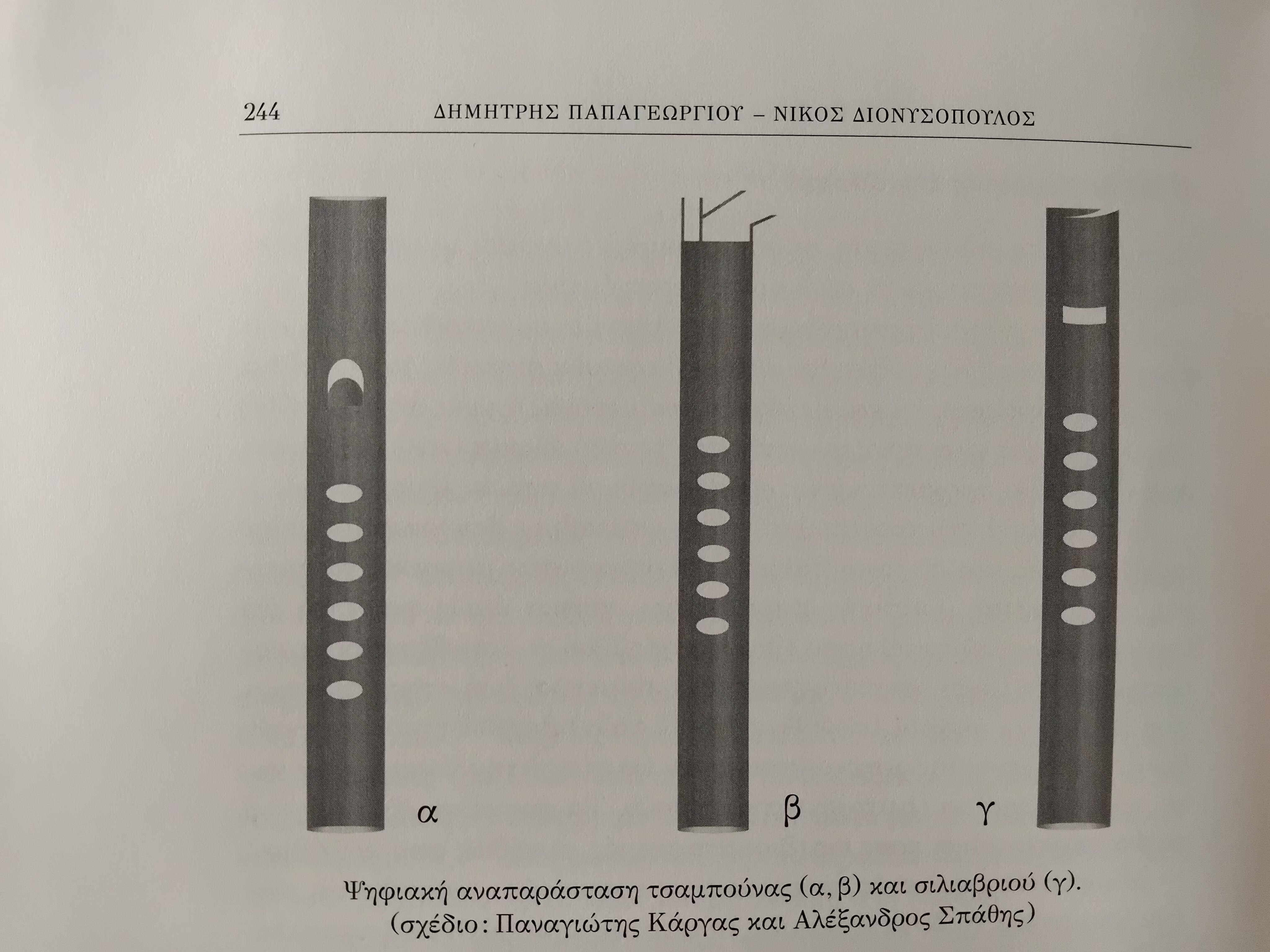
There is also a reference to the siliavri, that is, a suravli (a duct flute), which continues on p. 244 below the image.
So we read about the “existence of tsambouna (without a bag)”. I am quoting it verbatim. It is wrong. There was no tsambouna without a bag; there was something else that was called a tsambouna. A tsambouna without a bag would be exactly what the words suggest: a tsambouna (with two pipes, a frame and a horn) taken out of its bag and played with your mouth. This exists among other peoples. In Greece, it does not.
But what exactly existed on Limnos under the same name? They did not see it. It was described to them.
If you have never seen a mantoura—ideally, you should have made and played one as well—it is very difficult to understand it from a description. And from personal experience I can confirm that, before I saw one myself, I had read perfectly accurate descriptions accompanied by good photographs, and had understood nothing. Only when I started working with one in practice did my reading begin to make sense.
Given these facts, it seems that their informants were very skilled at describing things, because what we read describes a mantoura accurately. It has, however, been mediated through the pens of the two authors of the section, who appear not to have known the mantoura and therefore did not recognise it from the description. They confined themselves to reporting it fairly faithfully, so that it would make sense—to anyone in a position to make sense of it.
In the image we see what they themselves imagined from the descriptions: two variants of the so-called “tsambouna” and a siliavri. I have not included the description of the siliavri, but it says what one would expect: a suravli, much like more or less all the suravlis in Greece and all the duct flutes in the world. So, on the one hand, we can see that the images have not captured even remotely what these two instruments look like; on the other hand, every detail in the images could indeed have been described using the words we read in the text!
So, peeling away all this information, retaining what is correct, restoring what has been misunderstood and removing the erroneous conclusions, we arrive at the actual information, which is as follows:
On Limnos, people played mantouras, sometimes made in one piece and sometimes with a separate reed, with six or fewer holes (translator’s note: five is standard on the other islands, as on the tsambouna), and they called them tsambounes. They have now disappeared. They were also instruments for solitary use, not for “social”—that is, ordinary—music.
I could also add that, as far as I know, the structure of local Limnian music does not suggest that it developed around the tsambouna. Even the lyra, which on many islands was traditionally designed to play roughly what the tsambouna plays, makes use on Limnos—despite having the same design but a different application—of very different possibilities from the “tsambouna lyras” of other islands.
And finally, when I was doing my military service on Limnos, I had my tsambouna and had got to know a local shepherd. He had seen it and told me that he had never seen anything like it, but that in the old days they called what we have just been discussing—a mantoura—a tsambouna. I have not conducted proper research on Limnos, but I did meet the late Nasos Kotsinadelis and talk to him, mostly about lyras, of course. I also mentioned the tsambounes, and he told me the same thing: they did not have any.