The origins of rebetiko, 16 years on

Both, of course. Each where it is useful.

…etc. (the whole post)

For years now, I have tended towards a view very close to Loukas’s:

We have population movements caused by refugee flows and by internal (and external) migration. Masses of people move from villages to cities. They abandon the rural culture in which they themselves and all the countless generations of their ancestors had grown up, and try / are forced to integrate into the culture of the cities – a culture which they not only did not possess and found foreign, strange and hostile, but which had not even been definitively formed within the very cities that received them, since these too were constantly undergoing upheavals and ruptures in their social structure.

In his village, the future migrant / refugee had a musical code through which he expressed himself. This code was shared by all his fellow villagers, perhaps also by people from neighbouring villages (otherwise there might have been minor differences), and was certainly related to that of the more distant inhabitants of the wider region, and so on – and, deep down, was no different from all the corresponding codes throughout Greece; only the surface varied from region to region.

He knew this code, expressed himself through it, and carried it with him to the city.

Except that here he now had other things to express. In the pre-modern village, the individual was inextricably bound to the community, which, thanks to centuries of collective experience, had found ways of regulating its own life and, to a great extent, the lives of its members as well. Knowledge was primarily inherited and empirical; it consisted of certain fundamental, immutable truths.

Folk songs speak more about eternal, immutable truths (at least as they saw them) than about individuals. The names of their heroes, when they are not symbolic (Areti, Evdokia), are usually indefinite (Giannos and Marigo – that is, anyone; in other words, we are telling a story that did not happen in a specific place and time, but is simply always liable to happen to anyone, in this form or a similar one). Even historical songs, which refer to specific events or people, often elevate the incidental into the eternal (for example, by repeating stock verses from older songs, which the listener knows to be older and thus connects the specific event with the general truth).

Here in the city, though, the tough guy has to fend for himself. The community is not there for him to rely on, but even if it were, its collective empirical wisdom would be useless, since conditions here are entirely different and unprecedented. In the city, the ordinary working-class person is forced to turn more towards himself. He becomes individualised. From then on, his songs speak of individuals who face various situations from the real lives of the urban working classes.

The beautiful women in the songs are no longer “a slender lass”; they are specific women with names, backgrounds and professions, flesh-and-blood women.

But the code in which he expresses all this remains the one he knew from his homeland: the same traditional poetic metres (almost exclusively iambic and trochaic), with their rhymes; the same musical modes and rhythms.

Of course, we do not have songs with rebetiko (urban popular) themes that are, musically speaking, say, Epirote, Pontic or Cretan. (And if such songs did exist somewhere and I simply do not know about them, they remained confined to particular circles and did not have an overall influence.) We do have certain specific forms, chiefly the various nine-beat rhythms, which, among all the traditions of Greek folk music, point mainly to western Asia Minor. There must be some explanation for why people originating from anywhere in the Greek world ended up collectively adopting these forms rather than those of some other region, but the fact remains that the way these tunes work with these couplets is exactly how tunes with a different sound from Crete, Thrace or more or less anywhere else would work with the same couplets.

To sum up:

Early urban popular song is musically rooted in pre-existing local folk traditions. Its distinctiveness lies in what it expresses: the individuality discovered by the former inhabitant of the pre-modern village when he comes to integrate into the lower strata of urban society.
1 Like

We have the documented example of Lakkos in Heraklion, Crete, which Zaimakis discusses. The conclusion is indeed that it did not spread any further and did not have any overall influence on the song we are referring to. Of course, in theory, musicians who played with rebetes such as Baxevanis (Bernidakis), Foustalieris, Rodinos, Piperakis and others would have known about Lakkos. To me, it seems more likely that these musicians, at least those who returned, brought their influences to Crete.

Yes, that’s right. As far as I understand, the Lakkoudiana must have been more or less the same songs that we now call Tabachaniotika and know from Chania and Rethymno (the cities). They are very close to rebetiko, but not identical. The main differences are musical: most of them have much more complex melodies than most early rebetiko in particular, with far more melisma, and more or less the same modes (although I haven’t heard saba), but different rhythms (all duple-time, seated songs).

It is worth noting, however, that the Tabachaniotika do not sound Cretan. They may be played by the same musicians, both today and in Fou stali eri’s time, so they are inevitably performed in a similar style, but they are neither syrta nor kondylies nor anything else Cretan. They are an island of “other” music within the cities of Crete.

There are other urban folk musical idioms too. The Yianniotika-Zagorisia: much like the Tabachaniotika, they are played today by the same musicians who also play the “regular” music of Epirus, so they may seem to us like a subcategory of Epirote music. But they are not pentatonic, they are not tsamika, they are not in three-beat metre; they are nothing like what is customary in the traditions of the villages of Epirus. In fact, one can find more musical similarities with the Tabachaniotika.

On the other hand, the Tabachaniotika have a rebetia that the Zagorisia do not. Again, they are urban folk people, but not the same ones.

There are still others, which aren’t coming to mind at the moment. Perhaps all these were the parallel first stirrings of a new genre, of which only one eventually went on to acquire supra-local, nationwide dimensions and became “rebetiko”.

2 Likes

Let me correct something:

You could call Filentem and a couple of others tsifteteli as well.

My friend, a heartfelt plea: don’t be so hasty, and for one reason alone: all right, we don’t have any new information on the matter. Have we interpreted the old information correctly? I mean, for example: we have a number of interviews with the key players, as we might call them. Did we consider these interviews to be pieces of a… puzzle which, once completed, will reveal a single, complete picture of the issue? What use are new pieces of information when we haven’t yet made full use of the old ones?
Due to my workload, I’m finding it difficult to write a text as I would like, but I’ll return to this soon. Thank you.

2 Likes

I should probably correct that: early rebetiko.

I also saw what Eleni says above, …

…and my thought is that, yes, “urban folk” is clearer than “rebetiko” (in reality, “rebetiko” means whatever anyone who uses the word thinks it means!), but it is also broader. There are urban folk songs that are not rebetiko, such as the Ionian Island kantades. However many points of contact one may find where the kantada influenced rebetiko, it nevertheless remains certain that “Eis ton afro tis thalassas” is not rebetiko. It is, however, urban folk. (The non-urban folk songs of the Ionian Islands are folk songs like those found throughout Greece, even if they are not as well known.)

The same goes for urban Constantinopolitan songs such as “Manió”, and the Ioannina songs I mentioned earlier, etc.

Therefore, the adequacy of the term “urban folk” does not mean that we can use it in place of the more ambiguous term “rebetiko”. Rebetiko, however difficult we may find it to define in a way that everyone agrees on, remains an existing, distinct category within the broader urban-folk genre.

In the Ionian Islands there are various subgenres, such as arekia and serenade. The emphasis is on male polyphony, and some are a cappella. Following the union of the Ionian Islands and the decisive influence of the Ionian islanders on musical and literary life, as well as the international fashion for the mandolin and guitar, the Athenian serenade emerged—the genre that influenced rebetiko and laiko.

3 Likes

On the one hand, there’s that; on the other, they come back to the question of what rebetiko is, when Markos says that the mangas didn’t sing serenades. What I mean is that they seem to consciously distinguish between the mangas song, which we consider rebetiko, and the serenade, which of course had a huge influence on laïko music, since Tsitsanis and Papaioannou basically made hits with these songs after censorship was introduced. Let’s not forget censorship, either! Conscious efforts were made to “de-orientalise” the music on various fronts.

Certainly. But what does “influence” mean here? At some point, when rebetiko, having already charted its own course, encountered the kantada, it borrowed elements from it (chiefly the major two-part harmonies, wouldn’t you say? Although those weren’t present in quite that form in the kantada; perhaps something more intricate was going on there…)

And the bouzouki borrowed elements from the mandolin, but it remains a bouzouki, and of course the mandolin remains a mandolin.

I think there are also two-part harmonies among the tenors; four-part harmony consists of Tenor 1, Tenor 2, baritones and basses.

Perhaps we should look for the original influence in the theatre: revues, comic operettas, Greek, Italian and so on.

I don’t remember reading that in his biography. Does he say it somewhere?

Because it makes me wonder about “At dawn, three o’clock” (1937).

I don’t think anyone could disagree with that. I believe the period Nikos Politis places between 1933 and 1942 is the one that can be described as “rebetiko”. Although I would extend it to the closure of the record companies in spring 1941.

Ah, exactly. The last few messages helped me clarify what I wanted to say in #29:

Rebetiko may have been influenced by kantada, but it clearly did not originate from it. (Because the origins of rebetiko are what we are discussing.) The two simply both belong to the broader category of urban popular music.

However, rebetiko was cultivated in the cities by newcomers from the villages. Other urban popular genres probably originated among the folk classes either of the cities’ long-established inhabitants or of the villages where the particular urban folk genre was transplanted.

In the case of Lakkos in Heraklion (let me remind you that Lakkos is a neighbourhood of the city), we again have newcomers—who were not even Cretans.

And there are songs from before ’33 too, perhaps less well documented (not recordings), which I think we would call rebetiko.

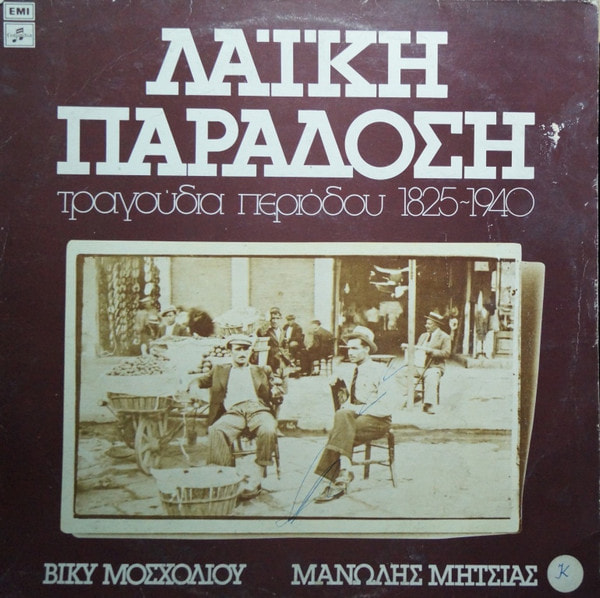
Do you know this record?

A 1975 album of covers by Mitsias and Moscholiou certainly cannot be considered evidence. But anyway, why does it say “1825–”? Basically, for effect. Of the anonymous and therefore undated songs, it includes a version of Manolis Hasiklis’s karsilamas, and Mori Ntountou. (And Confessions, which, however, are credited to V. Vermisoglou.)

We may not have any tangible proof that any of these three songs dates back to 1825 (in the midst of the Revolution!), but it is certain that they predate their first recordings; and, at least as far as the other two are concerned—not Confessions—I don’t think anyone would disagree that they are clearly rebetiko.

1 Like

I hadn’t taken this record into account, to tell the truth. Personally, I would put “Manolis the Hashish Smoker” among the Asia Minor rebetika. Besides, I think its first recording was made by Asia Minor musicians. Logically, it predates the first performance in 1929, but Ogdontakis is listed as the composer. As for “Dountou”, I would classify it as pre-discography rebetiko. In my view, discography could serve as a chronological dividing line. Those songs that we consider—or for which there is evidence—to be older could be included among the pre-discography rebetika, with an appropriate note. I’ve just looked into it and seen that Dountou’s first recorded performance was in 1926, with Piperakis.

They also studied the art of seamanship in Italy, in Livorno. I read it somewhere in the biography of an island captain from the era of 1821. If anyone wants a reference, I can try to find the details.

2 Likes

This particular version is in a melody somewhere between “Apo ligo ligo” and “Arabás perná / skóni gínetai”, which also isn’t very different from the Cypriot Androniki:

I don’t know where they got it from.

The Piraeus style is more Greek-centred, or, if you prefer, Greece-centred. But refugees also play a role in the Piraeus style, and certainly, once we include Tsaoús, violins and ouds, we must take into account the region’s tradition as a whole — that of Smyrna, Constantinople, and so on — across all its linguistic and religious communities.

Livorno, Genoa and other ports were places where they went to conduct their commercial transactions. A naval school had been established on Hydra, where Italian and Portuguese teachers taught naval theory, technique and foreign languages.

“The Hydriots founded a naval school which operated during the final two decades of Ottoman rule, with Italian and Portuguese teachers who taught naval theory, technique and foreign languages. The Italian Felice Caserta, a teacher from 1817 to 1821, was granted Hydriot citizenship, while the Italian revolutionary Giuseppe Chiappe, a Doctor of Law, foreign-language teacher and publisher of the newspaper The Friend of the Law, was granted Hydriot citizenship on 18 April 1821, one day after the official proclamation of the Revolution on Hydra!”

Source:Η ελληνική ναυτοσύνη το 1821: Η «πλουτοκρατική» Ύδρα - Cognosco Team

1 Like

When a song also exists in Greek, you can usually tell from the poetic metre whether it was first sung in Greek or in another language.

Sala sala is in a unique poetic metre. The only other song with couplets in the same metre is The Children from Your Neighbourhood. And it so happens that we know that “sala sala” is a corruption of a Turkish phrase heard in the Turkish version of the song. So, between the Greek and Turkish versions, the Turkish one came first.

Doktor has virtually no poetic metre at all. It fits however it happens to fit. And again, it so happens that we know that doktor is the everyday Turkish word for doctor, whereas it is not so in Greek.

Tourna (The Castle of Astypalaia), when sung in the Dodecanese style, consists of regular fifteen-syllable couplets, but I believe Papagika’s performance captures the stage at which the foreign-language song was trying, with its first clumsy steps, to become integrated into the Greek repertoire.

The same applies to Konialis: the old Greek performances do not follow any particular poetic metre. After many years of assimilation, of course, we arrived at the Leros-style Yavri, which, like Tourna, has fifteen-syllable mantinades, though that was not the case in earlier times.

And so on. These were not simply tunes that were generally available for anyone to sing in their own language. Each one originated in a particular language.

1 Like

The example I have in mind was from a biography written by Giannis Pergialitis; the captain would have been from Spetses.

2 Likes