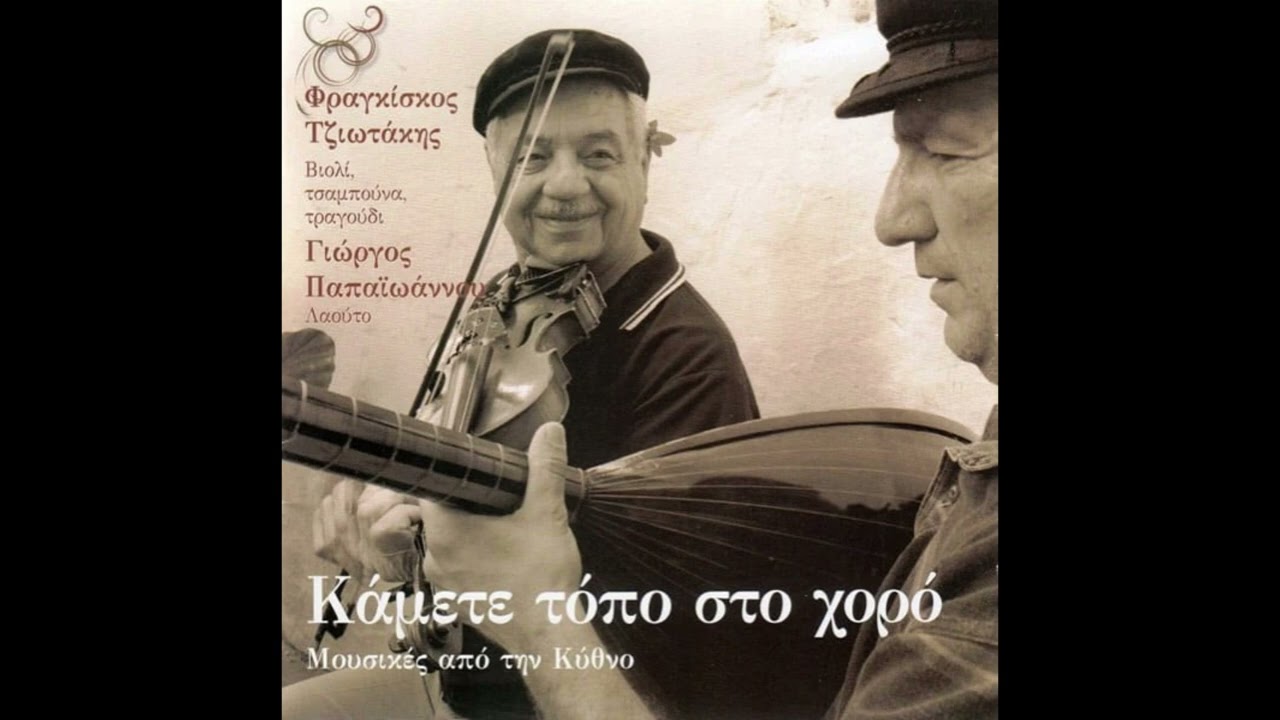
For Fragiskos Tziotakis, Kythnos’s reveller

:violin: For Fragkiskos Tziotakis, the master of revelry from Kythnos

As part of the two-year programme of activities „THE MUSICIANS: Hubs of cohesion, links of continuity“ (2026–2027), the Museum honours distinguished musicians of local or wider renown, highlighting their unique contribution to the continuation and renewal of traditional music.

The second event in September is dedicated to Fragkiskos Tziotakis from Kythnos.

The son of a miller and violinist, initially a barber and violinist himself, he spread his wings and travelled far from his modest Cycladic island, earning the title of patriarch of the tsampouna…

:spiral_calendar: Monday 21 September 2026
:eight_o_clock: 20:00

Speaking about Fragkiskos Tziotakis:
• ethnomusicologist Charis Sarris
• musician Vasilis I. Oikonomou

:musical_notes: Performing musicians:
Stamatis Gkrielas, Sotiris Margonis, Stamatis Mavrakis, Giorgos Papaioannou and Giannis Servos.

:musical_score: Musical direction: Sotiris Margonis

:round_pushpin: Courtyard of the Museum of Greek Folk Musical Instruments
1–3 Diogenous Street, Plaka

:admission_tickets: Admission is free – registration is required.

:telephone_receiver: Bookings by telephone: 210 32 54 129
Monday–Friday, 09:00–15:00

:ticket: Alternatively, via the platform https://www.more.com/gr-el/tickets/music/gia-ton-fragkisko-tziotaki/ with a free voucher for a limited number of places.
Advance booking opens on 8 September 2026 at 12:00.

The events are supported by Bodossaki Lectures on Demand – BLOD, the Blod.gr online lecture library of the Bodossaki Foundation.

We look forward to welcoming you to a special evening dedicated to a great musician and the precious musical tradition of Kythnos. :musical_notes:
2 Likes

Let’s put something on to listen to from Frangiskos:

Balos of Kythnos, 1972. The earliest recording, chronologically, of the music for this dance, which is now enjoying great popularity.

Balos of Kythnos again, 2012. Completely different. Not because there are many tunes for the balos, but because the one tune that exists consists of so many little motifs that no one ever plays them all, but chooses some one time and others the next…

That title was bestowed on him either by Liavas or by Charis Sarris, following the example of old Savvas Perselis, patriarch of the Kasiot lyra. The original model, of course, was the patriarch of rebetiko, Markos.

When the record «Kassos – Tunes of the Lyra – Three Generations of Folk Musicians» was made, featuring various members of the Perselis family, old Savvas was indeed their patriarch in a sense: the family had instrumentalists going back at least another two generations, but he was the oldest still living and the one most highly regarded (deservedly so) by those qualified to judge—in other words, Kasiot society. The record was made under Liavas’s direction, and it was he who coined the nickname «patriarch».

In Frangiskos’s case, the point must be that for more than half a century he was the most active and best-known tsampouna player apart from those who played only in their own localities, as he was a regular collaborator with the Dora Stratou Theatre. He was therefore among the first to make this instrument known to the wider public. It existed in abundance and in a variety of forms throughout the Aegean, but was always hidden away in some inaccessible mountain villages, far from any publicity. Theologos Gryllis was similar, of course, but Gryllis was essentially a session musician on the tsampouna, whereas Frangiskos is a genuine feast musician.

Frangiskos is 94 today, and I hope he remains in good health for many more years.

2 Likes

Thank you for the very interesting information!

Will Mr Fragiskos be attending the event? As a young musician, I would really like to meet him…

As long as the man is well—which I sincerely hope he is—it certainly will be.

In any case, of the musicians mentioned, Papaioannou has been a collaborator of Fragiskos’s for many years. (And, incidentally, he plays a lute that is well worth hearing up close; very few people nowadays know how to play like Papaioannou.)

2 Likes