To tell the whole story, though, Tountas didn’t keep Araba’s introduction; he created his own.
He even added a chorus—50% of it was his own composition. Give Caesar what is Caesar’s: here, he deserved to put his name on it.
The only problem was that Glykeria’s bouzouki player didn’t know how to count a karsilama and played the intro incorrectly (quite apart from the general butchering).
No, he would have been required to put “Adaptation”.
Given the standards of the time, when they chose whatever they fancied for themselves, we should count ourselves lucky 
(I’m talking about well-known people in positions at companies, not laïko musicians).
Guys, you sent me “down the rabbit hole”, as the English say, while I was looking for the Turkish version of the song. I found a reference in a short story by the Turkish man of letters HÜSEYİN RAHMİ GÜRPINAR, published in an Istanbul magazine in 1898. Here is the excerpt in an AI Greek translation:
After the Guruptan, we returned home.
Around midnight, we heard from above a piercing, low, whimpering groan from a zurna, as though it were crying, tearing through the misty, melancholy half-light of dusk and reaching us.
First, there was a taksim in Hijaz.
Then they began singing “Entarisi ala benziyor, şeftalisi bala benziyor”, translated as: “Her entari (long robe) looks crimson, her peach looks like honey”.
Yes, her entari did indeed look crimson, but the account of her peach required confirmation from the groom.
Judging by Gürpinar’s short story, the song was known in an urban setting from at least the end of the 19th century.
1 Like
In Empros in 1903, the following lyrics are printed:
A carriage goes by
a mad cart driver
step aside, my little girls
lest it run you down
…………………………….
In 1914, in another newspaper:
A carriage goes by
it turns to dust
lift your trousers
because they get dusty
I’ve heard it sung with “run, little girls” instead of “join the band, my little girls”.
and the second one with
“lift your little skirt
so it doesn’t get dusty”.
Neither of the two Greek songs coincides with the other throughout its entire melody, nor does either of them coincide with the Turkish one. All three coincide only in the basic verse. The refrains, turnarounds, bridges and introductions vary.
Tountas certainly had the Turkish song in mind; this is also apparent from the melodic passages he retained. But there is no way he did not know the Greek one either: it was a classic stray song of Smyrna.
So Tountas comes third chronologically and genealogically. Who were the first and second?
I think it more likely that the Turkish song came first, and that Arabas based his song on it. The basis for this hypothesis is the same as with other Greek-Turkish songs, Doktor, Durna (The Castle of Astypalaia), and so on: the poetic metre.
Whereas genuinely Greek traditional songs have verses that are uniform within each stanza (the first and second lines have the same number of syllables, the same stresses, and an A–B rhyme scheme), and the variety of metrical patterns is limited (iambic and trochaic fifteen-syllable and eight-syllable lines, and almost nothing else, with a few other patterns only rarely), here every line is different, the stanzas are irregular, and all of it simply happens to fit a melody that logically predated it. It predated it—and what did it do? Obviously, it was sung in another language, whose folk poetry may follow different rules.
“Arabas passes by, turning into dust”; “Arabas passes by, the Arabas driver is mad” (or deaf); “Stand aside, girls, or it’ll run you over”; “Lift your little skirt so it doesn’t get dusty”—these are all different.
Finally, Tsitsanis’s line “Arabas passes by”, which is emblematic and repeated as the first line in all three stanzas of his song, cannot possibly be a coincidence. The Smyrna song was hugely well known; he would certainly have known it.
Tsitsanis was inspired by two words—a half-line—from the Smyrna song and produced an original song of his own. Tountas borrowed proportionally larger sections of the melody, but I still consider what he produced to be his own. Using a significant proportion of the same raw material but handling it differently produces a noticeably different end result.
(Of course, it’s only a matter of time before someone—Eva, for instance—shows us that in old Smyrna the song also existed in some third language, in which case things will become even more complicated…)
@pepe, I’ve already done it…or rather, I quoted the Turkish Wikipedia page, where there are references to an Armenian and an Albanian song!


In any case, the song must have been more widely known. Here is an interesting story about the song, taken from a Turkish website and translated into Greek.
In 1913, when the battleship ordered from Britain was completed (the REŞADİYE ZIRHLISI), three hundred Ottoman sailors went to collect it. At the exact moment of the handover, the English began playing and singing their national anthem. Everyone stood to attention; afterwards, the English said that we should sing an anthem too. However, at that time we did not have a national anthem. Then one of the Turks, the çarkçıbaşı (chief engineer of the ship), realised the significance of the situation and, in order to save it, asked his companions: “Do you know Entarisi Ala benziyor?” — “Yes, we know it,” they said. “All right,” said the çarkçıbaşı, and gave the signal. They all began singing it together.
The English, standing formally to attention, listened to our fleet. In fact, at one point in the piece they even made a change: they changed the line “şeftalisi bala benziyor” to “Sultan Reşat bal’a benziyor”, and sang the song as a national anthem.
The folk song entitled Entarisi Ala Benziyor was collected and transcribed by Muzaffer Sarısözen, is numbered 621, and is included in the TRT repertoire.
1 Like
As if you’d let it go!  I hadn’t opened the links. Now that I have, I’ve learnt about Marouliō as well:

And about “Don’t Beat Me, Mother”, although that won’t be easy to find because it’s known in so many different versions, and in various tunes across Greece.
I notice that Viki’s article describes the Turkish piece as a karsilamas in hüseyni. Hüseyni? Isn’t it hijaz? But anyway, since I don’t know Turkish, I put it through an automatic English translation, and guess how it translated karsilamas into English? Welcome song! Indeed, in another old thread we had found that it referred to a welcome dance (in wedding customs), but I hadn’t realised that it was a word from everyday (rather than specialist, musical) Turkish vocabulary which means exactly that. Because obviously, the translator understands the most common current meanings of words, not the more specialised ones.
(Let’s not let the discussion veer off in that direction. I’m just noting it for future reference, since I came across it by chance. It’s related to another thread.)
_____________________________
The Albanian and Armenian ones aren’t in nine-beat rhythms; they’re in four-beat rhythms, so it’s not easy to say whether they’re the same tune in a different rhythm, or simply a hijaz tune that resembles another hijaz tune in its general melodic movement.
But listening to the Albanian one, I think I’ve remembered a Greek tune that’s the same or similar (a syrtos), to which they sing “Don’t Beat Me, Mother”!! Does anyone know it?
2 Likes
“A carriage passes.”
Neither a Kalamatianos (Καλαματιανός) nor a Karsilamas (Καρσιλαμάς).
It is called an “Agkrilamas” (Αγκριλαμάς), not an “Argilamas” (Αργιλαμάς): 2+3+2+2, a variation of the Karsilamas (which has 2+2+2+3).
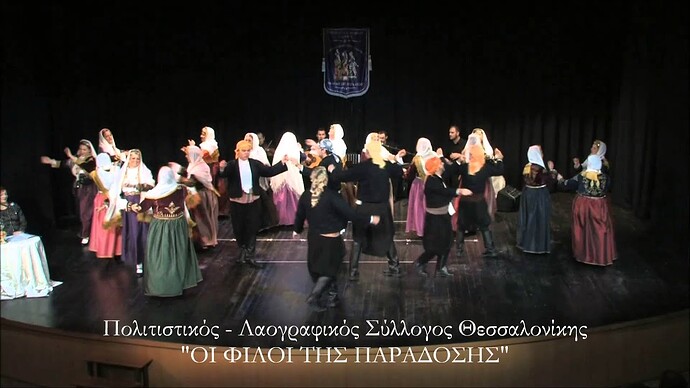
1 Like
This too was discussed in the same “other thread” I mention in #30, if I remember correctly.
It can be called agkrilamás, argilamás, agirlamás or, in some places, something else altogether. It derives from the Turkish ağırlamak = to treat, host, welcome. For how this word came to refer to the agrilamás or agirlamás dance, see here:
1 Like
There are, of course, exceptions in the 2322 structure that are neither antikristoi (αντικριστοί), aptalika (απτάλικα), nor karsilamades (καρσιλαμάδες).

1 Like
“Humble” dance, according to the YT comments.
Honestly, I didn’t know that.
This must be the “other thread” I remembered. The interesting part starts a little above where Nikos points to, goes on for quite a while, then there’s a change of subject, and at the bottom of the thread there’s a link to another thread where the discussion continues (until that one goes off track too).
Well, it’s definitely not a kalamatianos, no question about it. @mavrakos, who started the thread, was simply confused. They do indeed play a few tricks with the metre that can make you think they’re throwing you off.
2 Likes


Why did you upload these, my dear Fotis? How do they “fit in” with the topic we’re discussing?
I suppose so, because they show that Arabas was already known in Athens as early as 1899.
1 Like
But our subject was not whether, or since when, the araba (horse-drawn carriage) was known in Athens; other matters occupied us in this thread.